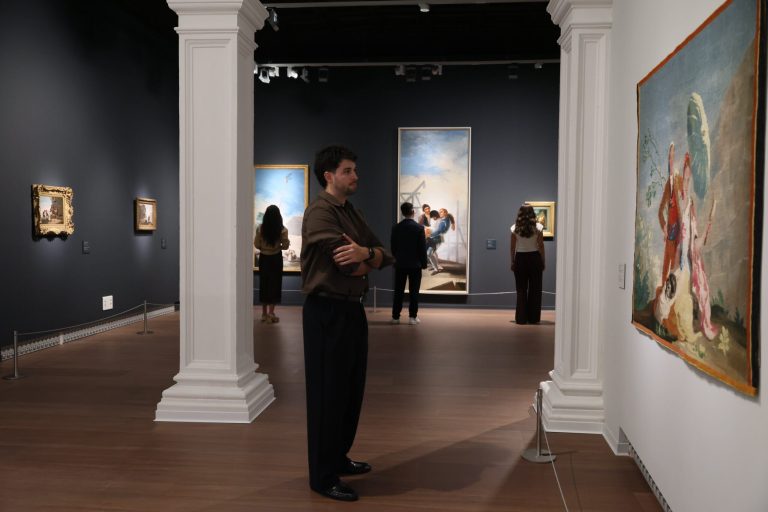
Pont-Aven (Finistère). “Behind every great man there is a woman.” Sophie Kervran, the director of the Pont-Aven Museum, who has committed her institution to promoting the place of women in the history of art, shows with Charlotte Foucher-Zarmanian, curator of the exhibition, to what extent this proverb was still relevant among the Nabis. This was an exclusively male group built on the model of a mystical secret society. Perhaps the particular context of the end of the 19th century, which saw the rise of the feminist movement, pushed these young men, several of whom had met in high school, to thus reinforce each other in their masculinity. It should be noted, moreover, that some of them grew up with a powerful maternal figure – these mothers have their place in the exhibition.
The route begins with Homage to Cézanne (1900) by Maurice Denis. In this painting, nine men dressed in black surround a still life installed on an easel, Fruit bowl, glass and apples by the Aix master. On the far right, Denis has depicted Marthe Meurier, whom he married in 1893. Looking with a slight smile at the viewer whom she thus introduces into the painting, Marthe wears a face-to-hand, an invitation to observe and understand. The role of intercessor, a sort of saint equipped with her attribute, that the painter thus gives her shows the importance she had in his life. Photos taken by Marthe of her husband with their children confirm this very strong bond.
A ” homeport “ : this is how the Nabis see their companions, “in line with the conventions of the time”, notes Charlotte Foucher-Zarmanian in the catalogue. One room is dedicated to family life, of which women are the pillars. They are often depicted sewing or looking after children. Some of them also take on the role of hostess maintaining the group’s bonds: the elegant France Rousseau, wife of Paul Ranson, was painted several times by Maurice Denis, who praised her “unalterable cheerfulness”. Few women escaped this patriarchal framework. The catalogue presents the Polish actress, journalist and author Gabriela Zapolska, who lived with Paul Sérusier for two years, but she is not mentioned in the exhibition. Lucie Reiss, mistress and model of Édouard Vuillard and wife of the artist’s dealer, Jos Hessel, was the pivot of a harmonious ménage à trois. She contributed greatly to making the painter known and, as such, is featured in the “Pull the Strings” section of the exhibition, which presents those who, through their connections and commissions, played an active role in the success of the Nabis. Gabrielle Bernheim, daughter and sister of art dealers, wife of Félix Vallotton, and Gabrielle Questroy-Wenger, mother-in-law of Georges Lacombe, are also among them.
The importance of tapestry
It was through their artistic qualities and their skill in lady’s work that others found their place in the careers of the Nabis, whose importance to the decorative arts is well known. Laure Bonnamour, mother of Georges Lacombe, practiced painting, engraving, illustration and embroidery. She is the executor and perhaps the co-author of the cartoons for several embroideries and tapestries by her son and Paul Ranson. France Rousseau-Ranson made half a dozen tapestries with Ranson and Lazarine Baudrion obtained with her husband, Jozsef Rippl-Ronai (the “Hungarian Nabi”), a silver diploma at the 1900 Universal Exhibition for a tapestry created jointly. The canvas Woman in red dress (1898) is a testament to their talent. The beautifully preserved colours of this tapestry are perhaps due to Aristide Maillol’s attention to the dyeing of the threads he used for his own creations. It was from him and his wife, Clotilde Narcis, a professional seamstress, that the Rippl-Ronai learned this art.
Finally, one cannot help but be moved by the fate of Marguerite Gabriel-Claude, wife of Paul Sérusier. After attending the École des Beaux-Arts in Paris, she became a teacher at the schools of the City of Paris and enrolled at the Ranson Academy where Sérusier taught. He recommended her to the couturier Paul Poiret, probably to supervise the Martine workshop which produced fabric and wallpaper models. The screen Hilly landscape with four leaves (circa 1910) is a personal interpretation of motifs borrowed from Paul Sérusier. Suffering from a long mental illness from which she eventually recovered, she spent the end of her life making her deceased husband’s work known.