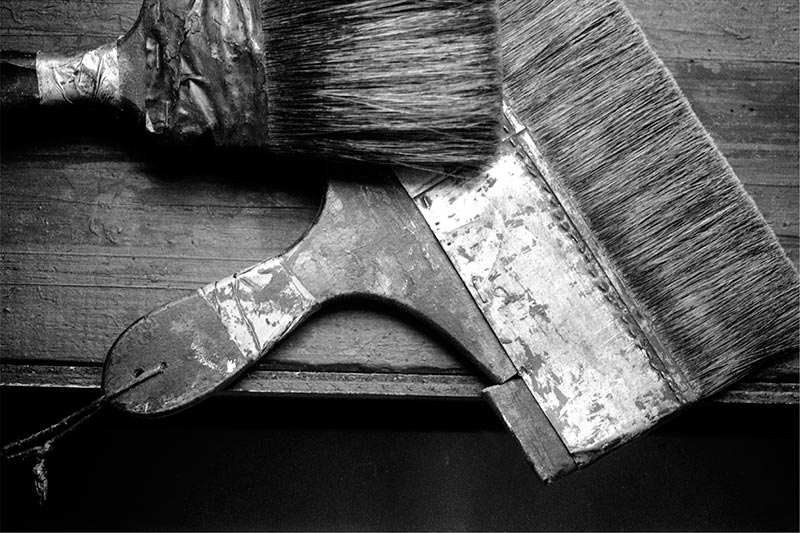
When Jean-Marie Del Moral first entered Joan Miró’s studio in Palma de Mallorca, in 1978, he was 26 years old. Miró went up to the mezzanine, grabbed a paintbrush and started painting. The photographer hadn’t asked for anything. Shocked, he didn’t move and simply triggered his camera. Forty-eight years later, this photograph is among the works presented at the Bouvet-Ladubay wine estate (Saumur).
Born in 1952 in Montoire-sur-le-Loir to Spanish republican parents exiled after the civil war, Jean-Marie Del Moral discovered photography at fourteen as an assistant in the photo department of an aeronautics company before becoming a reporter at Humanity. But his meeting with Joan Miró, during a report on Spanish intellectuals after the death of Franco, constituted a decisive turning point. She permanently oriented his work towards artists’ studios, which he has photographed for almost half a century.
The exhibition “Workshops and portraits of artists” brings together 107 black and white and color photographs devoted to 56 figures of modern and contemporary art. Among them, 23 have already exhibited at the Bouvet-Ladubay Contemporary Art Center, including Pierre Soulages, Gérard Titus-Carmel, Miquel Barceló, Monique Frydman, Christian Sorg, Jan Voss and Ben Vautier. The aim of the exhibition is clearly formulated by the photographer: to discover places that are usually inaccessible, far from any didactic approach. A way of offering those who are remotely interested in art an insight into the world of artists.
Joan Miró compared the workshop to a cave. Jean-Marie Del Moral enters it with discretion, without staging or spectacular effects. He photographs objects, tools, works in progress, traces of the creative gesture. The workshop never appears as a simple setting, but as the reflection of a thought in motion. The prints, with deep blacks, nuanced grays and contained colors, support this restraint.
Jean-Marie Del Moral, Pierre Alechinky, Maussane1997.
© Jean-Marie Del Moral
The first room presents seven large formats devoted to details from the studios of artists who have exhibited at the Art Center. Ben Vautier’s workshop is an obsessive accumulation of sentences and objects. Conversely, that of Jacques Monory is striking for its almost clinical simplicity. The contrast is striking. A series of portraits follows before the following rooms focus on several emblematic workshops.
The artists respond to each other from wall to wall, from one room to another. Joan Miró and Pierre Alechinsky thus face each other. Two universes that blue unifies, two humors that the poetic objects reveal. In Joan Miró’s workshop there was an inscription in French, “I am Miro”a trace of poetic self-deprecation that we find, a few decades later, in Pierre Alechinsky with his reference to Henri Michaux.
In the room dedicated to Olivier Debré, the photographer delivers one of the most beautiful finds of the exhibition. He later discovered that a Picasso monograph placed on the artist’s table created a perfect formal resonance with the studio itself. The guitar, the black mass, the cubist blue were found in the photographed space. This image illustrates what the photographer calls “unconscious mimicry”, that is to say the way in which the environment ends up shaping the gaze, and the gaze by recomposing the environment.
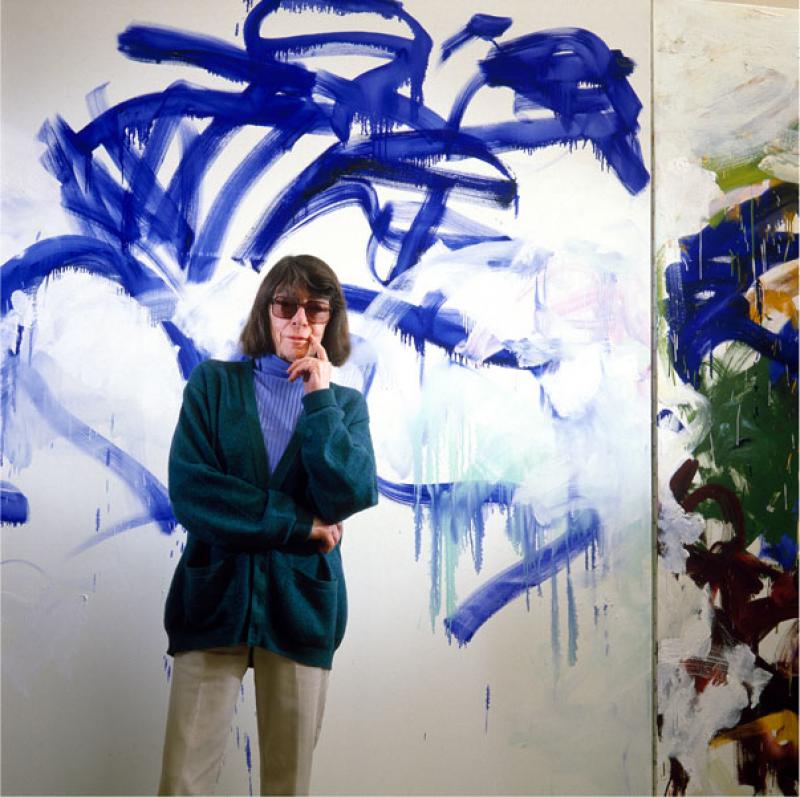
Jean-Marie Del Moral, Joan Mitchell, Vétheuil1998.
© Jean-Marie Del Moral
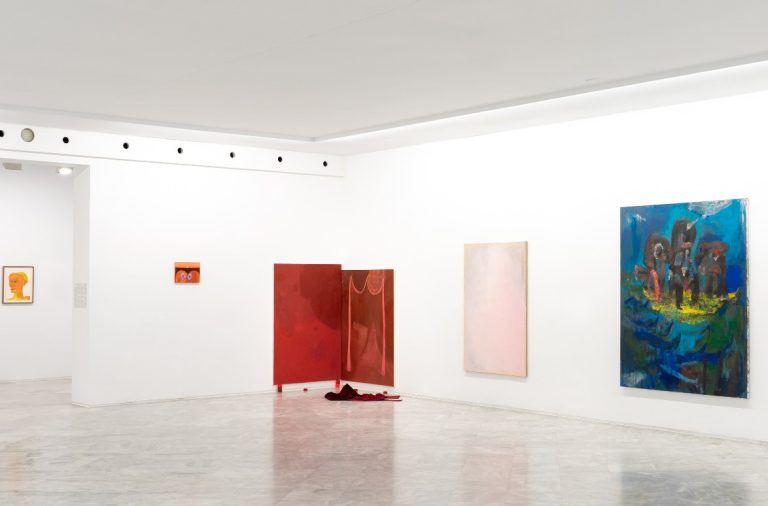
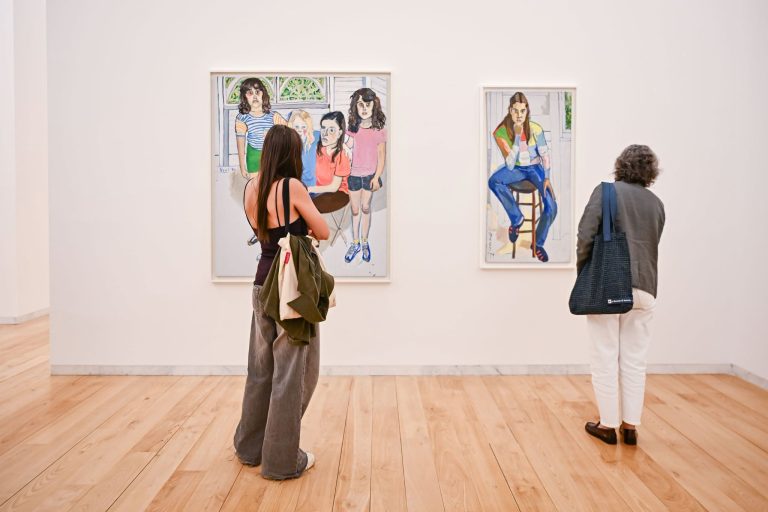
The scenographic bias makes the exhibition both rich and slightly frustrating. The connections between Christian Sorg and Gérard Titus-Carmel or even Jan Voss and James Brown are not the result of a simple clash effect. The photographer builds a network of correspondences where colors, shapes, friendships and artistic affiliations respond. But the absence of textual mediation ends up doing the exhibition a disservice. The unwary visitor, the very one that Jean-Marie Del Moral wishes to touch, will cross the rooms without perceiving the discreet connections that the photographer establishes between the artists. A few room texts would have been enough to fully reveal the richness of this dialogue between the artists. Lighting also serves certain works. Placed in shadowy areas or confronted with natural light causing reflections on the windows, several photographs lose part of their visual force.
The fact remains that these photographs impress with their accuracy, their power and the sensitivity of the gaze that bears them. Throughout the rooms, the journey of a photographer emerges who, in his own words, works “like a filmmaker or like a writer, but with photographs”. Joan Miró has been dead for more than forty years. Ben Vautier’s workshop has disappeared. Other places have changed appearance. The photographs then take on a particular resonance. They show moments that existed, that disappeared and that can never be reproduced.
The Bouvet-Ladubay wine estate, thirty years of contemporary art
Installed in old industrial buildings from the 19th century restored on the banks of the Thouet in Saumur, the Bouvet Ladubay Contemporary Art Center covers nearly 800 m² divided into nine exhibition rooms and a hall-bookstore, a few hundred meters from the troglodyte cellars of the estate, an eight-kilometer-long ribbon of galleries dug into the tuffeau. Founded in 1851 by Étienne Bouvet, the wine estate belonged to international groups for a long time before becoming independent again in 2015, when Patrice Monmousseau and his daughter Juliette bought it. The artistic turning point came in 1992, when Patrice Monmousseau invited the artist and collector Benoît Lemercier to design an art space accessible to the general public. In three decades, nearly a hundred artists, from Guy de Rougemont to Peter Knapp, have been presented. The visitor can extend the route by going down into the cellars, where the house’s crémants are still produced.