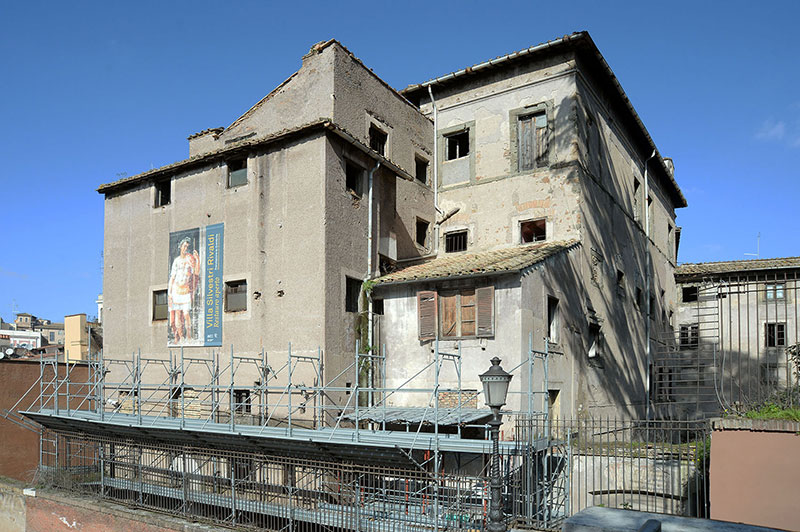
As the renovation continues, an advisor to Rome Mayor Roberto Gualtieri announced that the museum project in the Palazzo Rivaldi building should be completed within five years. Although it is planned to be dedicated to Roman art, its precise content remains uncertain for the moment, although different hypotheses have been put forward in recent years.
In 2020, the Italian Ministry of Culture (MiC) allocated 35 million euros of its budget to the renovation of Palazzo Rivaldi, out of the 60 million planned for the overall project. At that time, there was talk of establishing the National School of Heritage and Cultural Activity (Scuola nazionale del patrimonio e delle attività culturali), which trains heritage professionals – a project ultimately aborted. In 2024, the Lazio Region will acquire the building for 25 million euros, following an agreement with the MiC. The frescoes adorning the walls of the Palazzo are currently undergoing restoration, which involves removing the layers covering the ancient decorations. Guided tours are organized during the construction site by the Central Institute for Restoration.
The restoration of Palazzo Rivaldi accompanies the transformation of the archaeological center of Rome undertaken as part of the Carme program (Centro Archeologico Monumentale) carried out by the municipality of Rome, which represents a budget of 200 million euros and more than 80 interventions. It aims to reconnect the major archaeological sites of the city center, in particular by transforming Via dei Fori Imperiali, a large avenue linking Piazza Venezia to the Colosseum, to make it almost entirely pedestrian and cycle-friendly, and thus clear the view of the forums. Most of the work should be completed in 2027.
Several scenarios for the future Palazzo Rivaldi museum are envisaged. Shortly after the abandonment of the original project for the headquarters of the National School, the former Minister of Culture Dario Franceschini announced that he wanted to exhibit the Torlonia collection there, the most important private collection of ancient sculptures in the world, with more than 600 pieces.
More recently, in December 2025, the Lazio Region raised another possibility for Palazzo Rivaldi, that of creating a museum dedicated to the Grand Tour, bringing together notebooks, drawings and documents relating to the epics undertaken by 19th century scholars.
Built between 1542 and 1549, under the pontificate of Paul III (Alexander) Farnese, and attributed to the workshop of Antonio da Sangallo the Younger, Palazzo Rivaldi was inhabited by members of high Italian society, such as the Medici or the Colonna. The building narrowly escaped demolition when the fascist regime razed a large part of the Velia hill, on which it was built, between 1931 and 1932. Occupied in the 1970s and early 1980s, it then hosted concerts and cultural events, before experiencing several decades of deterioration and closure.