Paris. In the 20th century, landscape painting became history painting. Or rather, writes art historian Pierre Wat in the rich catalog of the exhibition at the Marmottan Monet Museum of which he is the curator, between these two genres, “a bond that we thought was undone [s’est] tied differently.” The first example he gives in the course is that of Water lilies painted by Claude Monet from 1914, quoting the artist’s words to art critic Arsène Alexandre : “There are French people fighting; I can only paint, I must do what I can do. » Starting from the device of immersive panoramas giving the public the illusion of witnessing the great battles, he created, to celebrate the armistice of November 11, 1918, the “aquariums” of the Orangery offering the visitor “the haven of peaceful meditation”. In doing so, he “fits like a glove” the vision of history, observes Pierre Wat.
Since the landscape now has so much to do with the war, we find its mark throughout the route. In the room which follows the rotunda where three Water liliesit is astonishing in Félix Vallotton (War landscape or The Bolante Plateau, Argonne, 1917), Paul Nash (Totes Meer [Mer morte]around 1940-1941) and Pascal Convert (Crystallized Verdun strain IV, 2011). The war then returns in the cryptic photographs Camp(S) unspeakable, introduction to silence (2019) by Johanna Quillet, which shows the current state of the Nazi extermination camp Sobibor – a magnificent forest; Untitled, Nyungwe primary forest, Rwanda #2 (2013), from the “Absences” series by Alexis Cordesse; Iraq (2001) by Sophie Ristelhueber; The Other Shore (2011-2017) by Émeric Lhuisset. She is also with Anselm Kiefer who photographed himself giving the Nazi salute in Instructions (Montpellier)[Occupations (Montpellier)] (1969-2022), and in the hand-colored screen print on paper by Britta Marakatt-LabbaGarjjat [Les Corbeaux] (2024) whose curator says in the catalog that the artist belongs to the Sami people. This work makes “following an embroidered story in the 1980s, which recounted the struggle of this indigenous people against the construction of a hydroelectric power station on their territory. Crows turn into black-clad police officers […]. The landscape is a counter-story: an act of resistance.”
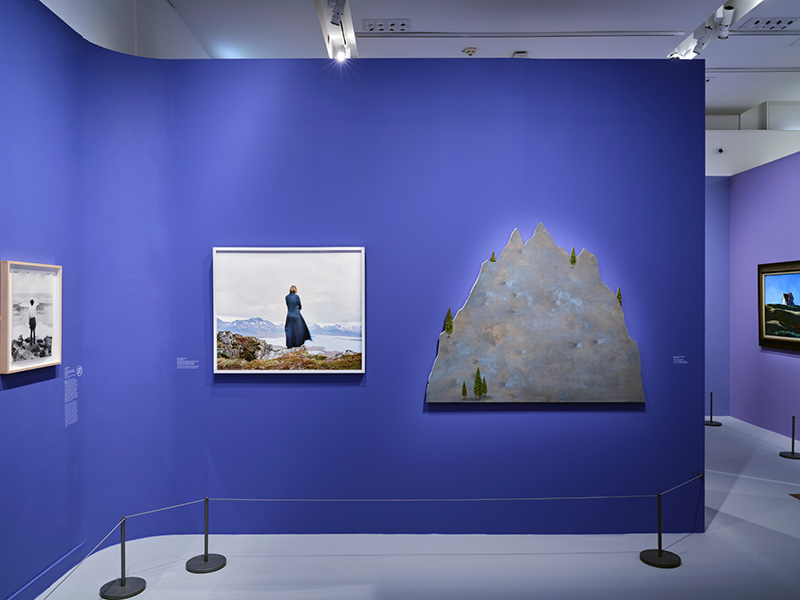
View of the exhibition “Landscape stories. From Monet to Hockney (1890-2026)” at the Marmottan Monet Museum.
© Studio Christian Baraja SLB
Unexpected resonances
Pierre Wat, who has never stopped his research since his book Peregrinations. Landscapes between nature and history (ed. Hazan, 2017), divided his subject into 11 sections hosting nearly a hundred works, in a display sometimes more about harmony and silent conversations. The curator chose, among the nearly 70 artists summoned to Paris (there will be more at the Grenoble stage of the exhibition), to highlight, alongside iconic images by Edward Hopper, Nicolas de Staël, Mondrian or Akseli Gallen-Kallela, the Ukrainian Nikita Kadan who draws fields where nothing grows, the hairy André Mantelet-Martel who traced his etchings on matrices cobbled together in the trenches, creators suffering from mental illness Gilbert Legube and Eugène Gabritschevsky. He also focused on little-known works by famous artists, such as Per Kirkeby, by soliciting private collections. Instructions by Anselm Kiefer is also, in this respect, an exceptional loan. And, in a variety of techniques, Josef Koudelka’s first panorama (Industrial zone (around 1986-1988), Datar Photographic Mission), an ambrotype (La Magel, spring, 2022) by Éric Antoine, the cyanotype prints of Émeric Lhuisset – two versions of the same photograph, one of which, deliberately not fixed, has turned midnight blue – or the hyperrealist pastel Bramble clutter (2022) by Paul Vergier.
The historian is sometimes surprised by the encounters provoked: “If someone had told me that one day I would put an Auguste Chabaud next to a David Hockney, I wouldn’t have believed it! The rapprochement of Soutine [Paysage (vers 1922-1923)] with the [Charles] Pollock [Untitled (Post-Rome), green (1964)], It’s amazing, but I found out after hanging them. And I didn’t know that one day Edward Munch [Nuit d’hiver (1923)] and Martial Raysse [L’Ami des nuages (1982)] could dialogue in this way. » Beyond the subject of the relationship of landscape and history, these unexpected resonances make this exhibition a success.
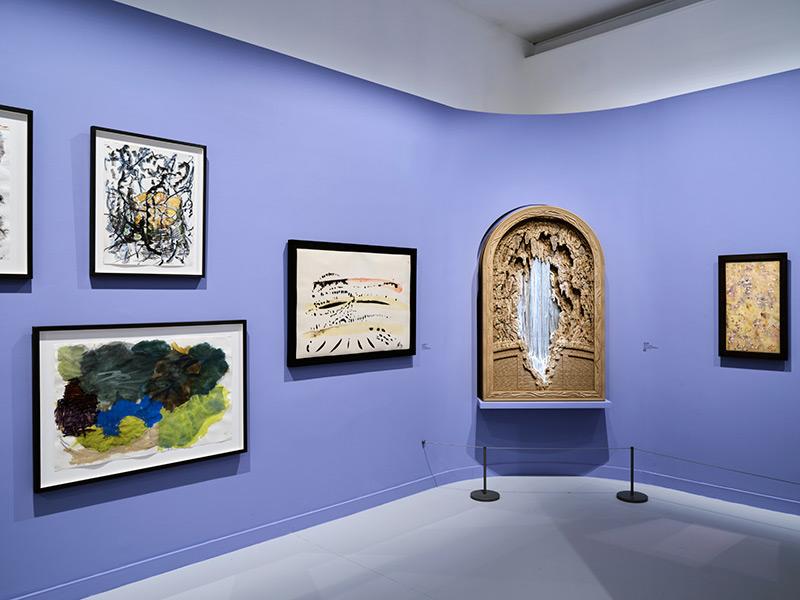
View of the exhibition “Landscape stories. From Monet to Hockney (1890-2026)” at the Marmottan Monet Museum.
© Studio Christian Baraja SLB