Venice. Exactly one year after the sudden death of the great Swiss curator of Cameroonian origin Koyo Kouoh, the Venice Biennale reveals its latest curatorial gesture. The first woman of African origin to be appointed artistic director of the Venetian contemporary art event, in November 2024, the founder of the RAW Material Company art center in Dakar (Senegal) had already crafted the scenario for the 2026 International Exhibition down to the smallest detail, from its main purpose to the selection of artists, including the scenography and graphic identity, when she died of cancer on May 10 2025. From then on, the curatorial team chosen by Kouoh, made up of curators Gabe Beckhurst Feijoo, Marie Hélène Pereira, Rasha Salti, journalist Siddhartha Mitter and researcher Rory Tsapayi, set about making its intentions a reality with a concern for rigor.
A sensitivity to vernacular know-how
Despite the painful circumstances of its conception, “In Minor Keys” is a resolutely luminous and benevolent exhibition, sensitive to the smallest artistic impulses. Continuing the metaphor of the “minor tones” of its title, which refer to intimacy and melancholy in Western musicological language, Koyo Kouoh is interested in the low frequencies of contemporary creation, in discreet murmurs, and in silences too. The exhibition, which takes place in the central pavilion of the Giardini as well as in the rope factory and in the spaces formerly devoted to the storage of artillery at the Arsenal, does not impose a route or fixed sections. It is more akin to an archipelago made up of 111 islets of varied geographical and spiritual backgrounds, most of them originating from the “global South” but sharing a common attention to questions of memory, care for the living and the decolonization of imagination.
The International Exhibition of this 61st edition reserves a particular place for “situated” artistic visions and ancestral cultural practices. Koyo Kouoh abolishes the hierarchy between art and craftsmanship and celebrates polyphonic contemporary creation, entangled in a constellation of cosmogonic, ecological, ritual and aesthetic visions. Here it seems suggested to the visitor to consider the “agency” of the artistic productions given to see, to use the concept defined by the anthropologist of art Alfred Gell in 1990: the works reflect an intentionality, that of their creators, which depends strongly on their original environments and visions of the world. Once stripped of a gaze reducible to Western aesthetic canons alone, the viewer can glimpse the polysemy of the works and the plurality of their uses.
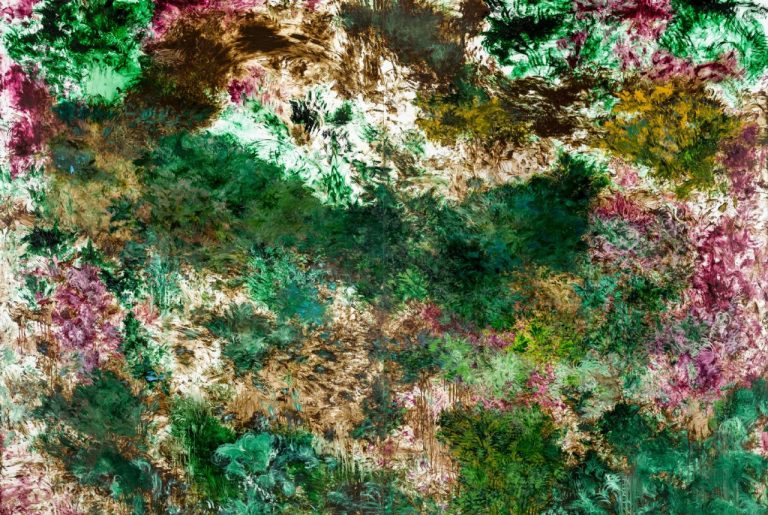
Works by Werewere Liking presented in the international exhibition.
© Marco Zorzanello
Courtesy Venice Biennale
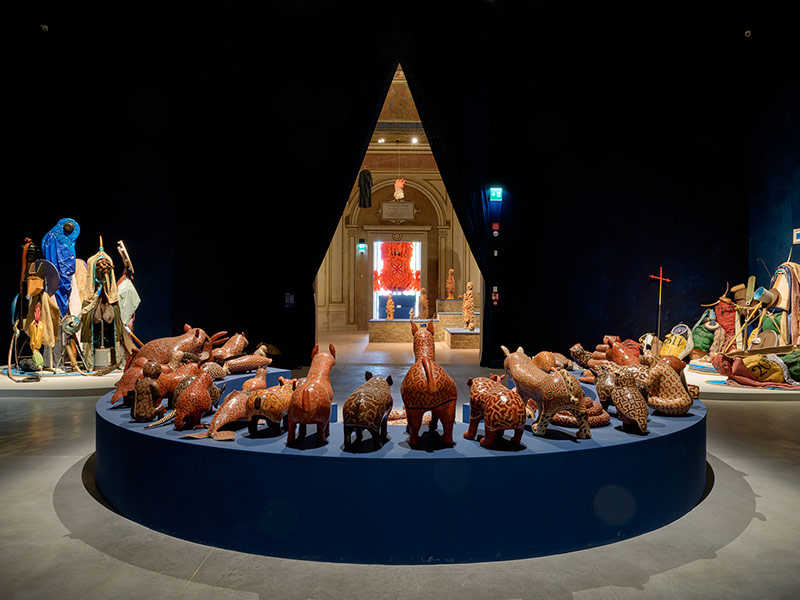
“In Minor Keys” is an invitation to consider contemporary art through the prism of cultural diversity: Amistad Takeover (2026, [voir ill.]) by Big Chief Demond Melancon, which opens the exhibition at the Giardini, is certainly a feather costume set with beaded embroidery of great beauty, but it is also the result of know-how shared by the Black Indian communities of New Orleans, in the United States, for more than one hundred and fifty years, and is intended to be worn by its creator during carnival. Further on, the impressive assembly of zoomorphic sculptures The Council of the Mother Spirits of the Animals was created by the artist Celia Vásquez Yui using the polychrome ceramic process, which has been passed down from one generation to the next for a millennium among the Amazonian people of Shipibo-Konibo, from whom it comes. The geometric patterns that adorn the sculptures, called kenéare representations of the cosmos that tribe members visualize during trances after consuming ayahuasca.
Collectives on the fringes of contemporary art
The exhibition is also interested in the margins of contemporary art, those who operate on shores other than the aisles of galleries and cultural institutions. Koyo Kouoh shines a spotlight on several independent teaching, sharing and artistic production ecosystems, founded and supported by artists from various places around the world, such as the New York interdisciplinary platform Denniston Hill, the Ghanaian artist collective and contemporary art incubator blaxTARLINES KUMASI, based in Kumasi, and the collaborative creation space Lugar a Dudas, in Cali, Colombia. By presenting numerous works created within the framework of these alternative spaces, the curatorial team adopts a relational approach to art and emphasizes the central role of the collective in artistic production, countering the tenacious myth of the creative genius producing his works alone in his studio.
And if a few well-known figures in contemporary art, like Kader Attia, appear on the list of 111 guests, “In Minor Keys” quickly gets off the beaten track: the majority of the artists selected by Kouoh are in fact not regulars at major international events. The exhibition therefore allows us to discover a myriad of voices usually barely heard in cultural institutions, including that of the formidable Werewere-Liking. If the Pan-African artist is best known for her work as a writer, the exhibition highlights her colorful pictorial work with a selection of around twenty paintings.
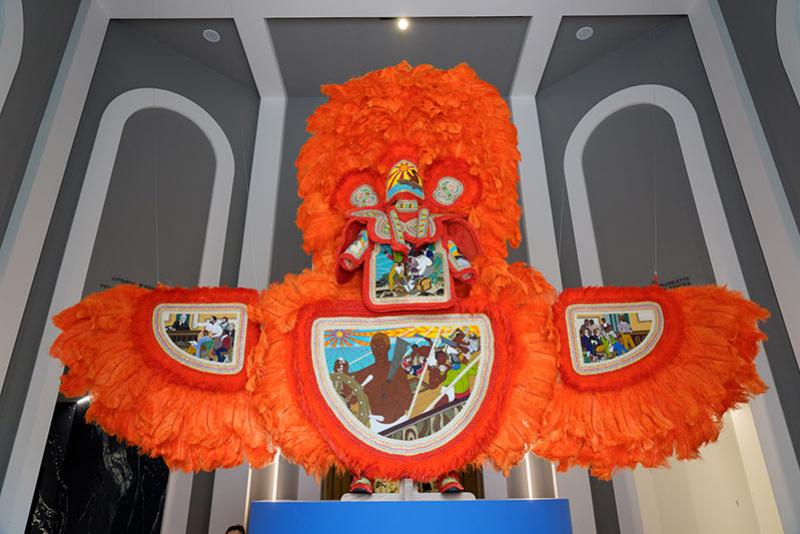
Big Chief Demond Melancon, Amistad Takeover2026, glass beads and rhinestones on canvas with velvet and feathers, 318 × 358 × 76 cm.
© Andrea Avezù
Courtesy Venice Biennale