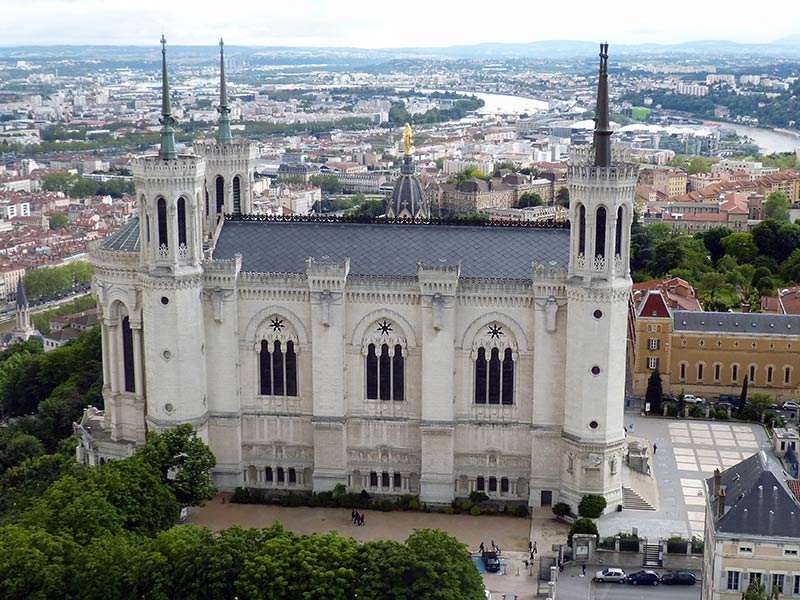
Lyon (Rhone). A jewel in the Lyon landscape, the Notre-Dame de Fourvière basilica overlooks the city, perched on the heights of its hill. It is this same dominant position that weakens it, exposing it to the full force of bad weather and violent winds. On the front line, its four towers now show significant structural damage. The Fourvière Foundation, private owner of the site, is currently finalizing the collection of funds necessary for their complete restoration, estimated at 5.2 million euros. The project should therefore be able to be launched at the end of February; it is planned to last eighteen months, until the summer of 2027.
Faced with the most urgent, the Fourvière Foundation first launched a first call for support, at the end of 2024, to finance the restoration of the two most degraded towers: those located on the west side, the most exposed to bad weather. For this private law foundation, patronage constitutes its main resource and allowed it to raise 2 million euros. But the initial project, which only concerned two towers out of four, has since been revised given the extent of the deterioration of the building. A larger program made possible thanks to the support of the Auvergne-Rhône-Alpes Region, which made a contribution of 1 million euros in September 2025. Added to this is the support of the regional directorate of Cultural Affairs and the Heritage Foundation, which contributed 200,000 euros. Struggling to find the missing 500,000 euros, the Fourvière Foundation launched a new appeal for donations last November. This final effort completes the financing of the project, which now includes the renovation of the lower parts of the towers and the rehabilitation of those located on the east side.
The first interventions will first aim to consolidate the stones at the top of the towers, which are very eroded. “They have multiple infiltrations of rainwater, which enter through the defective joints of the arrows”, explains the Fourvière Foundation, adding that “structural movements have also been spotted” with “horizontal and vertical cracks”. The diagnosis, established in 2023 by the firm Alep Architectes (which will also be responsible for project management of the site), had also revealed fragilities caused by the repairs carried out in the 1990s, the cement applied to the moldings having unfortunately accelerated their deterioration.
This restoration project is part of several recent work campaigns. Between 2008 and 2016, the entire framework and roof of the basilica were restored, as were its interior mosaic decorations. Then, from 2016 to 2022, the Fourvière Foundation carried out a major project to upgrade the buildings adjoining the basilica, a project entitled a “New impetus for Fourvière” and designed to strengthen the attractiveness of the site to the 2.5 million visitors on average each year.