Lille (Hauts-de-France). How can we explain that the twenty-two Regional Contemporary Art Funds (Frac), spearheads of the cultural decentralization policy of the 1980s, have been the subject of so few joint exhibitions on French territory during their history? Before 2026, their collections had only been shown together on one occasion, at the Abattoirs in Toulouse, in 2013-2014 – a fact all the more surprising given that the combined funds had traveled to Eindhoven (Netherlands) in 2015, then to Singapore, Seoul (South Korea) and Bangkok (Thailand) in 2017.
The Lille3000 association intends to revive the national dynamic with its major exhibition “Eclats du laughter!” », deployed on the three floors of the Tripostal: no less than one hundred and fifty works created by around one hundred artists that Caroline David, the curator and former director of Frac Nord-Pas-de-Calais (currently Frac Grand Large) during her period in Lille from 1982 to 1996, chose to revolve around the theme of humor and irony. Concerned about territorial equity, the curator drew four to five works from each collection (with the exception of Frac Réunion which could only provide two due to its geographical distance).
The exhibition highlights the exceptional value of the contemporary artistic heritage that the Fracs have built up for more than forty years. The three chapters of the project (self-presentation, diversion of artistic and linguistic codes, political satire) are all common threads which allow the curator to connect some of the most emblematic movements of the 1960s to 1990s, such as body art, Fluxus and conceptual art.
Martha Wilson, Mona-Marcel-Marge2014, Frac Sud – City of contemporary art
© Martha Wilson / PPOW, New York
A selection that avoids emerging forms
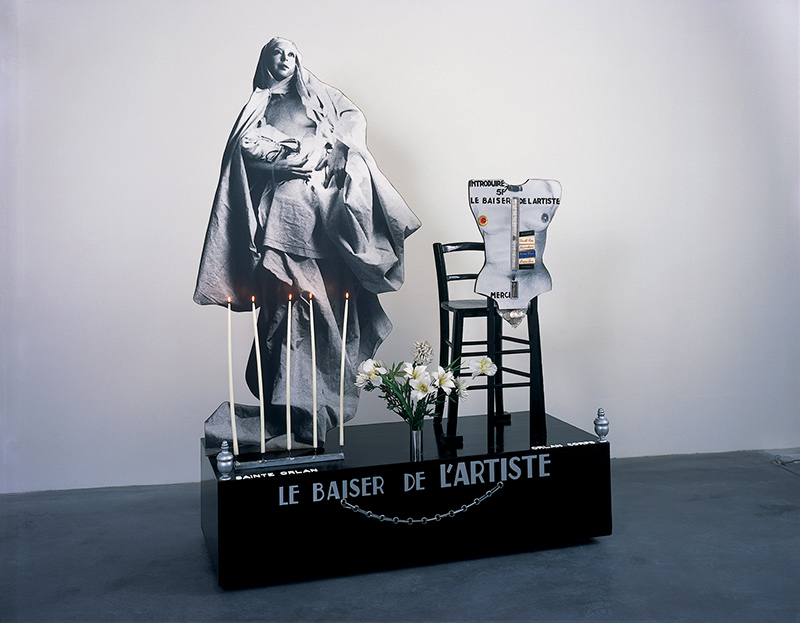
Ben Vautier, Marcel Broodthaers, Esther Ferrer, Alain Séchas, Bertrand Lavier… Each one more famous than the last, the great figures of contemporary art follow one another on the walls. If the general public aim and the scope of the exhibition undeniably require the highlighting of the most illustrious artists of recent decades, the curator could also have taken advantage of the Tripostal showcase to rehabilitate lesser shown, or even forgotten, visual artists who have played a key role in the history of contemporary art. Given the number of works lying dormant in the Frac collections (nearly 35,000), it is quite a shame that the selection focused on sets widely distributed in museums around the world since their acquisition, such as The Artist’s Kiss (1977) by ORLAN or The Mona Lisa is on the stairs (1969) by Robert Filliou.
The history of contemporary art narrated by Caroline David also seems to stop at the beginning of the 2000s. The imbalance is marked between the works from the 1970s to 1990s, which represent the overwhelming majority of the corpus, and the current proposals: the first section includes only two creations after 2010, the most recent dating from 2014. Digital art (3D models, digital collages, environments in reality virtual, etc.) is completely absent from the exhibition, the most “historical” mediums of contemporary art (installations, assemblages, performances, painting, drawing) having been favored. These curatorial choices prevent the exhibition from offering a true intergenerational dialogue and promoting contemporary conceptions of humor, such as that associated with Internet culture and found in many works of digital art.
In addition, many of the works created after 2010 were produced by renowned visual artists (Martha Wilson, Jean-Luc Verna, Laure Prouvost, John Giorno). Artists at the start of their careers occupy an anecdotal place in the exhibition, even though supporting emergence is one of the main missions of the Frac. Highlighting a significant number of young artists would have made it possible to show how these structures are not comparable to contemporary art museums.
“Bursts of laughter! » however has the merit of being rich in information and accessible thanks to the mediation work carried out by the lille3000 team: the Frac map and the introductory texts present these structures in a very complete manner while the developed cartels, the FALC (Easy to Read and Understand) booklets and the fun cartels offer reading levels adapted to different audiences.
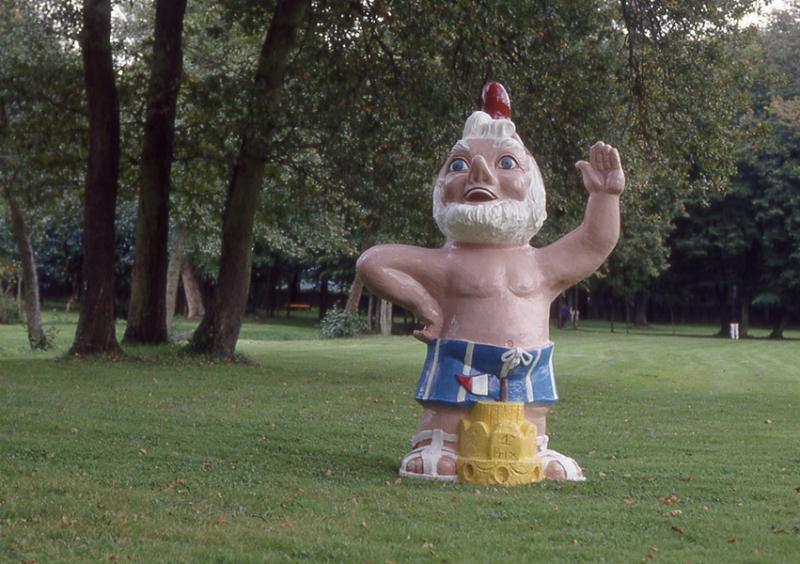
Panchounette presence, Dwarf! Dwarf! (II)1989.
© Stéphane Bellanger / Frac des Pays de la Loire