The increase in illegal constructions and demolitions of historic buildings in Jaipur has led the Indian justice system to intervene in the management of the heritage of the city, which has been listed as a UNESCO World Heritage Site since 2019. On September 26, a judge of the High Court of Rajasthan initiated proceedings ex officio against the authorities responsible for the conservation of the fortified city. The magistrate, Pramil Kumar Mathur, relied on information published by the daily Rajasthan Patrikaas well as the concerns expressed by the World Heritage Committee. On October 1, a panel of the High Court officially registered the case as a public interest proceeding (Public Interest Litigation), intended to have the failures of administrations examined by the courts.
The grievances mainly relate to unauthorized transformations of old buildings, encroachments into protected areas and the proliferation of commercial construction which alters the historic urban fabric. The judge also denounces the inadequacy of controls and the inaction of the competent services in the face of certain demolitions. He recalls that the Indian Constitution requires the State to protect monuments of historical interest and makes the preservation of cultural heritage a duty of citizens.
The Amber Fort in Jaipur (India).
The High Court notably asked the municipal authorities and the bodies responsible for town planning to draw up, within two weeks, an inventory of irregular constructions. Administrations must also produce the applicable regulatory texts, specify the controls carried out and communicate the measures taken against the violations noted. The judge also requests information on work authorizations, heritage impact studies and administrative responsibilities. The authorities concerned have been called to answer in court, with a new hearing scheduled for the week of October 26.
A backup plan still unfinished
The legal intervention comes at a time when UNESCO is demanding guarantees from India on the conservation of Jaipur. During its 47th session, in July 2025, the World Heritage Committee noted several shortcomings: destruction of historic houses, new constructions threatening the integrity of the inscribed perimeter, insufficient human resources and difficulties in coordination between administrations. He also highlighted the shortcomings of the management system and the absence of sufficient assessments of the consequences of certain real estate projects on heritage. An updated report on the state of conservation of the site must be transmitted to the World Heritage Center before December 1, 2026.
The preparation of Special Area Heritage Plan (SAHP), a document intended to govern the protection and development of the historic city, is also significantly behind schedule. According to the Times of Indiathe PDCOR company, responsible for its development, had still not submitted its project at the beginning of October. The document still needs to be reviewed by theArchaeological Survey of Indianational organization responsible for the protection of archaeological and monumental heritage, before its transmission to UNESCO. These delays complicate the preparation of the report expected in December.
A historic city subject to real estate pressure
Founded in 1727 by Maharaja Sawai Jai Singh II, Jaipur is distinguished by its orthogonal urban plan, organized around wide arteries and surrounded by ramparts. The city owes its nickname of “pink city” to the facades repainted in 1876 on the occasion of the visit of the Prince of Wales, future Edward VII. Its historic center, with an area of approximately 710 hectares, notably preserves numerous havelistraditional residences built around interior courtyards, some of which have been transformed or demolished.
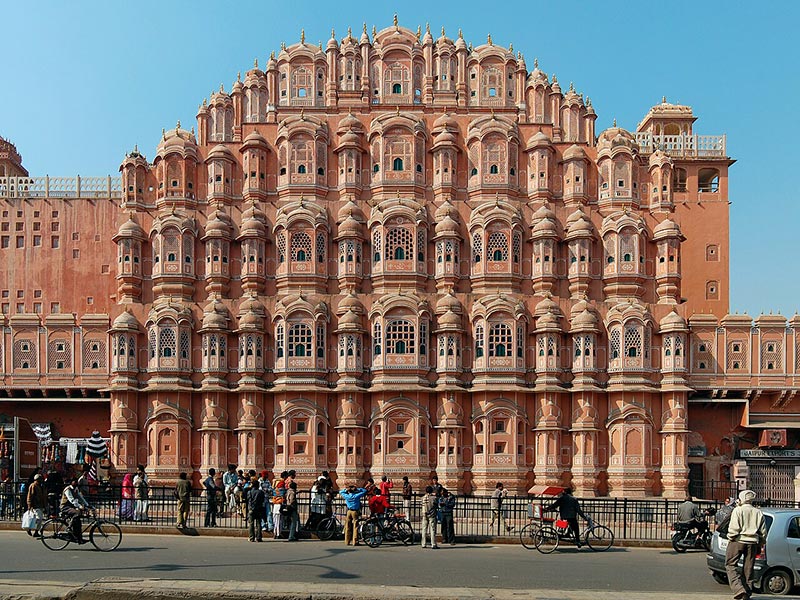
The historic perimeter also includes the Hawa Mahal, or Palace of the Winds, a five-story building built at the end of the 18th century. Jaipur also has the Jantar Mantar, an 18th century astronomical observatory listed separately as a world heritage site since 2010, as well as the Jal Mahal, a palace built on Lake Man Sagar.