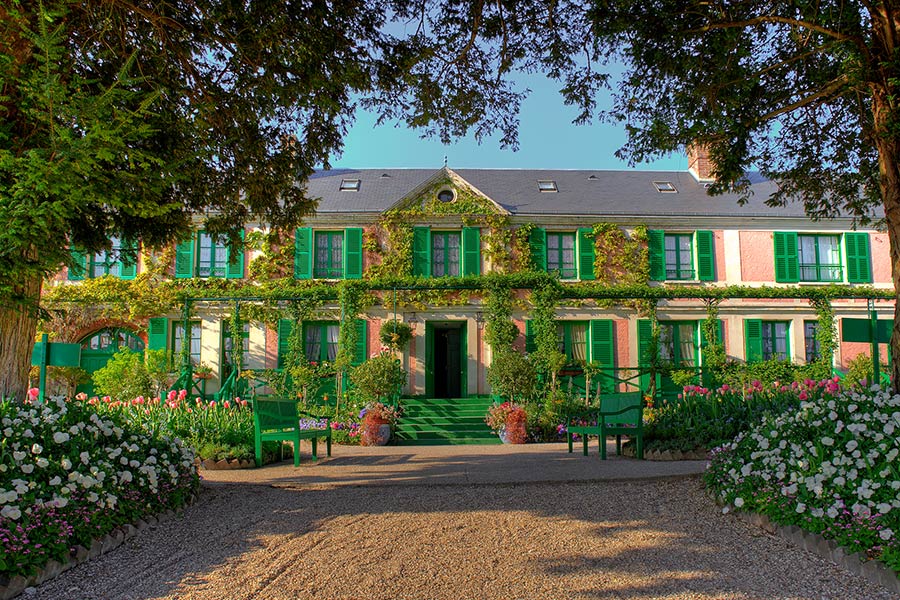
Giverny (Eure). The April sun hesitates. When he decides to touch the flowers still fresh with dew, the first buses are already invading the tiny village. It’s barely 10 o’clock. Streams of humans come out. Americans in fleeces and caps, Asians dressed in pink or black. Some 500 people then crowd into rue Claude-Monet, two kilometers which concentrate all the life of the village. The painter’s house and gardens, the museum, the church. And the shops. Until 1 p.m., you will have to wait almost two hours to access the house and gardens of the painter who lived in Giverny from 1883 to 1926. “In people’s minds, coming here is like seeing the Taj Mahal or the pyramids, they only come for half a day for the gardens during an express trip to Europe,” explains Cyrille Sciama, the director of the Musée des impressionismes located on the main street.
This is the Giverny paradox. A village visited every year by nearly a million visitors which becomes a ghost when the gardens with their famous water lilies close at 6 p.m. Here we only consume Monet. Behind the scenes? a gulf between this worldwide notoriety and the meager resources of a town of 430 souls with an annual budget of 600,000 euros. “I have the problems of a metropolis with the means of a village”, laments the new mayor, Sébastien Despoix, who ran the Giverny bakery for years. On the other hand, the gardens stand out for the opacity of their finances already pointed out by the Court of Auditors in 2015. However, if we count on the basis of an average ticket estimated at 11 euros, 75% of adults at 13 euros and the rest at a reduced rate, ticketing alone would generate between 9 to 10 million euros per season. At the same time, navigation on the Seine, boosted by the rise of green tourism and the Paris 2024 Olympics, has amplified this mass tourism while the village does not have the means to hire a municipal police force. A very different dynamic from that of Pont-Aven where the 110,000 visitors to the Gauguin Museum irrigate local art galleries and biscuit factories, generating nearly 170 million euros in benefits across Cornwall.
Interior of Monet’s house.
© Maison et Jardins Claude Monet
Gardens, an economy in isolation
Along the painter’s house, the queue grew even longer. “It’s no worse than the Louvre!” “, slips a Brazilian into singing English. Here, everything runs in perfect self-sufficiency in the village. We enter through the shop where mazagrans bearing the image of the master, scarves and coasters are piled up. Art books too. And we come out the same way. Alain-Charles Perrot, director of Claude Monet’s House and Gardens, defends himself with institutional elegance by asserting that tourists also visit “the museum, the church, the cemetery” and the gardens go like this“benefit the various businesses in the village”. Adding with a certain confidence that “the Academy of Fine Arts has an ethic that is not commercial”. Still “the village and its inhabitants do not benefit from the economic benefits, which only benefit a handful of traders”, decides the mayor.
Sébastien Despoix does his accounts. “I receive around 50,000 euros from Monet’s gardens to finance four seasonal toilet workers, maintain a parking lot smashed by buses, and try to organize security in a street where thousands of people parade every day.” If the gardens, their restaurant and their shop were subject to the business property tax (CFE) like any business, the municipality would undoubtedly receive three times more. But the site managed by the Academy of Fine Arts is exempt. Non-commercial ethics has its tax advantages… In the end, the tax benefits only concern a handful of traders. The count is done quickly. Nine restaurants including one belonging to the gardens and another to the museum, a bakery, two food trucks and four independent souvenir shops. That’s all. Today, the municipality does not have the means to renovate the town hall or the village hall. Nor even those to replace the school’s digital board. An organization to rethink? In Chenonceau (Indre-et-Loire), the castle belongs to a family which pays its local taxes and employs 150 seasonal workers. Not to mention the geography of the village which requires the visitor to cross it to reach the entrance. The expense is mechanical, inevitable.
Emancipation impossible?
200 meters from Claude Monet’s House, the Museum of Impressionism occupies a unique position in this trompe-l’oeil landscape. “There is no automatic conversion rate between the gardens and the museum,” warns Cyrille Sciama. Of the massive flows generated by Maison Monet, the museum only captures 15% to 17%, or 140,000 to 160,000 visitors per year. The cause is visitors who only have a few hours before escaping to Mont-Saint-Michel or the D-Day beaches. A dissociation which can also be read in the public. Where the gardens attract 54% foreigners, the museum relies on a clientele that is 80% French. “The challenge of the gardens is to absorb 4,000 visitors per day while ours is to attract people to our often contemporary exhibitions,” summarizes Cyrille Sciama.
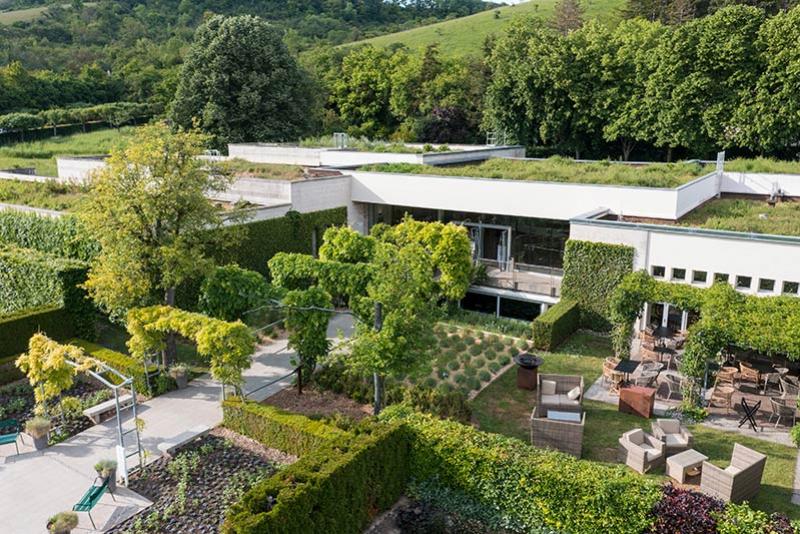
The Museum of Impressionism in Giverny.
© Manemos / Gilles de Claevel
The museum may proclaim a renewed identity for contemporary art, but the “Monet system” always ends up putting it back into its orbit. The exhibition “Before the Water Lilies” brings together (until July 5) at the Museum of Impressionisms 26 original works by the master with the objective of exceeding 100,000 visitors, where a contemporary art exhibition caps at 40,000 entries. Emancipation has its limits. Even the carte blanche given to Daniel Buren (from July 17) is subtly part of an obligatory dialogue with the owner. “Transforming these half-day visits into overnight stays with businesses open even in autumn would change everything,” sighs the director who tried unsuccessfully to open the museum after the season. A very different situation in Auvers-sur-Oise (Val-d’Oise) where Van Gogh spent his last days: the Van Gogh House welcomes up to 5,000 daily visitors in high season who spend between 40 to 60 euros thanks to a closer link between culture and shops which remain open all year round.
Amusement park or village?
“Sometimes it feels like we’re in Disneyland,” Charles grumbles, locking the gate of his house while shrugging his shoulders: “That’s not going to stop them!” » He says he has several times found visitors in his garden having a picnic. Sylvie, his wife, nods: “It’s good to have visitors but sometimes it’s too much. » A shared impression especially when tourist flows overflow. Christine Cloos, a visual artist who has lived in Giverny for thirty years, slides into her novel Serial murders in Giverny (ed. des Falaises): “Ah, the Foundation! This sprawling octopus which takes over all the houses in the village, which has decided to transform Giverny into an amusement park. » For Alain-Charles Perrot, the inconveniences brought by gardens are minor compared to their benefits. “And even if this brings inconvenience to their peace of mind, the residents manage to put up with it,” sharply asserts the director of the gardens. It must be said that here everything is protected to the point of paralysis. The slightest renovation is done under the supervision of the architect of Bâtiments de France, and creating a new business is impossible. Build even less. The village is frozen in a fresco painted by Monet that tourists come to admire. And the inhabitants are part of this decor. “But we’re not in a zoo…”sighs the mayor. Cyrille Sciama is more vindictive, more realistic too. “If there were no gardens, there would be no Giverny. » No doubt. But this impression of an amusement park in memory of the painter is even more intense when the season ends. Everything closes suddenly. Overnight, the village empties, the iron curtains of the shops are lowered until the next spring. However, real estate prices are up to 30% higher than in neighboring villages. Giverny is a brand that benefits everyone. But does it benefit Giverny?