Bilbao,
More than a decade after the Picasso Museum in Malaga provided her with an anthology, and within the framework of a recovery of the artist for the international public that has already included exhibitions at the Guggenheim in New York, the Tate, the Moderna Museet in Stockholm or the Hamburger Bahnhof in Berlin, the Guggenheim Museum Bilbao opens to the public this weekend a new retrospective of the Swedish Hilma af Klint, increasingly less enigmatic for the general public but still awaiting more exhaustive studies, since she barely showed her work in life and its recognition is recent.
This exhibition includes a review of his journey from his first figurative compositions, with traditional themes, and his automatic drawings to the pieces already made under the influence of spiritualism, such as the series paintings for the temple either Percevalan exploration of the occult, and his latest watercolors. Given that he was unable to find viewers who could or knew how to understand him, and that he barely shared his images with the esoteric communities of which he was a part, Klint had the intuition and good eye to carefully save and classify his production until a coming society understood, perhaps, his non-objective art, a pioneer of future abstractions, which was closely related to his spiritual visions and to theosophy, the current of Rosicrucianism or Rudolph Steiner and his anthroposophy.
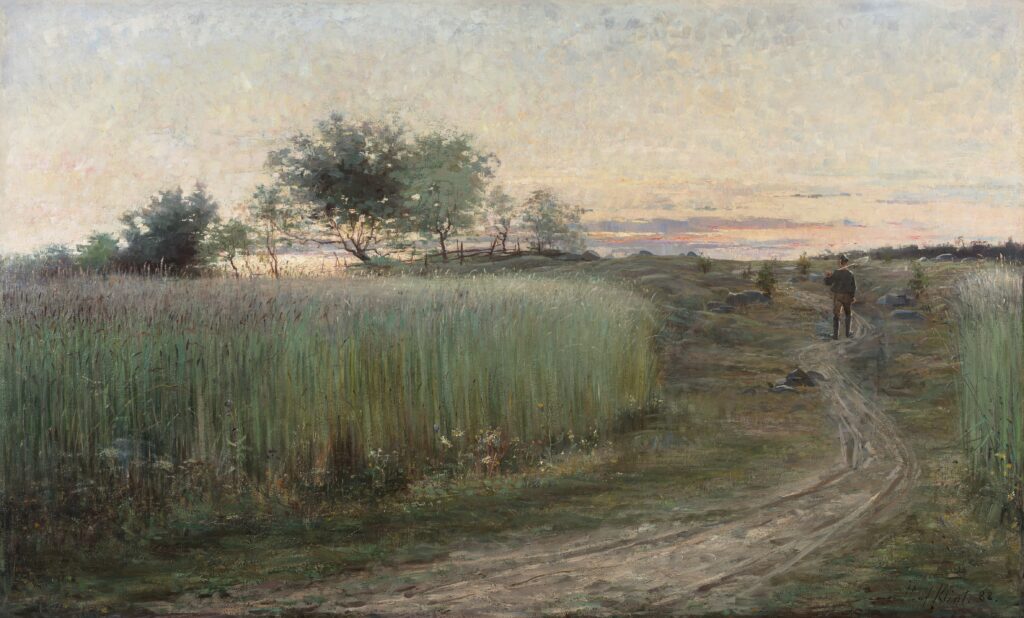
The tour begins by remembering that, due to her belonging to a noble family that had acquired prestige for military reasons, Klint was able to receive a broad education, as was not common among women of her time (she was born in Stockholm in 1862 and died there in 1944). Her father was a cartographer, an instructor in astronomy, navigation and mathematics, and it is believed that the knowledge she would acquire in these subjects left its mark on her most spiritual work, an apprenticeship that she completed with that acquired through traditional channels, at the Royal Swedish Academy. of Fine Arts, which was one of the first European institutions to allow its students to draw from live models.
It is not very special that Klint began to be interested in spiritualism sessions, since they were common in his time although they were reviled by many and by believers in traditional religions: we remember that Alfred Russel Wallace theorized at that time about the existence of an intelligence superior and the possibility that life on Earth went beyond what was scientifically explainable; that the chemist William Crookes was very close to occultism, as was Conan Doyle, creator of the very empirical Sherlock Holmes; and that Edison formulated the intention of creating a telephone that would allow its users to communicate with the dead. These were years in which religious and philosophical that promised to reveal an eternal truth that combined the spiritual, the material and the universal. Founded by the Russian Helena Petrovna Blavatsky, it seduced, in addition to Edison and Wallace, Mondrian, Kupka, Malevich and Kandinsky, leading figures, like Hilma, of abstract art.
Like so many of her contemporaries, this author assumed that there was no reason for friction between science and spirituality, given that both seek the discovery of higher truths, and together with Anna Cassel, Cornelia Cederberg, Sigrid Hedman and Mathilda Nilsson she composed the so-called group of The five (De Fem)meeting to try to connect with the beyond and channel their sensations through automatic writing and drawings that did not require reflection either; As we said, several can be seen in Bilbao.
When Klint understood that one of the five supposed spirits that guided them asked them to make astral paintings that represented the essence of the world and, once done, to build a temple that would house them, her companions gave up, but she would begin to work, for nearly a decade, in the aforementioned paintings for the temple: two hundred pieces that, he believed, were drawn by supernatural forces, which revealed messages about the intangible through his hands. The first set of works of that cycle was named WU/ Pinkname in which W would allude to the subject and OR to the spirit, embodying WU, therefore, its duality; The rose, for its part, would be linked to the secret order of Rosicrucianism, whose emblem was a rose in the middle of a cross, where the Swede and her circle carried out their spiritualism sessions.
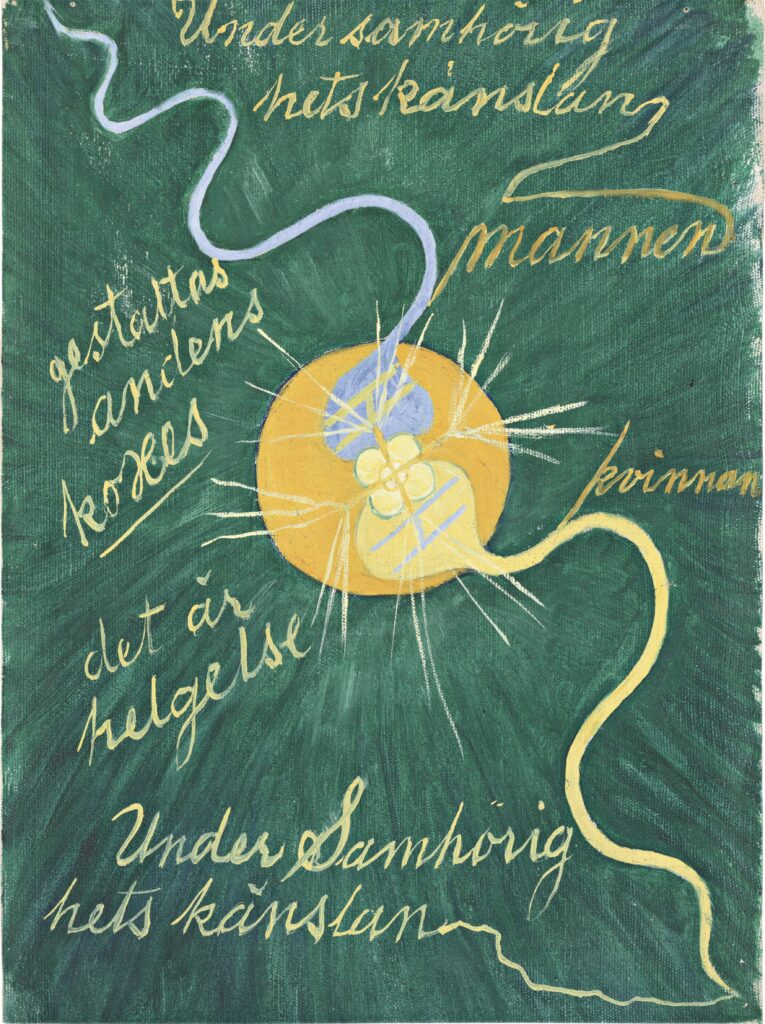
His first 26 canvases for the temple respond, meanwhile, to the title of Primal Chaosfor relating to theosophical teachings about the beginning of the world; According to these, at the beginning there was a unity, which was broken, constituting the history of our planet a story of continuous attempts to re-fuse the opposites that were then separated, such as masculine and feminine, good and evil. Not long before beginning that series, Klimt had joined the Theosophical Society, which defended the possibility of accessing deep spirituality through meditation or intuition.
Some of these paintings can be seen in Bilbao: within this set Pinkwe will find a group of pieces dedicated to Eros in which yellow and blue intermingle, which would respectively symbolize the masculine and the feminine; or a dozen large paintings of figures, increasingly more abstract, that offer, once again, different degrees of distance or closeness between man and woman.
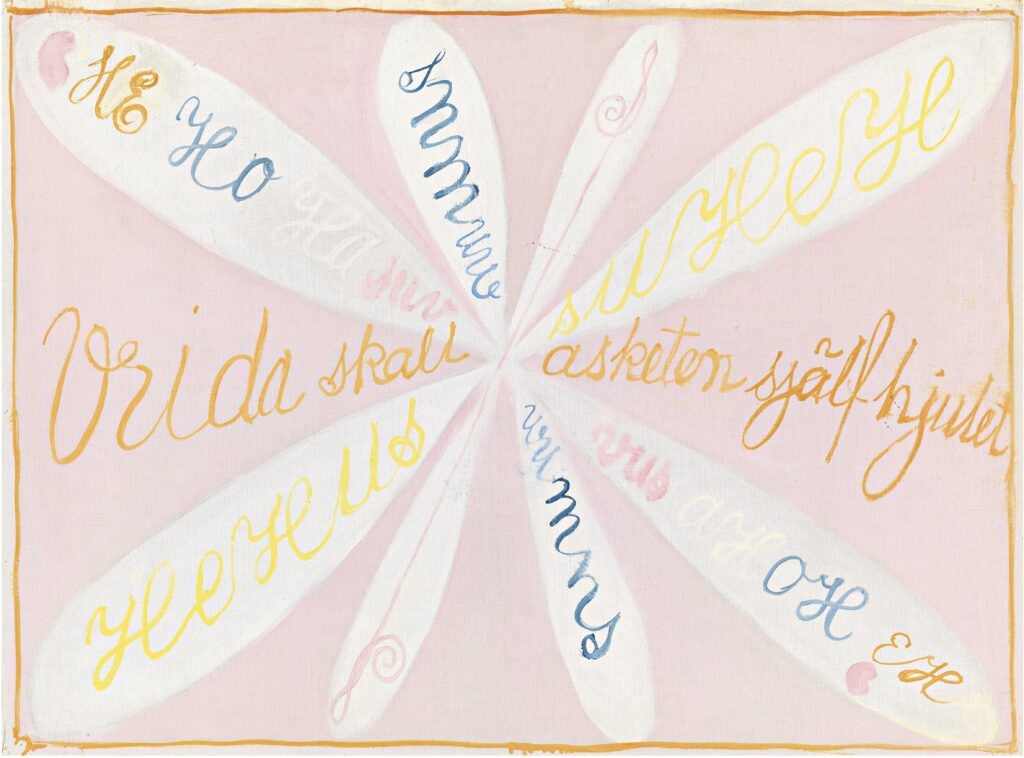
Another fundamental group of paintings for the templewhich has also arrived in Bilbao, is that of The seven pointed starin reference to the symbol of many religious and occult traditions. His canvases then gradually grew in size and the use of line in them refers to what we could see in his first automatic drawings, although it is more controlled. The reduced tones of these works and the lack of depth have been considered antecedents of later abstractions by other authors.
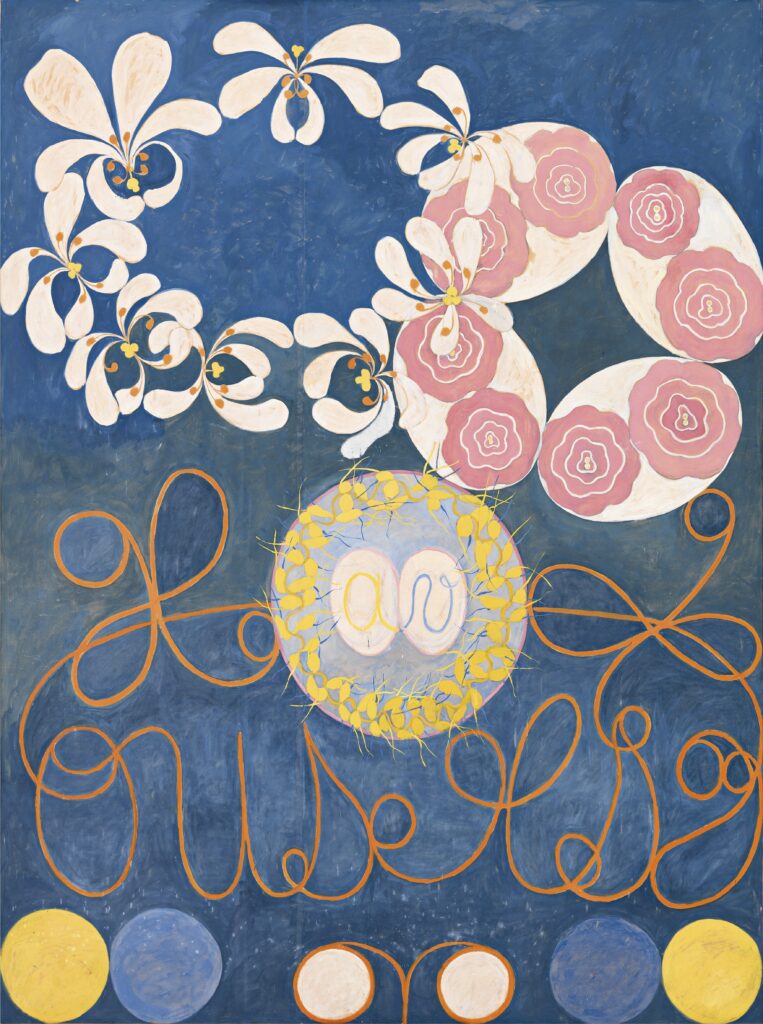
And they couldn’t miss the ten greatest: Klint claimed to feel, in September 1907, that he was invited to create “ten paintings of paradisiacal beauty” linked to the four stages of human development: childhood, youth, maturity and old age. Due to their monumentality, it is very likely that, at least in part, they were executed on the ground, and she used the tempera technique, the one used in the altars of the Florentine churches that the artist had been able to admire some time before.
The following year she decided to take a break from this almost Herculean project, a four-year break after which, as she declared, the spirits were still with her, but in a different way: she assumed, it is assumed, greater autonomy regarding methods and colors. In his new work we find a growing number of swans, a motif that he had already used before: they gradually became more abstract and geometric and, due to the colors that he combines in them (black and white, yellow and blue), they appeal again to dualities between life and death, light and darkness, the masculine and the feminine.
The biblical story regarding the beginning of the world, together with his theosophical beliefs, inspires the compositions of The tree of knowledgewhich we can associate with nature and Art Nouveau due to its shapes (that tree is located halfway between the earthly and divine spheres); and the symbol of the Holy Spirit is related to the group The dovewhere she also reflected the combat between Saint George and the dragon (between good and evil), posing the saint as an alter ego of herself.
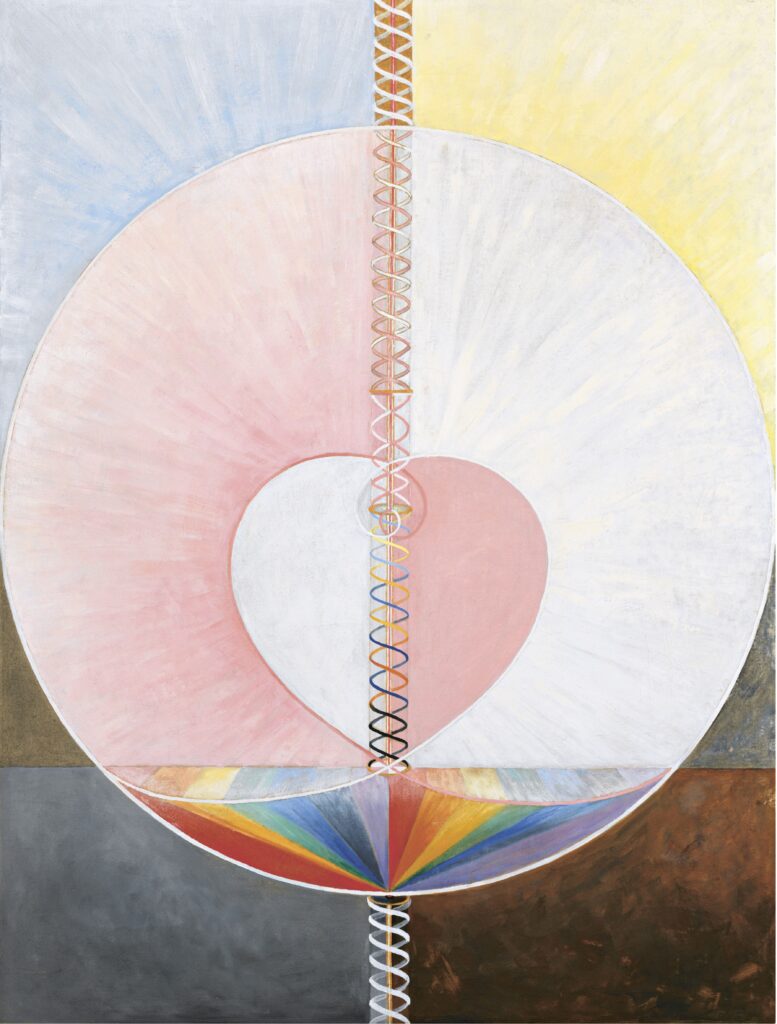
His series of works culminate at the Guggenheim paintings for the temple three altarpieces that we must understand as a compendium of that ambitious project in form and substance: in them he expressed his conviction that human evolution had to occur in two directions, from the divine to the material and vice versa. The use of a metal sheet provides luminosity and evokes, once again, traditional religious art.
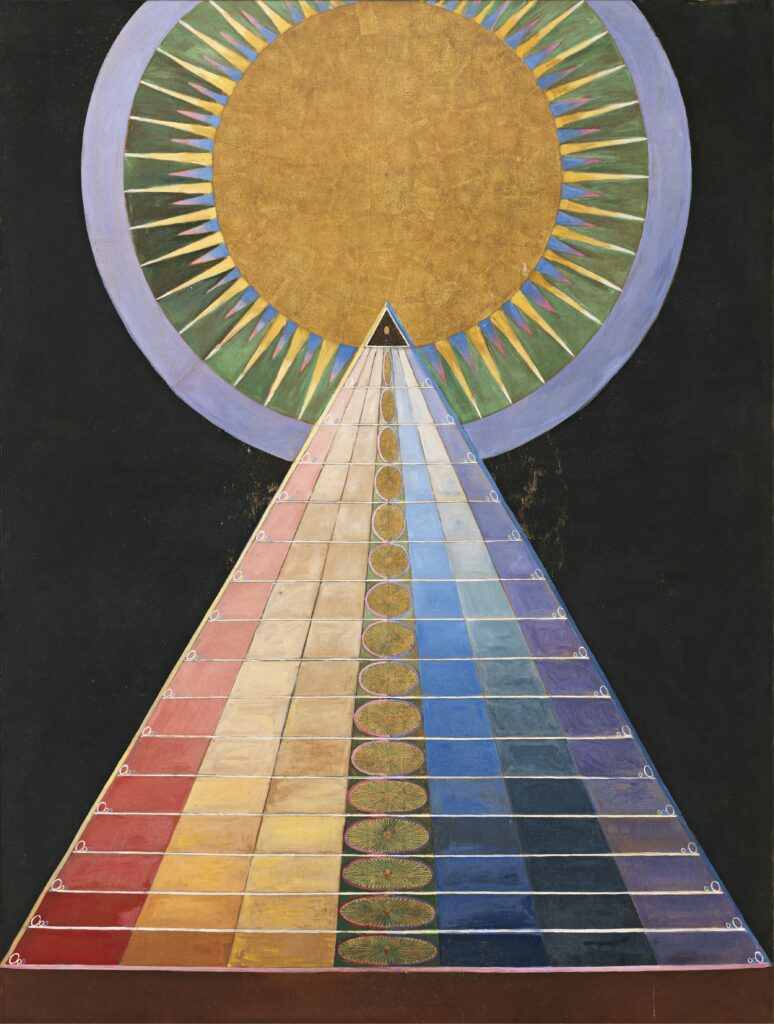
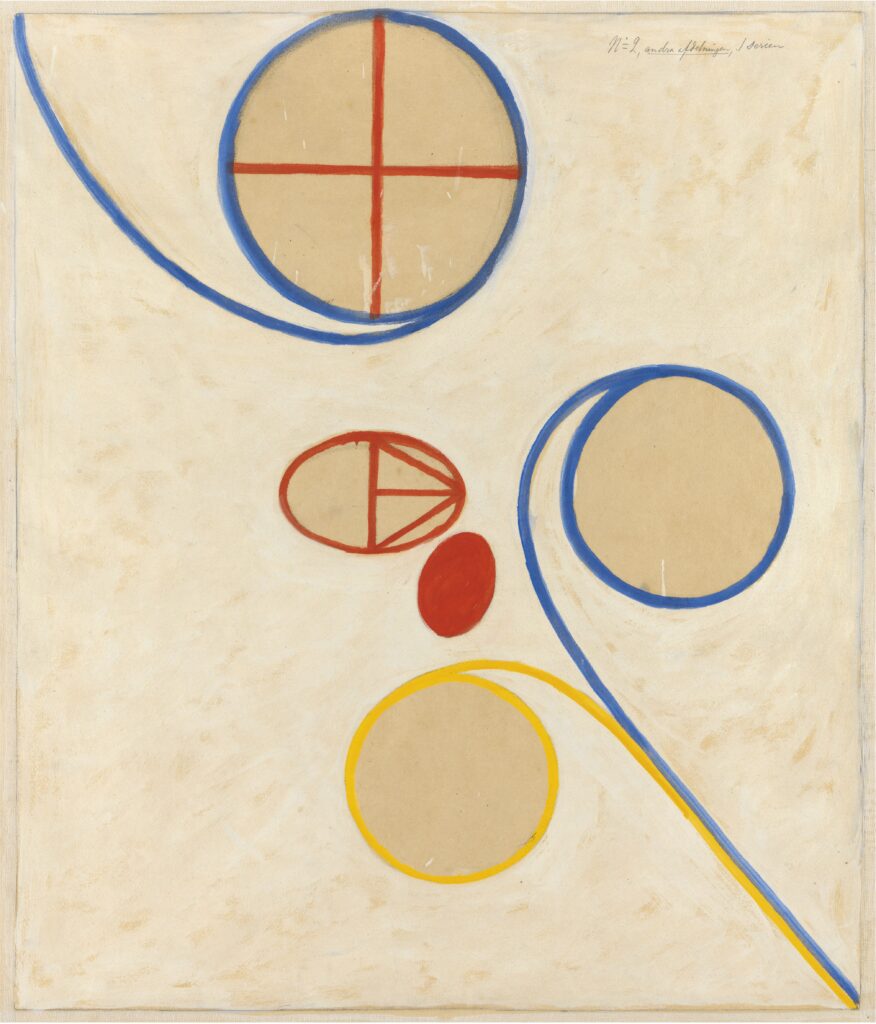
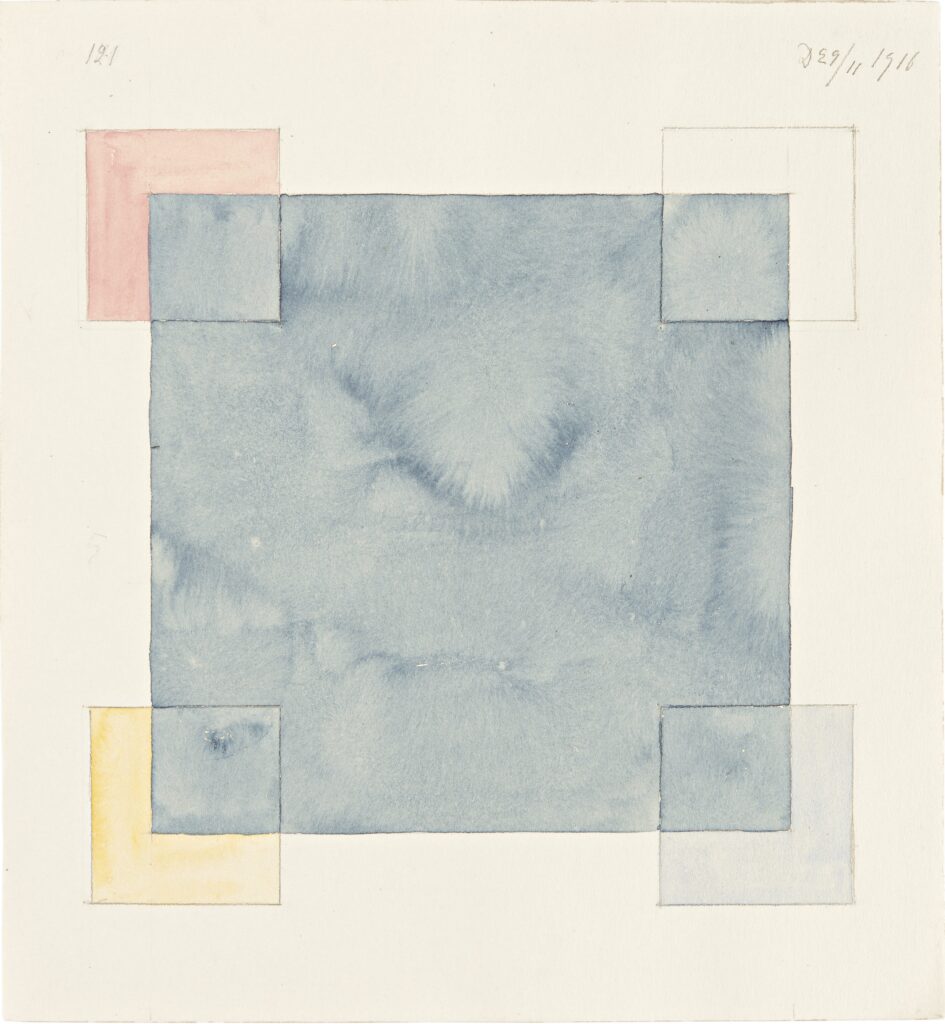
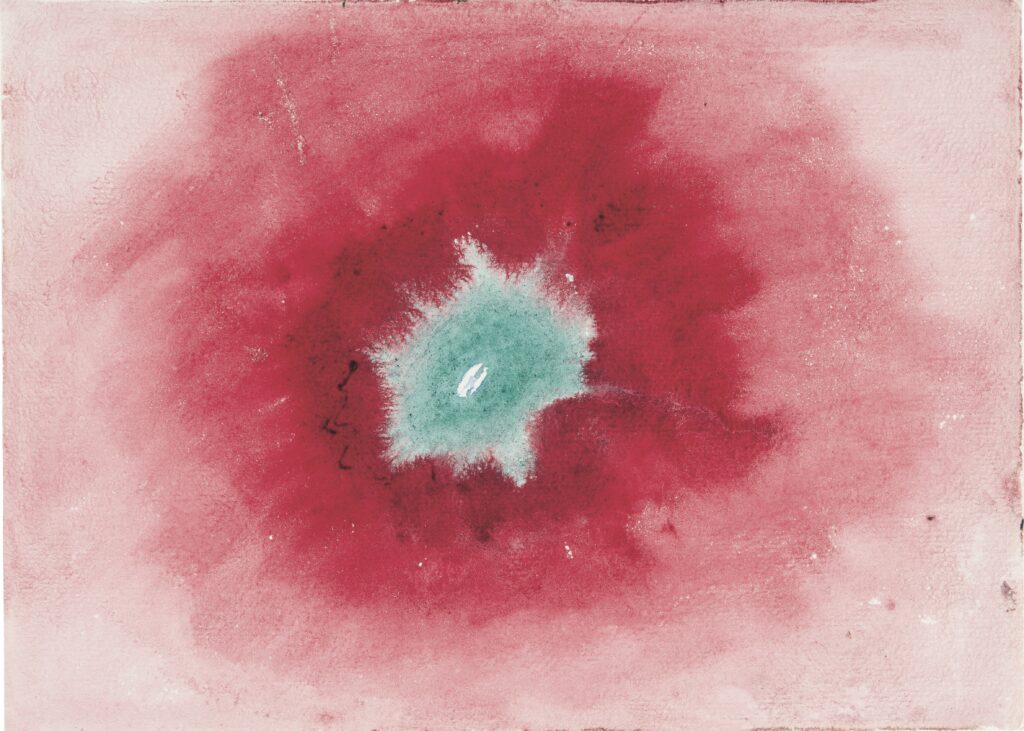
And they close the exhibition the series Percevalin which he continued to investigate the meaning of the messages he would receive from the spirit world; the atom serieswhich he considered as the gateway to the cosmos, the first stone in the return to primal unity; geometric pieces in which circles and crosses would portray the invisible and the watercolors that integrate About contemplating flowers and treespossible sketches of the spiritual forces of nature in which he once again demonstrated how advanced his techniques were: he used a wet sponge to apply the paint, so that the movement of the color on the support was free. Or it was the spirits who dictated it.
Hilma af Klint
GUGGENHEIM MUSEUM BILBAO
Abandoibarra Avenue, 2
Bilbao
From October 18, 2024 to February 2, 2025