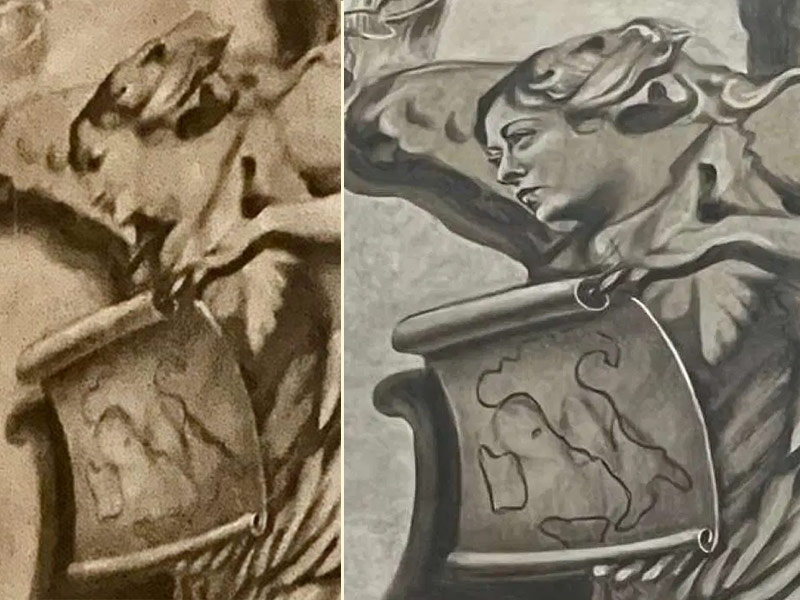
Could the Italian Prime Minister have inspired an angelic figure? In any case, this is what the recent restoration of a fresco in the San Lorenzo in Lucina basilica in Rome suggests. After water damage at the end of 2025 having damaged the chapel, Bruno Valentinetti (local artist and sacristan of the church) repainted the fresco.
Giorgia Meloni.
The original fresco represented a little angel with no particular identity. The restored angel now has an elegant face with fine features (clear forehead, straight nose, thin lips) and curly brown hair falling on the forehead. Observers point out that her features strangely resemble those of Giorgia Meloni. She, too, has an oval face, arched eyebrows, thin lips, and brown hair that is often combed back. However, some details differ. For example, the painted character’s eyes appear more almond-shaped and his expression more solemn. La Repubblica notes ironically that“before the restoration, there was a generic cherub. Today, she is the face of the most powerful woman in the country”.
This affair took on a political dimension. For the opposition, it illustrates the risk of proximity between the government and the Church or the temptation to make culture a “political tool”. On the Church’s side, the incident embarrassed the diocese of Rome, forcing the local Church to recall the impartiality of the sacred. Cardinal Reina warned that sacred art cannot be exploited. He insisted on the exclusively liturgical vocation of these images.
Restaurateur Bruno Valentinetti claims to have acted only according to his own judgment, and not to have taken inspiration from a living character. The diocese indicates that this initiative was taken without informing the competent authorities. The Italian Ministry of Culture has launched an administrative investigation into the work. The diocese of Rome has opened its own canonical investigation.
The Basilica of San Lorenzo in Lucina is a Roman Catholic basilica located in Rione Colonna, Rome. Founded in the 4th century, it was officially consecrated in 440, under the pontificate of Pope Sixtus III. The building was rebuilt and remodeled several times, notably in the 17th century with baroque interior interventions. In the 19th century, the Baroque decoration of the nave was replaced by frescoes painted by the painter and sculptor Roberto Bompiani (1821-1908). The basilica houses the tomb of Nicolas Poussin (1594-1665).