
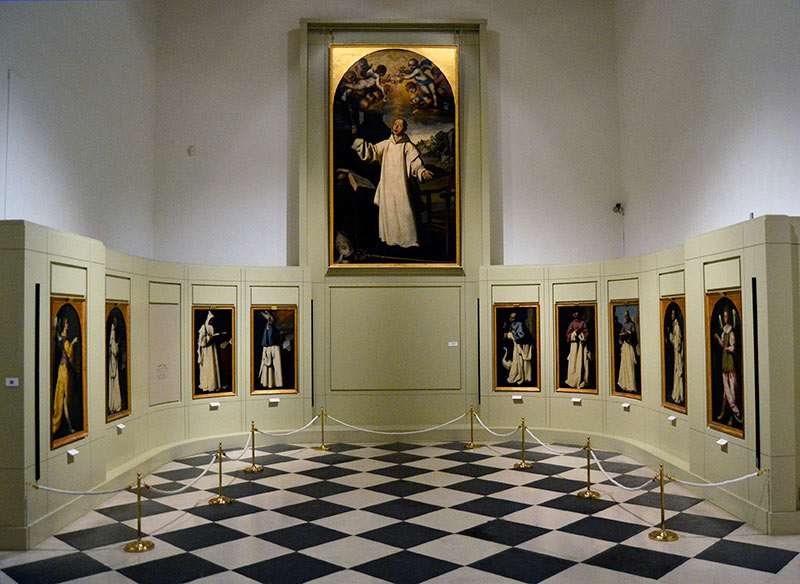
Spain. Props hold up the ceilings, water infiltrations recur and the collections remain inaccessible to the public and researchers. Since 2018, part of the provincial museum of Cádiz (in the south of Spain) has been closed. No reopening date has been set.
The building that now houses the museum and Academy was originally a Franciscan convent. In the 1830s, Minister Mendizábal had Church property confiscated throughout Spain. The Academy, installed since its foundation in 1788 in the palace of the Marquises of Recaño, seized the opportunity and moved into the convent liberated in 1838. The provincial museum was born shortly after, partly made up of works resulting from these same confiscations. The two institutions share the building. When the Region transferred the School of Fine Arts to a new building, the Academy found itself the sole occupant of the most degraded third of the whole, now abandoned.
Founded in the same classicist spirit as the Royal Academy of Fine Arts of Saint Ferdinand in Madrid, the Academy of Cadiz had from the beginning the ambition of a first-rate institution. The rule requiring that each incoming academician submit a work has, over two hundred and thirty-eight years, constituted a fund of unusual density. Pablo Juliá, who is now president, introduced photography and comics among the recognized disciplines and brought in new profiles, musicians, art critics and architects, where the institution traditionally only welcomed practitioners of fine arts in the classical sense.
A heritage under cash for eight years
The heritage packed today is considerable: plaster casts of classical sculptures ordered from the Spanish embassy in Rome in the 18th century and transported by sea, period furniture, a vast 19th century library, ceiling paintings created by Alejandrina Gessler known as Anselma, as well as around fifty avant-garde works executed in 1966 in homage to the poet Rafael Alberti. Everything has been packed in boxes for eight years. Restorers advise against any movement without an elaborate plan: the solid wood library, built by assembly without metal fixings and anchored in the masonry, is considered untransportable. The other part of the museum which remains open notably preserves anthropoid sarcophagi (antique coffins in human form) from the 9th-10th centuries BC and several paintings by Zurbarán. According to Pablo Juliá, contacted by The Arts Journal, “part of the works cannot be moved without risk, which blocks any transfer operation, due to lack of suitable technical and financial means”.
The Cadiz Museum.
© Museo de Cádiz
Pablo Juliá does not hide his discouragement: “We find ourselves forced to refuse many requests from researchers because we cannot access funds. » Since 2024, the institution has held its activities in premises lent by the municipality. Entry into the old premises now requires a construction helmet. “We have a very significant and important heritage, and no one takes care of it,” he summarizes. He also mentions a situation that he judges“unthinkable”with partially collapsed spaces and temporary solutions deemed insufficient.
Administrative inertia
The blockage is above all administrative. The building is managed by the Region, which refers responsibility for the work to the Ministry of Culture, owner of the provincial museum collection. The municipality, for its part, claims certain rights over the building. Madrid has invested 735,000 euros in the repair of the roofs and announces as the next step the museographic renovation of the Casa Pinillos, a neighboring building inaugurated in 2012 and still awaiting this intervention to function as an extension of the provincial museum. But the overall rehabilitation project for the degraded wing, envisaged for several decades as a future extension of the museum, remains without a timetable.
The ministry indicates that it is waiting for the formation of the next regional government to resume discussions. “It seems we have lost all interestsays Juliá, who even alerted the Minister of Culture, Ernest Urtasun, without obtaining a concrete commitment. The day something really collapses, maybe someone will react. »
The Academy is preparing a joint manifesto with the Institute of Andalusian Academies, which brings together all the institutions in the region. Pablo Juliá is also planning a trip to Madrid, where the painter Carmen Bustamante is to be named corresponding member of the Royal Academy of Fine Arts of Saint Ferdinand: “We are going to speak with very important figures in the world of heritage in order to obtain their support. » Eight years after closure, no work date has yet been set.


