Coinciding with its half-century of existence and with a line of exhibitions dedicated to exploring new readings of architecture as a language, a living space and a way of situating ourselves in the world, the Fundació Joan Miró will dedicate its major anthology for the next year to the designer Charlotte Perriand, in collaboration with the Kunstmuseen of Krefeld and the Museum der Moderne of Salzburg and with the support of the brands Cassina and Louis Vuitton, in addition to the sponsorship of the BBVA Foundation.
From the beginning, Perriand defended precisely that this architectural discipline, plastic creation and design should not be approached autonomously when outlining any project; From its synthesis differentiating experiences of contemporaneity would be born. The Frenchwoman, daughter of a tailor and dressmaker, entered Le Corbusier’s studio at 35 rue de Sèvres in Paris when she was only twenty-four years old; It was 1927 and she asked him to hire her as a furniture designer, although at first the author of the Villa Savoy refused with a phrase that has gone down in the annals: We don’t embroider cushions here. Months later he apologized to her and, after being taken by his cousin Pierre Jeanneret to see the very cold Bar sous le Toîtinvited her to join his team.
Working in her workshop, after training at the École de l’Union Centrale des Arts Décoratifs, she became friends with talented young architects and designers from around the world who, like her, had taken the opportunity to work for Le Corbusier as unpaid or, if they were lucky, poorly paid assistants – they were also, it seems, quite cold. Together with him and Pierre Jeanneret, he devised a series of tubular steel chairs, which then and still are considered emblems of the machine age; versus the artisanal approach and style Beaux-Arts that had been imbued in him during his student years, are inspired by the mechanical aesthetics of the cars and bicycles that he saw on the streets of Paris. They remain his best-known work, but Perriand remained in Le Corbusier’s studio for more than a decade and collaborated there with the cubist painter Fernand Léger and with the furniture designer Jean Prouvé. She continued, in fact, to be a leading figure in the modern movement until her death in 1999, when she was hailed as one of the few women who succeeded in a then predominantly male field.
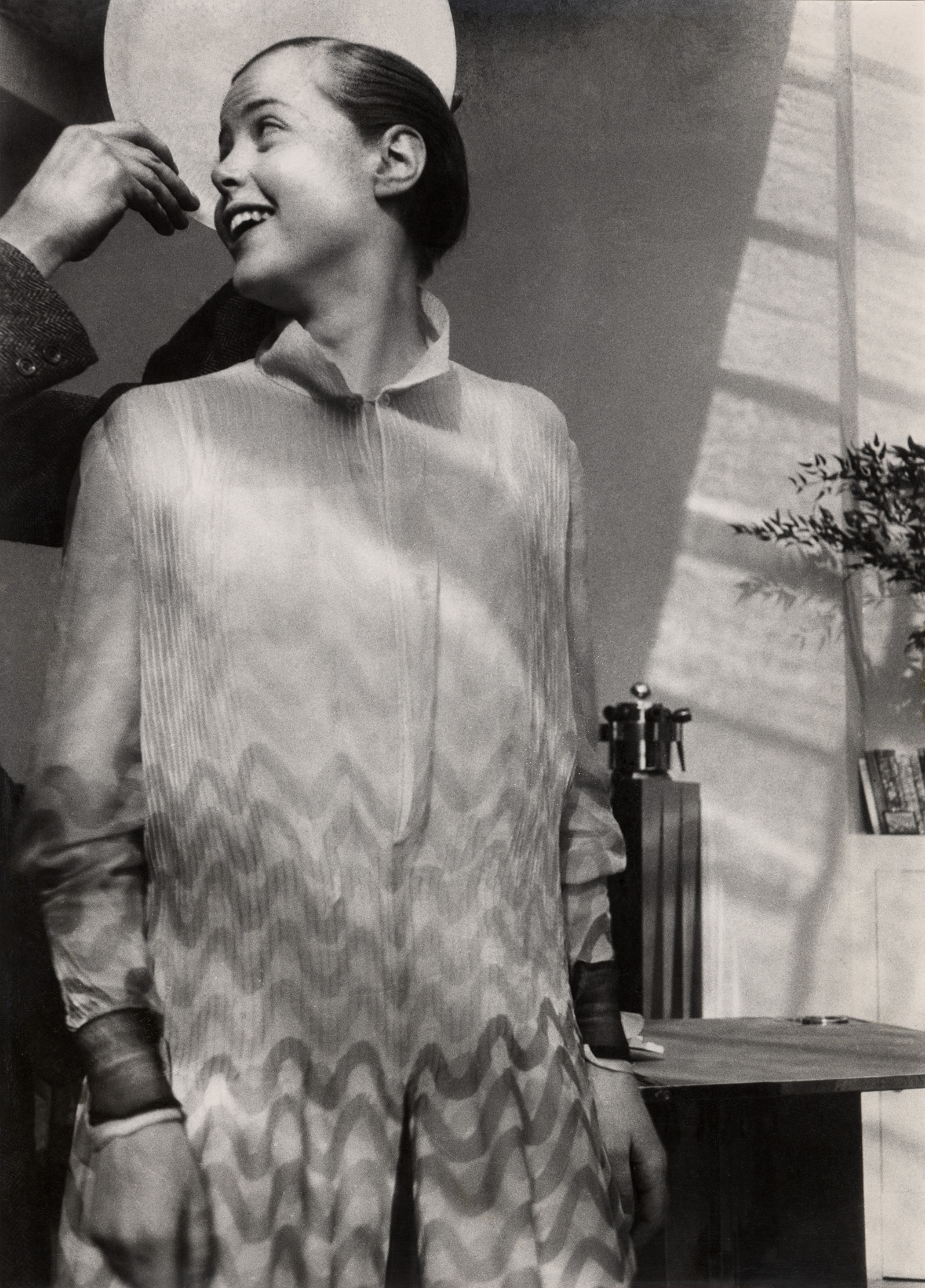
Charlotte Perriand with Le Corbusier’s hands holding a plate as a halo, 1928. Photograph: Pierre Jeanneret/AChP 2025
Before Perriand’s arrival in the ranks of his team, Le Corbusier had furnished his buildings with carefully selected prefabricated furniture, such as the simple bentwood chairs made by Thonet and the compact versions of club chairs by Maple & Co. of London. Still, in Today’s decorative art specified exactly what he expected from this area, identifying three essential types of furniture: necessities, furniture and human member objects, and defined the latter as extensions of our limbs adapted to human functions, which are specific needs and functions; therefore, as specific objects and furniture. In his words, the human member object is a docile servant. A good servant is discreet and humble to let his master free. Certainly, works of art are tools, beautiful tools.
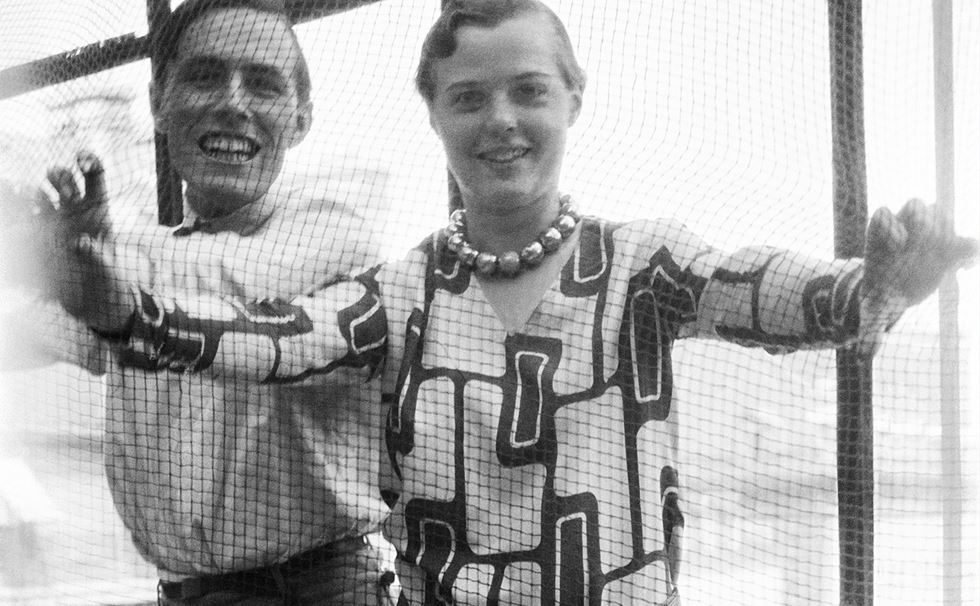
Perriand put his mentor’s principles into practice by designing three chairs with chrome-plated tubular steel bases for two of his 1928 projects: the Maison La Roche, a house in Paris, and a pavilion for his American clients Henry and Barbara Church, in the garden of their house on the outskirts of this city. At Le Corbusier’s request, he devised a chair for conversation, the B301 with a fabric backrest; another for relaxation, the LC2 Grand Confort, square in shape and upholstered with thick fabric; and a third for sleeping, the refined B306 chaise longue, designed from the sensual curves of 18th century French divans. Perriand would pose for publicity photos of that chaise longue with his legs crossed, in a very well-known image. He also wore a necklace made of industrial bearings.
Working with Le Corbusier led Perriand to adopt a strict discipline as a designer: Even the smallest pencil stroke in a design had to have a purpose -he later recalled- to satisfy a need, or respond to a gesture or posture. And be achieved at mass production prices. To this end, he tried to persuade the French firm Peugeot to adapt the steel tubes of its bicycles for the manufacture of furniture; when that company refused, he convinced the aforementioned Thonet, maker of Le Corbusier’s favorite bentwood chairs, to produce a series of pieces for the 1929 Paris Autumn Salon.
Displayed as Home equipmentits installation at that date consisted of a model apartment considered a vision of luxury modernity. The glass floor was lit from below to refract light onto the glass ceiling, all the chairs had metal bases with leather or canvas upholstery, and a tubular table with a top of the same glass was supported by a section of the struts of a biplane wing. Perriand also devised a series of lightweight, portable screens that served the dual function of dividing the space and serving as storage, and added homely details, such as an animal skin over the bed and a separate shower.
In 1930, Perriand’s marriage ended and she moved to another penthouse, in Montparnasse. During this decade, he designed furniture and accessories for various Le Corbusier projects, including the Pavilion Suisse student residence at the Cité Universitaire, the Salvation Army headquarters in Paris, and his own apartment in the attic of a building on rue Nungesser-et-Coli.
His work continued to evolve and, in his mid-thirties, he experimented with rustic materials, such as wood and wicker, under the influence of Savoy vernacular furniture. By then, these materials seemed as extravagant and radical as her early penchant for glass and metal, but she was convinced that they would allow her to achieve her goal of developing affordable, functional and attractive furniture, mass-produced for the public.
It was in 1937 when he left Le Corbusier’s studio to collaborate with Léger on a stand for the Paris World’s Fair and, later, to work at a ski resort in Savoy itself. At the outbreak of World War II, she returned to Paris to design prefabricated aluminum buildings with Pierre Jeanneret and Jean Prouvé until, in 1940, a friend from the rue de Sèvres studio arranged a trip for her to Japan as an industrial design consultant to the Ministry of Commerce and Industry. During his stay in that country, he advised the government on how to raise design standards in Japanese industry to develop products for export to the West.
When Japan joined the war as an ally of Germany, she attempted to return to France, but due to the naval blockade, she was trapped in Vietnam from 1942 to 1946. During that period, she studied local carpentry and weaving techniques.
Upon his return to France, he resumed his career. His first project was a ski resort, in 1947 he collaborated with Fernand Léger on a hospital and later with Le Corbusier on his Unité d’Habitation apartment building in Marseille. The experiences in Japan and Vietnam continued to influence his work, which combined many of the functional elements of Japanese interiors, such as sliding screens to redefine specific spaces, with Indochinese delicacy in working with natural materials, such as wood and bamboo. These notes were repeated throughout his career, in initiatives such as the Méribel ski resort and the League of Nations building in Geneva, the remodeling of the Air France offices in London, Paris and Tokyo or his continued collaboration with Prouvé.
Although Perriand remained active, her presence as an independent designer was less publicly than her participation in Le Corbusier’s studio. However, towards the end of his life, his reputation resurfaced following his 1985 retrospective at the Musée des Arts-Décoratifs in Paris and his 1998 exhibition at the Design Museum in London. The most important thing is to understand that what drives the modern movement is a spirit of investigation, a process of analysis, not a style.he stated in one of his last interviews. We worked with ideals.
The Fundació Miró exhibition will emphasize his relationship with Josep Lluís Sert: they met in 1928 and their friendship and intellectual conversation lasted until his death in 1983. During the Civil War and the beginning of the Second World War, Perriand hosted the architect and his wife Moncha Longás in Paris and, almost thirty years later, attended the inauguration of the Fundació Joan Miró in 1976.
This anthology will feature unpublished content, will refer to his connections with various international artists and, above all, to his conception of design as a tool to imagine a kinder future.
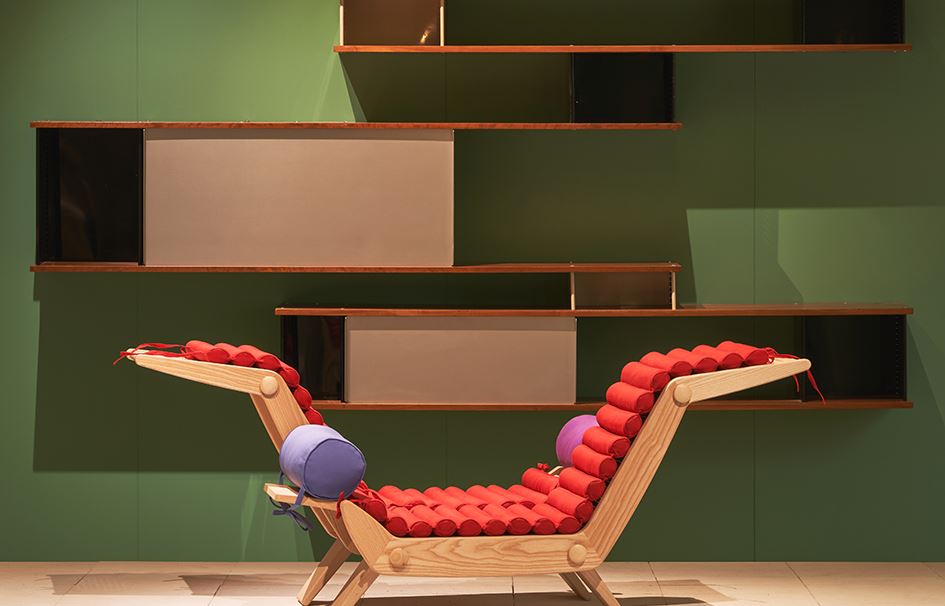
Charlotte Perriand. Double chaise longue1952. Cassina