Bruges (Belgium). A widescreen video of Peter Frankopan welcomes visitors to BRUSK’s inaugural exhibition. The two feet in the center of the map, drawn around 1150, by the Arab geographer Muhammad al-Idrissi, the professor at the University of Oxford and commissioner, invites us to change perspective. And to no longer make Europe the center of the world as imagined in Bruges and on the continent in the Middle Ages. A crossroads of arts and commerce, the Flemish metropolis was at the time at the center of a first form of globalization which resulted in reciprocal exchanges with the countries of the North, with Asia and with the Mediterranean world. World city, Bruges saw the circulation of people, goods, religious convictions, ideas with other cultures and other belief systems.
A scenography designed to break down barriers between worlds
“Broad Vision” explores these relationships through 250 objects and works of art, from Bruges collections and more than 90 international lenders which invite us to see how the city looked at the rest of the world and how it was looked at in return. It should be noted that if one of the stated ambitions is to move away from a Eurocentric vision of the planisphere, all of the scientific experts who collaborated with the British historian come exclusively from European universities. The scenography reflects this interconnectivity through the absence of compartmentalization, of geographical and chronological hierarchy between the different worlds evoked and the objects and works proposed. It also takes advantage of the monumentality of the space and its ceiling height to offer specific zones simply demarcated by vertical strips of fabric which allow fluid access as much as they attract attention and offer the visitor complete freedom of wandering.
Jan Provoost (1465-1529), Crucifixioncirca 1501-1505, oil on wood, 116 x 171 cm, Musea Brugge.
© Hugo Maertens
Thanks to the canals and the Zwin estuary, Bruges was able to have access by sea to England, Scandinavia and the northern countries, favoring commercial relations, but also knowledge, with for example, the splendid Liber Floridusthe “medieval Wikipedia” collected by Lambert de Saint-Omer. The same goes for the circulation of relics, sometimes taken away by political exiles such as the supposed cloak of Saint Bridget brought back to Bruges by Gunhild of Wessex who found refuge there after the Battle of Hastings.
The pilgrimages of the Flemish counts to the East and the Holy Sepulcher as well as the close relationships between Robert I of Flanders and Emperor Alexios I Comnenus of Constantinople forged strong links between Flanders and the heart of the Christian world. With its countless churches, monasteries and convents, the city which attracts many pilgrims becomes a crossroads as much spiritual as commercial. The Crusades – where the counts of Flanders played a major role – opened the doors to an unknown world and to Jerusalem which is represented in detail in The Passion of Christ by Hans Memling or in a Crucifixion by Jean Provoost (see ill.) probably inspired by the painter’s observations during a pilgrimage.
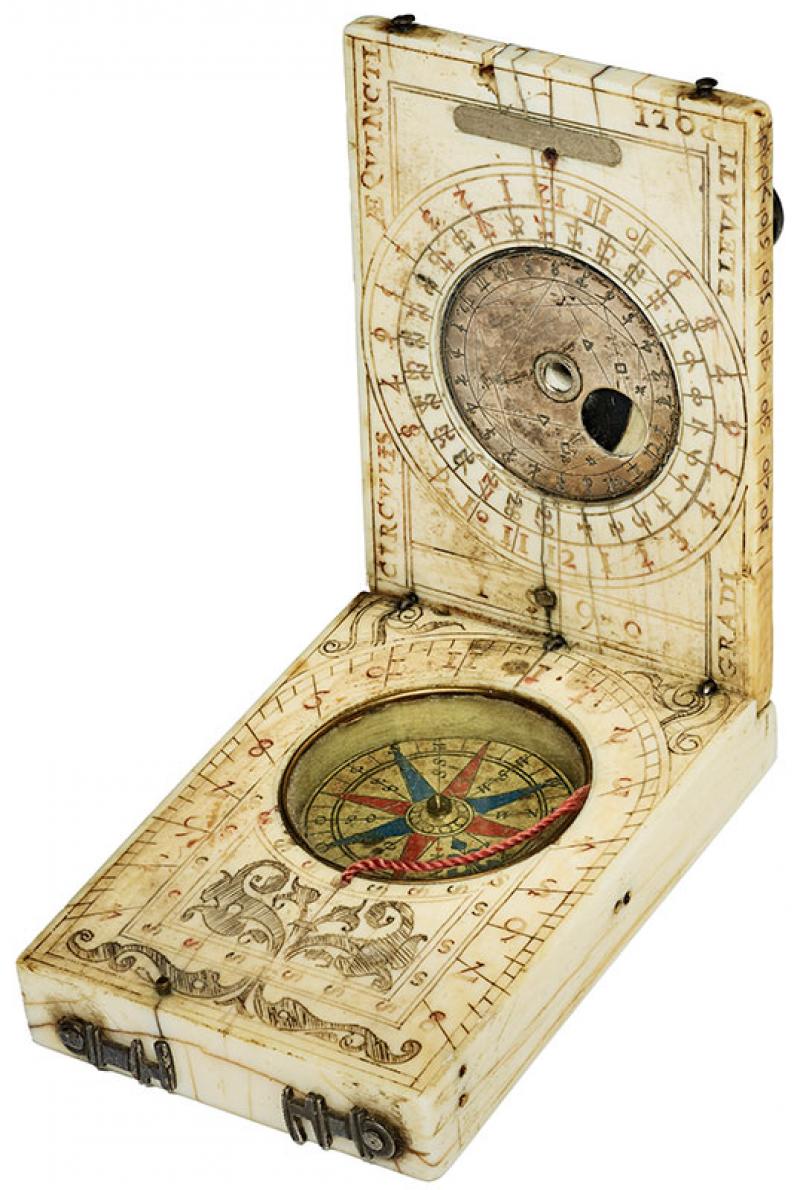
Sundial with compass, circa 1570, ivory and silver, 7 x 5 x 2 cm, Antwerp.
© The Phoebus Foundation
Between the 14th and 16th centuries, the Bruges elite was part of a network of exchanges between the reigning powers in which the Burgundians and the Ottomans played a major role. THE soft power passed through the art and portraits of sovereigns and their court as shown in the section “The world of the court”. Curiosity is also appropriate on the Islamic side where we see in The Book of Kingsproduced in the middle of the 15th century in Shiraz, the meeting of East and West in the opening double page which depicts Solomon and the Queen of Sheba, like an ideal couple.
The Mediterranean offers Bruges a gateway to Africa and the Islamic world, multiplying mutual influences. From the pigments used in the oil painting of Jan van Eyck to manuscripts and goldsmith objects like this precious box made in Egypt, which in France has become a reliquary decorated with precious stones.
At the end of the 15th century, the discovery of the Americas would conveniently open other maritime routes to compensate for the loss of Constantinople. Bruges benefits from expansion towards Madeira and the Azores to become an important sugar distribution center. A sundial with a compass in ivory and silver (see ill.), or a superb astrolabe with a toothed calendar, made by Muhammad Ibn Abi Bakr in Isfahan in the 13th century, tells of this call from the open sea.
The last piece of the Bruges puzzle
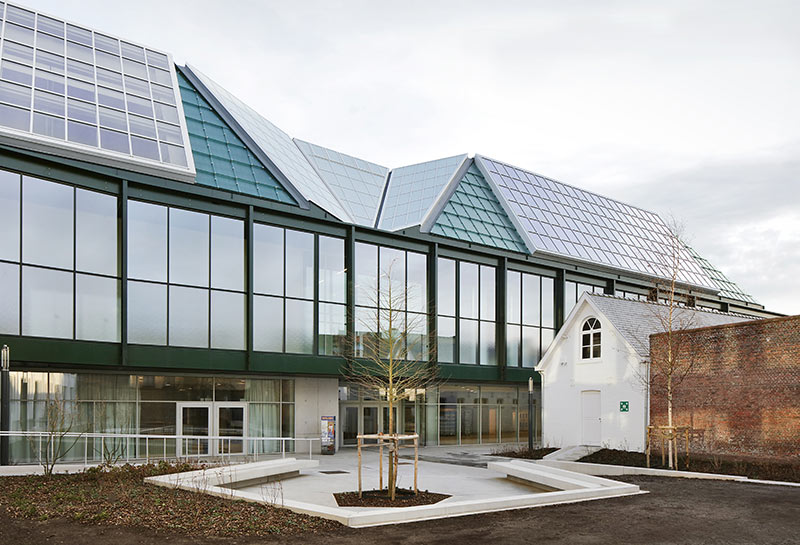
Cultural place. The creation of BRUSK is the culmination of a desire that has long tickled Musea Brugge, the platform for Bruges museums. Although the city brings together a common collection and more than twenty museums with a specific identity, it did not have a suitable place to present temporary exhibitions, reinforcing the storytelling of the city. The construction of a new space also made it possible to present specifications to architects to exhibit sometimes expensive works in the best conditions. Chosen after a competition, the architectural offices Robbrecht and Daem from Ghent and Olivier Salens from Bruges responded with a building that was both monumental and discreet, well in the spirit of the times: more than an exhibition hall, it is intended to be a place that invites dialogue and meeting. Located upstairs, the two rooms, measuring 800 and 1,600 m² respectively, offer a continuous space with sloping roofs and a height of 13.5 m at the highest point. The ground floor, largely glazed and open on both sides, is intended to be an urban square, free of access, with its bar and shop. The walls bordering the stairs are decorated with a large dreamlike fresco in four parts, The Whispering Walls Dream, made by Laure Prouvost by combining the traditional technique of strappo and direct painting on a support of lime and marble powder. From 2027 to 2031, BRUSK will host in one of its rooms, the major pieces of the Groeninge Museum then closed for renovation.