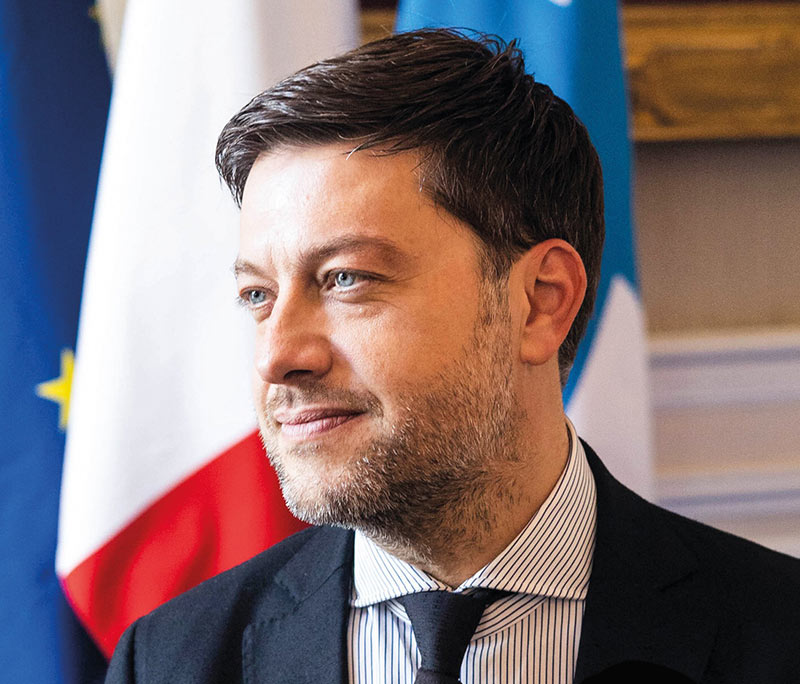
A notary clerk by profession, Benoît Payan joined the Socialist Party (PS) during his student years, climbing the ranks until becoming mayor of Marseille in 2020 and then being re-elected in 2026.
Does this victory in the last municipal elections, fought hard for the National Rally (RN), change anything in your way of governing culture?
This result gives me more energy, not less. I keep cultural policy in personal delegation for a simple reason, that of affirming that culture is not an accessory good.
Precisely, thirteen years after “Marseille-Provence, European Capital of Culture” in 2013, which did not really benefit working-class neighborhoods, can culture save Marseille?
It’s true, we missed out on 2013, which should have been an incredible explosion. Despite everything, today we welcome 5 million tourists and our museums are always full when all the other cities are plummeting. Nobody seems to see it because Marseille is talked about through its folklore. As soon as a debate begins, we talk about Kalashnikovs, OM and accent. And when we talk about culture, we talk about rap and we stop there.
How do we go beyond this folklore and bring a child from working-class neighborhoods into a fine arts museum?
It’s true that going to see Frans Snyders (1579-1657) or Nicolas Poussin (1594-1665) is not easy. So every summer we do culture outside the walls, in the neighborhoods. This takes on multiple dimensions such as projections on facades, copies of works, art history but also drawing, pottery and music workshops. Demand is very strong. This is also the reason for the free permanent collections in our municipal museums. And not just for schoolchildren but for everyone, Marseillais and tourists included.
But don’t these summer activities mask a structural lack when you had promised one library per district? Because six of them still don’t have one. Where are we?
You don’t build a library like you build a veranda! And during the previous mandate, we accumulated obstacles: Covid, business bankruptcies, inflation in construction costs, not to mention an extraordinary geopolitical reality. Despite everything, next year we will deliver one of the most beautiful libraries in the south of France, in the 3rd arrondissement, the poorest in Marseille.
Artistic and cultural associations complain about annualized funding, without the implementation of multi-year agreements like in Bordeaux or Lyon. What’s stopping you from taking the plunge?
We are not able to do this financially! But let’s look at reality. The Metropolis, the Department, the Region and the State have all reduced their funding while the City of Marseille is the last to maintain its funding. It is their right and even their primary function for artistic associations to criticize their funders, but let us remember that the 2025 culture budget is around 111 million euros, an amount up 25.5% compared to 2024.
Is this tenable in a context of budget cuts such as the 5 billion savings requested by the State from communities?
Marseille is probably the only large city in France which, in a difficult financial situation, is constantly increasing its cultural budget. I do not spend on prestige in order to preserve what matters, notably a culture that is an engine of emancipation. A society without culture and artists “becomes barbarized”. And to seek additional funding, I am now turning to patronage; it’s not very well seen in the cultural world, but you have to choose your renunciations.
Patronage, what exactly is it for?
We have major projects like the “Centre Bourse”, the Gèze Arena, the renovation of the Carli Palace or that of the Marseille Opera. For the latter, we already have patrons, who however do not wish to reveal themselves for the moment. What I can say is that they have understood that the Opera will not be called the “Panzani Opera”. No naming commercial. It will simply be the “Marseille Opera”.
Marseille Opera.
Precisely, the regional chamber of accounts pointed out serious governance problems for the opera in 2023. You then mentioned the idea of asking for the “National Opera in the region” label, which would not necessarily have allowed a change in governance…
Governance will necessarily change because the status of the opera will change. I had in fact thought of the “National Opera” label, but, after examination, it does not offer many more advantages. I want to make it a metropolitan opera because the Metropolis is an investment tool that ensures financing over the next thirty years.
It is therefore also a sign of reconciliation with the Metropolis…
The time has come for appeasement, to say the least! And if the “National Opera” label has been abandoned, it is also because the Métropole is now entering the game. It will allow us, with patronage, to completely renovate the opera. It could be the first equipment that Marseille transfers to the Metropolis, a strong signal of institutional normalization after years of tensions.
So is the “Centre Bourse” one of the major projects of your mandate?
Among others. It is a place where there will be culture, science, leisure, an auditorium and a “children’s philharmonic” where they will discover the clarinet, the saxophone, the cello.… But in the end, talking about structures is much less important than talking about culture…
But equipment is important!
Of course, but what we need above all is to rediscover a living link with the works, the ideas and the authors.
How do we achieve this?
By fighting for works of art to come to Marseille, by teaching children to look at them. My ambition is that a kid living in the 3rd arrondissement and who doesn’t yet speak French well starts crying in front of a painting by Caravaggio, because talent is timeless. We are therefore preparing an exhibition around the painter Louis Finson (1580-1617) and Caravaggio which will be presented at the Museum of Fine Arts at the end of 2027.
You have to go see the artists, read them. Understand what they want to tell us. In his book THE Shore of Sirtes (1951), the writer Julien Gracq shows how men start a war out of boredom, out of stupidity, out of a feeling of omnipotence. This is what we are experiencing today…