Troyes (Aube). Is it a journey to the end of the night or an expedition to the center of the Earth? Upon entering the exhibition that the Museum of Modern Art in Troyes is devoting to a Celtic figure, the Prince of Lavau, ten years after the discovery of his tomb by teams from Inrap (National Institute for Preventive Archaeological Research), the visitor is plunged into darkness. At its feet, a video projection traces the history of the successive occupations of the necropolis site, from the Bronze Age to the present day. Around it, photographs of the construction site tell the story of this exceptional discovery. They show the most beautiful archaeological discovery in France since the beginning of the century, that of the tomb of this prince buried around 450 BC. AD in Lavau.
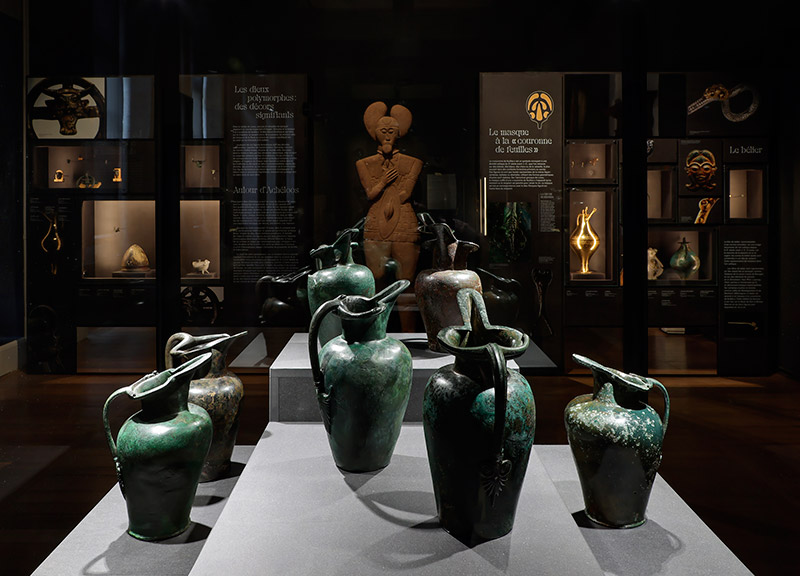
During a construction site for the construction of a commercial zone, archaeologists exhumed a monumental burial chamber, in which his skeleton rested, on a two-wheeled chariot, adorned with a torque and gold bracelets and accompanied by rich funerary furniture containing objects of extreme refinement, such as a bronze cauldron [voir ill.] decorated with the river god Acheloos or an Attic oenochoe (vase) enhanced with gold and silver. One of the feats of this exhibition is to resurrect this prince, while reporting on the work of the scientists who analyzed and restored these objects as well as the remains to write a new page in the history of the Celtic elites.
God Acheloos cauldron treasure Lavau.
© Denis Gliksman /Inrap
From Lavau to Vix
Archeology lovers will not fail to be transported by this exhibition which is as beautiful as it is captivating. Newbies will be just as interested. An educational introduction immerses the visitor in the excavation of the tomb and the research that followed, through videos, maps or an exhibition of tools. After a historical context and a presentation of the first transalpine exchanges and the funerary sites of the Petite Seine – in particular the tomb of the Princess of Vix, one of the richest princely tombs in the Celtic area, discovered in 1953 about sixty kilometers away, in Côte-d’Or – visitors are ready to meet the Prince of Lavau.
Thanks to facial reconstruction techniques, his face was able to be restored: a healthy, dark-haired man with dark skin, who died at the age of around 30. A drawing presents his funeral clothing with precision and sensitivity: gold torque and bracelets, helmet in fine basketry and leather decorated with gold and coral, leather belt embroidered with silver threads on which a ceremonial knife was attached, clothing held by a fibula decorated with coral.
In a room with black walls, these ornaments are displayed on a yellow background, while objects from other sites are presented on a dark background, accompanied by clear texts and enlargements of details. The gold torque thus dialogues with that of Vix, with all the more effectiveness as the bracelets found in Lavau could be those that the princess was missing: the prince would perhaps have come from a princely family of Vix, before founding his own territory downstream on the Seine.
Sober and effective, these dialogues allow for illuminating comparisons, which not only instruct but also beguile the eye. Thus, the ceremonial knife, a symbolic tool for sharing the meat of this funerary banquet, becomes more intelligible in comparison with other similar objects whose sheath decorations appear with more clarity, and the fragmentary remains of the Lavau chariot, presented on a drawing in the background, light up in contact with those of the Bouranton chariot, better preserved.
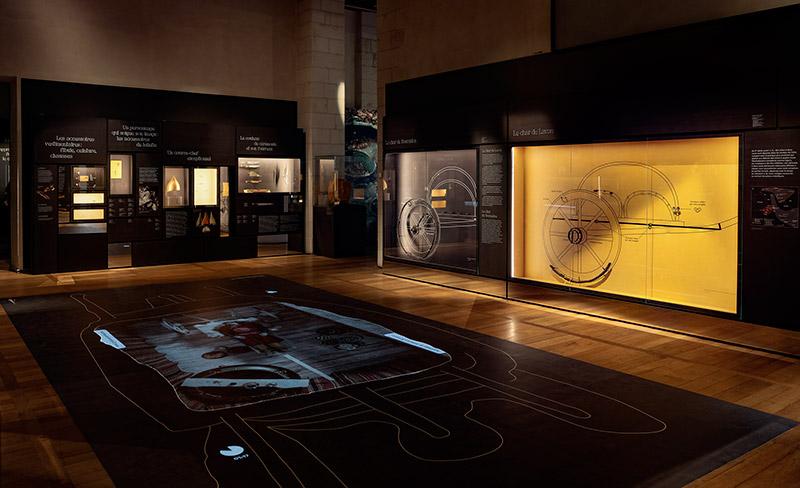
View of the exhibition “Lavau. A Celtic prince on the banks of the Seine” at the Troyes Museum of Modern Art.
© Caroll Bell / City of Troyes
Parts of the funeral banquet
The basing of objects plays an essential role here in giving meaning to the remains. It is thanks to him that the cauldron decorated with figures of Acheloos, one of the most beautiful pieces of this funerary banquet, regained its imposing form: unlike that of Vix, it has only undergone minimal restoration, in order to allow future research. After ten years of analyzes at the C2RMF (Centre for Research and Restoration of Museums of France), researchers found residues of red wine flavored with honey, probably imported from Marseille, and established that it was placed on a tripod topped with a wooden board where dishes had been placed. This is displayed around the cauldron in the window, facing a proposed 3D restitution of the deposit. Only the sublime oenochoe is exhibited in a dedicated window, interacting with other vases decorated by the same painter – the opportunity to appreciate its delicacy but also that of the gold and silver ornaments which were added to it by the Celts to make it an object of great luxury.
The route ends in a room designed by archaeologist Bastien Dubuis, director of the excavation of the Lavau site, who wrote a thesis on this tomb. This exceptional ensemble in fact rewrites the history of the Celtic elites of the First Iron Age, integrated into a vast network of exchanges linking Champagne to the Mediterranean. Was this artistocrat buried with objects of such refinement a prince or a king who would have exercised his authority over a territory corresponding to the region of Troyes? Research continues, and the exhibition, accompanied by an excellent, richly illustrated catalog, offers a precious snapshot of a science in progress, where each object continues to reveal its secrets.