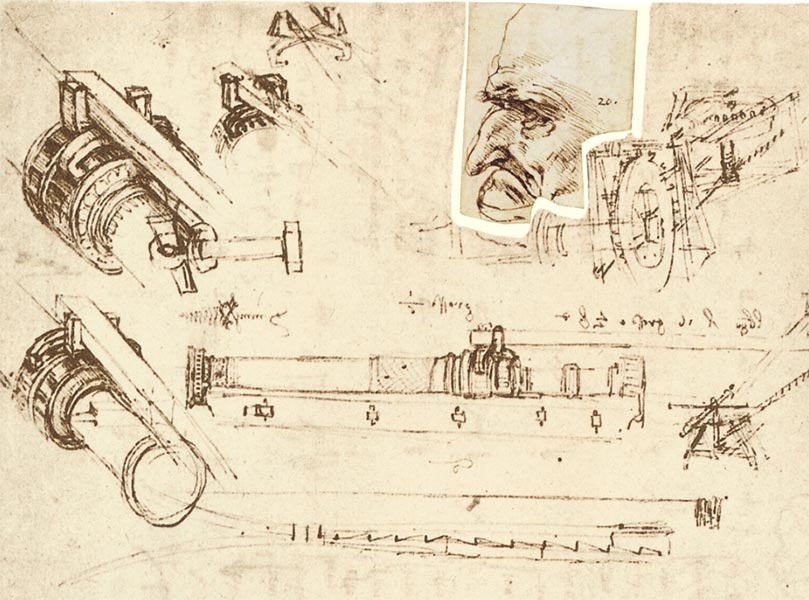
A set of facsimiles of drawings by Leonardo da Vinci has joined the Leonardotheka on June 8, enriching the digital library with an exceptional collection of more than 500 pages. This gives free access to the largest manuscript collection by the Florentine master reconstructed to date. The project, led by the Galileo Museum in Florence in collaboration with the Pinacoteca Ambrosiana in Milan, the Leonardina da Vinci Library, and the Royal Collection of Windsor, marks the culmination of ten years of work.
Since 2023, the platform has made it possible to browse the Codex Atlanticusa monumental work containing more than a thousand pages of notes, sketches and drawings by Leonardo da Vinci, made between 1478 and 1519. Assembled and bound almost a century after the death of its author by the sculptor Pompeo Leoni, it documents a wide variety of work which reflects the career of Leonardo, an engineer, architect and scientist. The first phase of the Leonardotheka project was devoted to the digitization of these plates kept at the Ambrosian Library since the 17th century, with the aim of making them accessible to as many people as possible.
Today, the optimized version of the platform gives a whole new scale to this project. Thanks to the participation of the Royal Collection of Windsor, it is no longer a question of a simple digitization of archives, but of the reconstitution of an ensemble dismembered several centuries ago. When he composed the Codex AtlanticusPompeo Leoni created another album from Leonardo’s pages, rich in around 500 documents of a more artistic nature, bringing together figurative drawings and landscapes. After passing through Spain during the residence of Pompeo Leoni in Madrid, sculptor at the court of Philip II, the codex was acquired by the Count of Arundel, a great collector of drawings. The latter brought it to England, where it joined the royal collections around 1680.
Having passed into the hands of Francesco Melzi, student and heir of the Renaissance master, then into those of his son Orazio Melzi, who ceded part of them, Leonardo’s notebooks reached Pompeo Leoni already fragmented. The Milanese sculptor made themed albums, which became the Codex Atlanticus and that of the Windsor collection.
For the first time in four centuries, the volumes from England and Italy are brought together. They reflect a polymath Leonardo da Vinci, recreating the broken link between the artistic and scientific dimensions of his work. Leonardotheka 2.0 is specifically focused on rereading the two sets as a whole, allowing visitors to carry out cross-research between the archives of the two institutions. Around fifty recompositions of fragments from the original work, developed by associated researchers, are available online. They recreate a working method that combines observation of the environment and scientific research.
The project is an example of the use of digital technology to bring together a heritage dispersed in particular historical conditions. For Fabio Cassese, Italian Ambassador to the United Kingdom, the initiative shows that “Leonardo belongs not only to Italy, but to the cultural and scientific heritage of all humanity”. In a context where interstate discussions linked to the decentralization of national heritage are frequent, these remarks, reported by Fine artunderline the role of digitalization in this type of dialogue. The researcher in historical, social and cultural anthropology Marion Bertin, specifies Arts Journal : “Such projects facilitate knowledge and digital access to works and objects, but they cannot claim a true denationalization of collections. They do not question material property”. The doctor adds that such projects raise another question, “that of digital data sovereignty”while specifying that in practice, accessibility to these platforms is “extremely limited, as they require very good internet connections and computer viewing”.
If the Leonardotheka brings together a unique ensemble, it remains incomplete. Many of the Renaissance master’s Codexes appear in European collections. The National Library of Spain currently preserves two Codex Madridlinked to the passage of Pompeo Leoni at the court of King Philip II. In London, the Victoria & Albert Museum has some of the Codex Forster in its collections and the British Library holds the Codex ArundelEdit. The Institut de France still preserves the “Paris Manuscripts”, small notebooks by Leonardo seized during the Napoleonic campaigns. The only copy present in a private collection, the Codex Leicester is owned by billionaire Bill Gates.