Belgium. In Brussels, museums attracted some 4,963,000 people in 2025, a figure slightly lower than that of 2024, a record year with 5,056,000 visitors. This is indicated by the Brussels Museums federation, which counts more than 125 Brussels museums. If the first half of 2025 resulted in a total drop of 5% in attendance compared to 2024, the summer saw a return of the public with an increase of 11% and the autumn confirmed the trend, with an increase of 18% in September and October, in particular thanks to “Museum Night Fever”, a nighttime event which aims to renew and increase attendance at museums through festive and cultural events aimed at younger audiences.
The drop in attendance was more marked in the center of Brussels and in the majority of major museums (AfricaMuseum, Comics Museum, Museum of the City of Brussels, Museum of Musical Instruments, Royal Museums of Fine Arts, Institute of Natural Sciences, etc.)
Bozar, which highlights a multidisciplinary orientation and the decompartmentalization of disciplines, attracted 749,518 visitors over a total of 820 events, an increase of 20% compared to 2024. The exhibitions were visited by 372,490 people, including 90,000 for “When We See Us”.
At the Royal Museums, new route and reopening of a planned wing
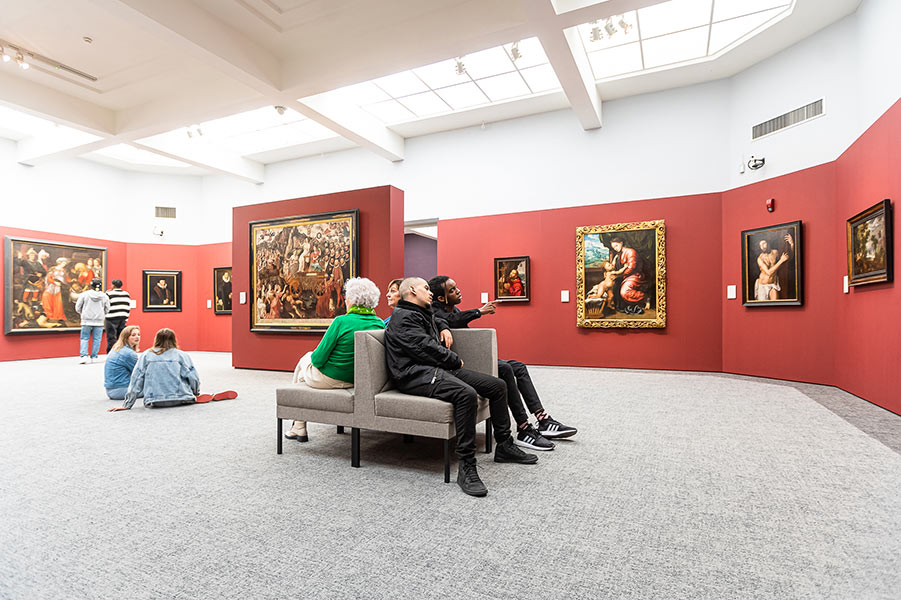
Nearly 600,000 visitors pushed through the doors of the Royal Museums of Fine Arts, on its three open sites, namely the Magritte Museum, the Old Masters Museum and the Constantin-Meunier Museum. A slight drop compared to the overall attendance in 2024 which can be explained in particular by the closure of the Wiertz Museum and the absence of temporary exhibitions likely to attract a wider audience. Reduced accessibility, following the long works carried out in the museum district, may also have deterred some. The year 2026 should mark a transition before two major projects for the years that follow: the inauguration in spring 2027 of a brand new route which will continue through the collections from the 15th to the 21st century. 2030 will see the reopening of a wing of the museum closed until that date to the public for renovation.
Brussels Museums also highlights the success of the exhibitions on Art Deco and Art Nouveau, a success amplified thanks to the Art Nouveau Pass. For 2026, the foundation is concerned about the consequences of the prolonged absence of a Brussels government, which delays the programming of temporary exhibitions with a direct impact on attendance.
In Antwerp, the Royal Museum of Fine Arts (KMSKA) is looking forward to a record year with 570,000 visitors, which corresponds to 35,000 more people than in 2023, the year of reopening. It was especially Hans Op de Beeck’s “Nocturnal Journey” which attracted crowds (250,000 visitors from March 22 to August 17), becoming the most visited exhibition of a contemporary artist in Belgium. “Donas, Archipenko & La Section d’Or”, focusing on interwar art, attracted 160,000 people.
In Bruges, despite the absence of a major exhibition this year, all of the city’s museums experienced slight growth of 0.8%. On the heritage side, it is the belfry and the Notre-Dame church, with its sculpture by Michelangelo, which were popular, especially by foreign visitors (+ 1.3%). The most visited museum was the Groeninge Museum. The strongest growth is to be found at the Folklore Museum, whose complete renovation resulted in a 23% jump in public attendance.
No less than 70% of visitors to Bruges museums come from abroad, especially from neighboring countries, France in first place (160,000), followed by the Netherlands (80,000) and Germany (70,000). Finally, among non-European visitors we see a growth of 6% for Americans (74,000) and 30% for Japanese (7,000).