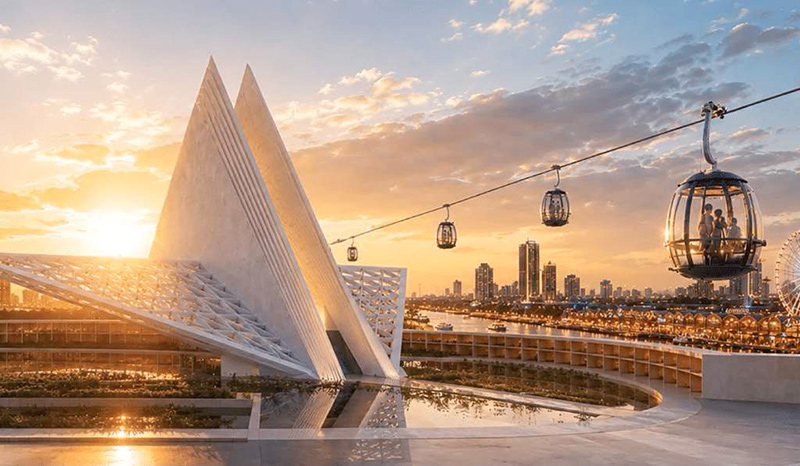
On the theme of light, echoing the city’s nightlife, the new branch of the Museum of Ancient and New Art (MONA) located in Australia is due to open in 2029 on the banks of the Chao Phraya River in Bangkok. The project, led by the company DarkLab, brings together the Australian private museum and the Thai real estate group Asset World Corp Public Company Limited (AWC).
With this new location, MONA, located in Hobart in Tasmania, is inaugurating its first space abroad. AWC also plans to build a cable car to transport visitors across the river to Asiatique The Riverfront shopping center, where the museum will be located. It will host works from the collection of David Walsh, exhibited at the Australian MONA, which will also be responsible for curating the exhibitions. AWC will have to supervise its construction as owner of the museum, and the project management is entrusted to the Australian agency Six Degrees Architects.
As Leigh Carmichael, creative director of MONA and DarkLab, suggested when describing a building “unconventional and unique”the branch will retain the atypical identity of the Tasmanian parent foundation, while adapting it to the Thai cultural and historical context. The cable car, designed as a work of kinetic art, will give visitors a taste of the original museum experience they will discover at MONA Bangkok. AWC President Wallapa Traisorat introduced him as “a world-class cultural venue that inspires creativity and promotes the emergence of dynamic artistic communities”.
With more than 5 million visitors since its opening in 2011 and a cumulative loss of more than 400 million Australian dollars (€245 million) – financed by David Walsh’s own funds – the MONA in Hobart is like its founder: whimsical, with a taste for risk. A multimillionaire professional bettor gifted in mathematics and banned from several casinos in his country, David Walsh has made this institution his “playground and (its) megaphone”. In 2011, he opened MONA on the Moorilla wine estate, acquired by David Walsh in the 1990s, to exhibit a collection of more than 3,000 works of ancient and contemporary art. Designed as an “anti-museum”, it brings together Egyptian sarcophagi and installations by James Turrell, which visitors discover through a display unfolding via a spiral staircase which descends into the meanders of its underground galleries.
The permanent collection attracts with its provocative pieces, including the Cloaca Professional by the Belgian artist Wim Delvoye. The installation, made up of suspended machines that digest food and transform it into excrement, takes scatology to the extreme. As for Stephen Shanabrook’s sculpture, On the road to heaven the highway to hellit shows the mutilated body of a suicide bomber, cast in chocolate. There is also a photo of a “flower” made up of tinted rabbit ears, cow eyelashes and baby mouse heads, signed by German artist Heide Hatry. A selection not so surprising for those who consult the museum website beforehand, where the works are listed in self-deprecating categories, going against the grain of convention – “has its own digestive system”, “questionable moral genesis”, “allows curators to imagine for a moment that they are working for a real museum”.
A curatorial practice that defies norms, to the point of being sanctioned by the courts. In 2024, a visitor filed a complaint against the museum for discrimination, targeting a work by Kirsha Kaechele, American artist and wife of David Walsh. Installation Ladies Lounge prohibited access to men, in order to replay on the male gender the old legislation which prevented women from entering Australian pubs, active until 1965. The conviction was, however, lifted on appeal.
The new MONA takes part in the process of opening Bangkok to the contemporary scene. In 2025, it inaugurated its first international contemporary art museum, the Dib Bangkok, and this year the New York gallery owner Harper Levine opened a space in the Thai capital. The MONA will join the Pier Museum, also opening in 2025 on the banks of the Chao Phraya.