Washington, D.c. “We hold these truths to be self-evident: all men are created equal; they are endowed by their Creator with certain inalienable rights; among these are life, liberty and the pursuit of happiness. » Life, liberty and the pursuit of happiness… For some two hundred and fifty years, these few words have inspired America in the construction of this democratic dream outlined by the Founding Fathers in the Declaration of Independence, the adoption of which, on July 4, 1776, marked the birth of the nation.
In 2026, when the muffled sounds of fireworks resounded across the four corners of the country – which had been announced as historic as the date they were celebrating, accompanied here and there by the “O say can you see…” of the national anthem and the tsoin-tsoin of neighborhood brass bands, the United States seemed more united by the stars of their flag than by a common vision of their history and the state of their democracy.
“America is not the sum of its mistakes”
For months, the 47th President of the United States, Donald Trump, has intended to give the holiday patriotic accents in the service of an idealized, or even, according to his critics, simplified, vision of America, articulated around the major themes of his Maga movement (Make America Great Again): American exceptionalism, the defense of a cultural identity and the rejection of a liberal rewriting (from the left, editor’s note) of History and progressivism, assimilated to ” communism.”
“As for those who peddle Marxist lies about our heritage, who tell our children that we live on a stolen land or that our heroes were oppressors, they are doing far worse than slandering our past: they are slandering and attacking our future. We won’t let them! “, thundered Mr. Trump in a major speech at Mount Rushmore on July 3, on the eve of the celebrations. Under the giant effigies of his great predecessors George Washington, Thomas Jefferson, Abraham Lincoln and Theodore Roosevelt, carved from the granite of South Dakota, the American president insisted: “America is not the sum of its mistakes” and warned his fellow citizens: “We must love our country. »
If the great American fair organized by the Trump administration in Washington struggled to attract crowds during the first days, there is no need for a presidential injunction so that, from the East Coast to the West Coast, the festival takes over the country on this July 4 inscribed in the genes of the nation. Whatever the fractures that cross American society today, from coast to coast, thousands of parades, fireworks, block parts Improvised and traditional naturalization ceremonies brightened a weekend marked by an intense heat wave and violent storms.
In New York, fifty years after the Bicentennial festivities, thousands of visitors gathered on the quays to witness the return of the Italian sailing training ship Amerigo-Vespuccialready present in 1976 and guest of honor of the “Sail4th 250”. In all, more than forty large sailing ships from around twenty countries sailed up the Hudson, escorted by American and allied warships and flown over by more than 150 American and allied aircraft, including the Patrouille de France, which traced the colors of the American flag in the sky.
In Los Angeles, rapper Queen Latifah hosted the major America’s Block Party concert at the Memorial Coliseum, while in the Midwest the Celebrate 250 festival, organized at the foot of the Gateway Arch in Saint Louis, combined a show of 1,500 drones and one of the largest fireworks displays in the country over the Mississippi.
3D rendering of the Block Party at the Memorial Coliseum in Los Angeles.
© LA Coliseum
But behind the enthusiasm observed on a local scale, two hundred and fifty years after Thomas Jefferson and his peers, the tension which has run through American history since its origins, beyond current divisions, remained palpable. It is no longer so much the text of the Declaration that is debated, nor its authors, but rather the way in which it is intended to enlighten future generations.
250 objects that give substance to the promises of 1776
On board theUSS Kearsargea US Navy assault helicopter carrier, the former Marine and current Vice-President of the United States JD Vance thus chose to take up, in his July 4 speech, the founding promise of “life, liberty and the pursuit of happiness”, to invite Americans to celebrate “250 years demonstrating what a free people are capable of accomplishing”, and to defend and pass on a legacy.
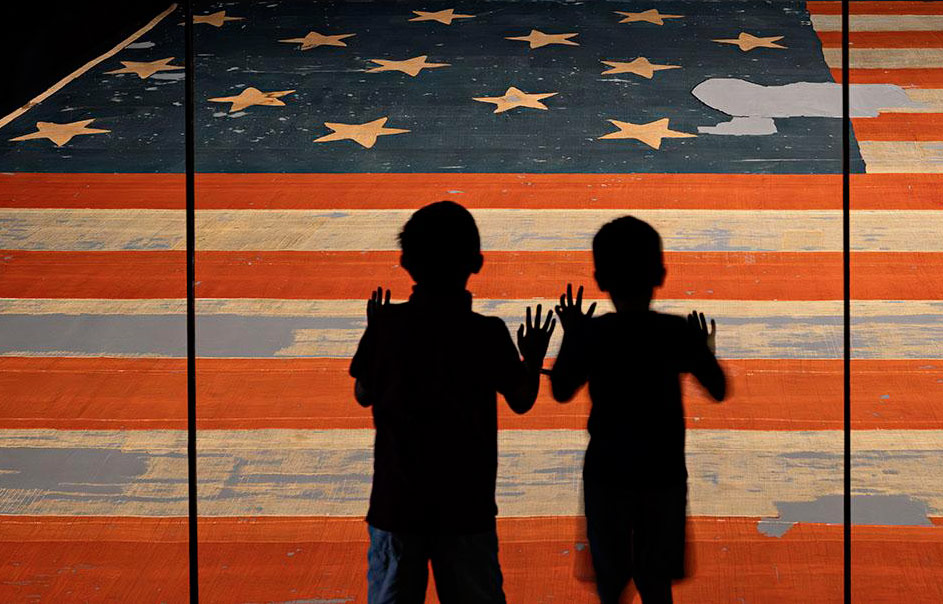
In Washington, the Smithsonian’s National Museum of American History uses the same words of Jefferson as a starting point for a completely different reflection. In the exhibition “In Pursuit of Life, Liberty and Happiness”, the museum retraces, through 250 objects, the way in which Americans have strived, for two and a half centuries, to give substance to these promises of 1776, “often against the odds or in the face of opposition, but always with the conviction that it was possible to achieve them”. Guided by the “actions and links” which unite the different American histories, the journey returns to a heritage, certainly, but also to a conquest that is still relevant today.
“This July 4th is yours, not mine. You can rejoice, I must cry,” said the former slave and abolitionist Frederick Douglass to his audience on July 5, 1852, in his famous speech “What to the Slave Is the Fourth of July?” » (“What is the 4th of July for the slave?”). After saluting the principles of the Declaration of Independence, he denounced the abyss which still separated these ideals from the reality of slavery. Since then, the 1776 promise has continued to be invoked by those demanding their place in the American narrative. Historian Heather Cox Richardson sees today in the text “a vision that Americans have constantly seized upon to demand their own inclusion.” “American democracy is never complete, she recalls. It is still a work in progress. »