
Paris. Neurologist and historian of science, author of numerous publications, Laura Bossi is also an exhibition curator. She collaborated with her husband, the art historian Jean Clair, and was general curator of the major exhibition “The Origins of the World. The invention of nature in the 19th century”, presented in 2021 at the Musée d’Orsay. In the company of Sylvie Carlier, director of collections at the Musée Marmottan, this time she addresses the original theme of sleep in Western art, in its multiple aspects – religious, mythological, literary, scientific, intimate, etc. Centered on the long 19th century, the route, combining paintings, sculptures, ceramics, works on paper and photographs, however stretches from the 5th century BCE to the present day.
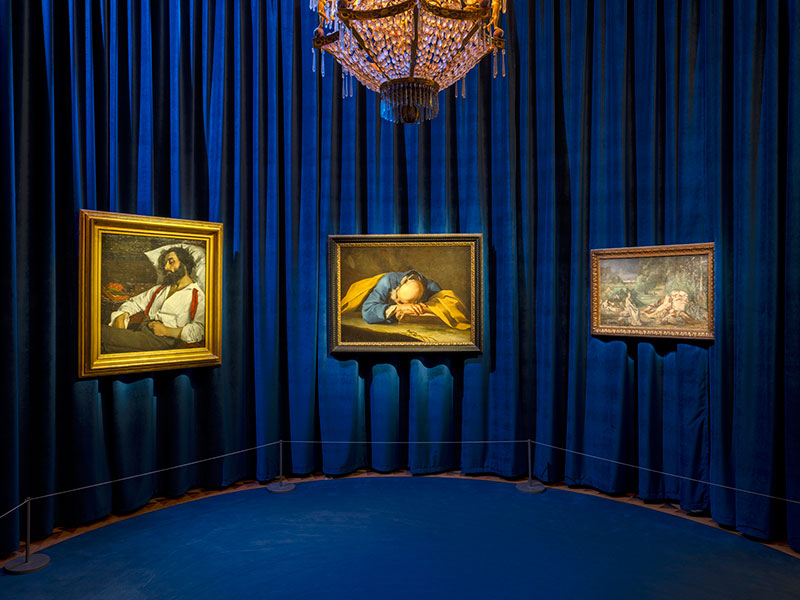
Resolutely classic, and therefore very different from what “The Time of a Dream” (2024-2025) was at the Musée des Confluences in Lyon, the exhibition with its elegant scenography goes off the beaten track in the choice of the 130 works presented. Thus, renouncing Courbet’s numerous sleeping women, the commissioners retained The Clairvoyant Or The Sleepwalker (around 1865) by the same painter. The ensemble evoking sleep in the Old and New Testaments is very successful, with its sculptures loaned by the Louvre and the Museum of Fine Arts of Lyon – Saint John sleeping (1500-1515), Three sleeping Apostles (14th century), The Dormition of the Virgin (2nd half of the 15th century) – but also the monumental painting The Resurrection of Jairus’ Daughter (1878, [voir ill.]) by Gabriel von Max from the Montreal Museum of Fine Arts and The Creation of Eve (1881-1882), by George Frederic Watts, on loan from the Watts Gallery in Compton (England).
View of the exhibition “The Empire of Sleep” at the Marmottan Monet Museum.
© Studio Christian Baraja SLB
European artists of the 19th century are particularly well represented with, in addition to Max and Watts, the Danes Ditlev Blunck and Michael Ancher, the Norwegian Edvard Munch, the Swiss Ferdinand Hodler, the English Evelyn De Morgan, the Scot John Faed, the Spaniard Joaquín Sorolla, the Italian Gaetano Previati and the Czechoslovak Maximilián Pirner. A nice place is given to the prints of the German symbolist Max Klinger.
Some riddles
Sixty-seven lenders, collectors, galleries and museums responded, like the National Gallery of Ireland which entrusted Sleep (1790) by Goya or the Szepmuveszeti Muzeum of Budapest which sent his enigmatic Sleeping girl (around 1615-1620) of which we do not know the author and which could represent a Mary Magdalene exhausted from having cried a lot… Another enigma: what represents Noon (1923) by Felice Casorati, where we see two young girls sleeping on the floor of a house and a boy, from behind, reading, all three naked? These questions are one of the many charms of a journey whose prologue, the strange painting The Prisoner of Sargasso (1991) by Paula Rego, does not illustrate a scene from the eponymous novel by Jean Rhys but shows the artist’s entire family asleep and as if victims of a spell, i.e. ten people and a dog deeply asleep under the veranda of a Portuguese house.
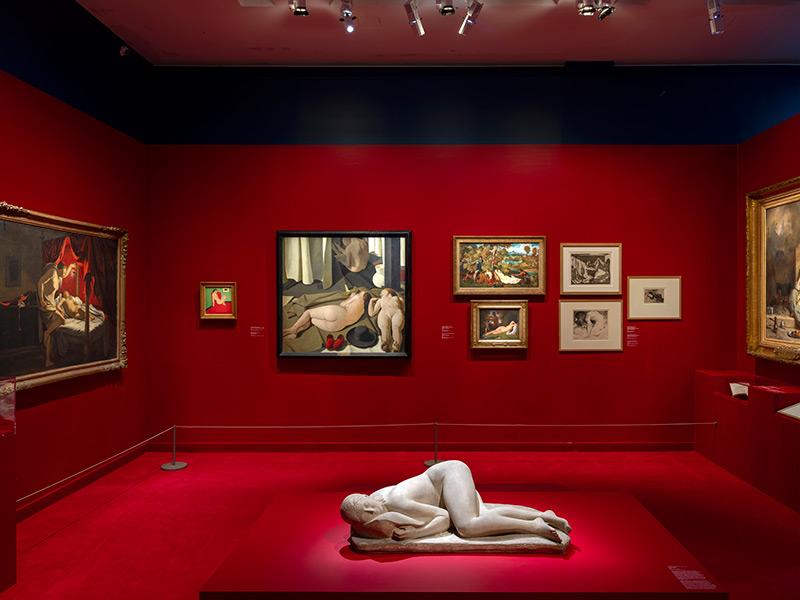
View of the exhibition “The Empire of Sleep” at the Marmottan Monet Museum.
© Studio Christian Baraja SLB


