Meaux (Seine-et-Marne). An activist who uses his notoriety and his pen, as well as a touch of catastrophism, to alert the state of religious heritage. With a vast network which brings her up the emergency situations on the ground, she does not hesitate to resort to fundraising to save the monuments in danger: if it was not feminine, this description could correspond to current figures of the heritage causes. But it is from the Marquise de Maillé (1896-1972), a precursor of the methods of what is called the “heritage fight”, of which it is, and for which the Bossuet de Meaux museum devotes an exhibition.
This active personality of the interwar period until his death in 1972 is not yet fully integrated into the history of French heritage. Unjustly, as the Meldois course shows, as its methods to alert and mobilize have been a school. Rich in original archive documents, it thus deploys leaflets announcing the launch of subscriptions to save such or such rural church.
The exhibition follows a fairly classic biographical course, and welcome to present this personality closely linked to the association The safeguard of French art, and to the heritage movement of the 1920s and 30s, when the aristocracy and the French elites grab the cause of monuments in danger. Pink and mauve shades introduce his aristocratic education and the passion of heritage fights, followed by a studious palette to return to the scientific contribution and the heritage of the Marquise. The route is well sequenced and pleasant to visit.
Juan de Roelas (attributed to), The worship of shepherds17th century, oil on canvas, classified as historic monuments in 1907, Saint-Martin church, Favières (Seine-et-Marne).
© DR
The diversity of archival sources presented (surveys, press articles, propaganda documents), such as objects (including some national treasures saved by Aliette de Maillé) make the exhibition a little more than a biographical course, and small on foot subtly evoke the golden age of learned societies.
The discourse carried by the texts of rooms is sometimes imbued with a lyrical momentum, which slides at the end of the exhibition towards a hagiography, which raises the question of the critical distance maintained with the subject. His work is presented through the limited prism of his direct entourage (the safeguard of French art, his friend Jean Hubert for example), without being replaced in a broader perspective on the evolution of the concept of heritage, before, during and after her.
A commitment marked politically
More disturbing, an important part of his life has almost passed over in silence: his commitment to the royalist movement of the French action, and his proximity to the extreme right-wing anti-Semitic theorist Charles Maurras, who had his room within the castle of Motte-Tilly, remains of the Marquise. A certainly embarrassing proximity for those who wish to rehabilitate the action of Aliette de Maillé, but impossible to ignore if it is pretended to approach it as an object of history. This point is only evoked briefly, in a few words on a cartel. It is however central to understanding the commitment of the Marquise, and the strong restrictions which it poses in its conception of heritage, which is almost exclusively interested in churches and cloisters in danger.
His fight finds an intellectual genealogy rooted on the far right, citing directly The great pity of churches from France From Maurice Barrès on his leaflets, and imputing a number of heritage ailments to the 1905 law. An accusation also taken up without quotes in the texts of rooms, although a century of decline greatly tempers this assertion (in comparison with other European countries). Likewise, the notion of “beauty” constantly mobilizes the Marquise, and which is an important political marker in this period of avant-garde, is not questioned. The error from which this journey is guilty is ultimately quite banal: not to see in the heritage a political object, even when the signs that it is eminently are obvious and manifest.
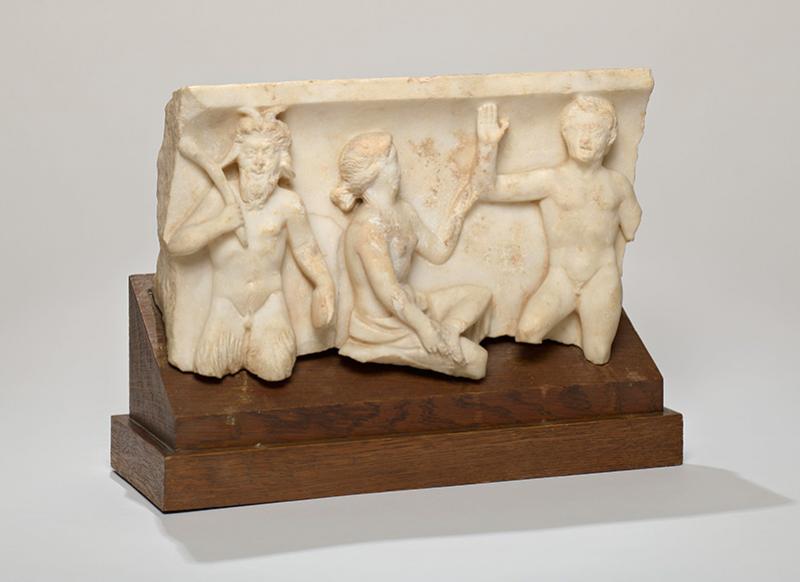
Nymph and satyrs, fragment of ancient sarcophagus, unclear, white marble, castle of Motte Tilly.
© Center for national monuments