Madrid,
In the catalog of one of his last exhibitions in the Fernández-Braso Gallery, Alfredo Alcain explained that, since the beginning of his career, he had not modified his way of painting too much and that does not believe much, or nothing, in the artists who introduce marked changes in his work.
The retrospective that the Alcalá 31 Chamber of the Community of Madrid gives it today demonstrates that its interests and the basis of its reflection (the painting itself, its components and processes) have not turned since they began to form in the late fifties. But also that their research around this technique – fundamentally on the line, the color and the possibilities that the teachers offer – can lead to very diverse fruits.
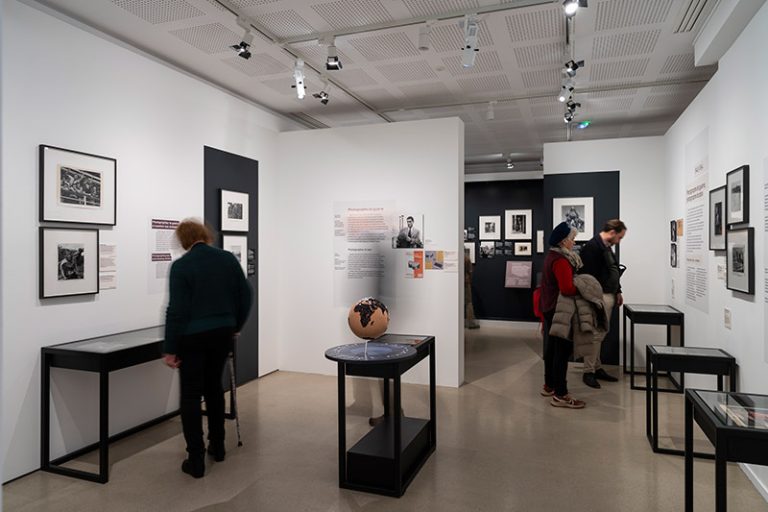
In its exhibition line aimed at exhibiting and claiming the work of Spanish authors of its generation (with Luis Gordillo he opened this room his autumn program in 2023), the community offers this anthology, curated by Mariano Navarro, which has more than 150 pieces: mostly paintings, but also recorded, drawings, collages and sculptures.
Its ordination responds more to formal criteria than chronological (in general, the work of the sixties and seventies remain in the upper part; those of the fifty, eighty and ninety in the casual -So recognizes him- of the cane for embroidery Petit-Point that we will see at the beginning of the route.
The first work in the exhibition is, yes, pictorial and significant: it is called To painting and contains a palette with multiple tones immersed in a landscape that repeats them (or vice versa). It gives way to a set of compositions in which this Madrid author, who has always resided and worked in the capital, honored Cézanne in an improvised, but solid way: in Pontejos he found and acquired the embroidered reproduction of his Fruit, tablecloth, glass and apples And that would be the principle of various works in that technique of Petit-Pointseeking to study what interpretations of his lifting natures could achieve using cane (or which could get the cane with him an intermediary).
In addition to creations in diverse formats, he developed small independent fragments of those, which replicated some of their parts but, examining autonomously, constitute abstractions. The culmination of that set would come, precisely, with the meeting of thirty -five of those fragments in a great image: a complete still life and, in turn, divided. For these drifts regarding his initial paths, he believes Alcain that his tribute to Aix-en-Provence was rather unfaithful.

Bodegones constitute, in any case, the axis of their career (also their temporal center, because they were their gender more approached in the eighties and the nineties, and Alcain continues to work). In most cases these are reinterpretations of those that the Cubists deployed (with a clear tribute to Juan Gris, emeilad bottles, press), but we will also find them more fruit and close to pop, always in very living tones, or sculpted in materials such as wood and bronze. The closest and less search nourishes again and again its motives.
Calvo Serraller came to classify, at the time, these pieces in three groups: the still lifes under mechanized freezing that evoke Roy Lichtenstein; the subjects to perverse mechanized freezing, with Cézanne in the spotlight; and those materialized in sculpture under the cubist imprint.


His abstractions of the nineties (the artist prefers to take that term with tweezers) are not born of the absence of figurative references, but of the purification and synthesis of those previous still lifes: the first fruits and fruits will give way to color and the lines; The strokes come to be their remains. Dodge, yes, the rigor of geometry in favor of the game, a game that Alcain identifies with the pictorial exercise: It is a capricious geometry, I do not know how to qualify: it would go more towards the painting itself.

The compositions that await us on the upper floor of the Antonio Palacios building refer to the context in which Alcain grew and began working (the years of consolidation of the dictatorship) and especially contain doors and shop windows of neighborhood shops that already painted them, in the sixties and seventy, they began to close: mercerías, hueverías, dairy or overseas. Its design, by simple and effective, seemed non -existent.

And a last section of the exhibition also implies games: tributes to figures such as Giotto, Klee, Mondrian, Ottone Rosai or Morandi, debtors of his stay in Italy with a scholarship of the Juan March Foundation.
Irony and experiment are as present in their production as color, line and attention to manual trades, whose tools also led exquisite drawers on wall.

“Alfredo Alcain. A retrospective”
Alcalá Sala 31
C/ Alcalá, 31
Madrid
From September 10 to January 11, 2025