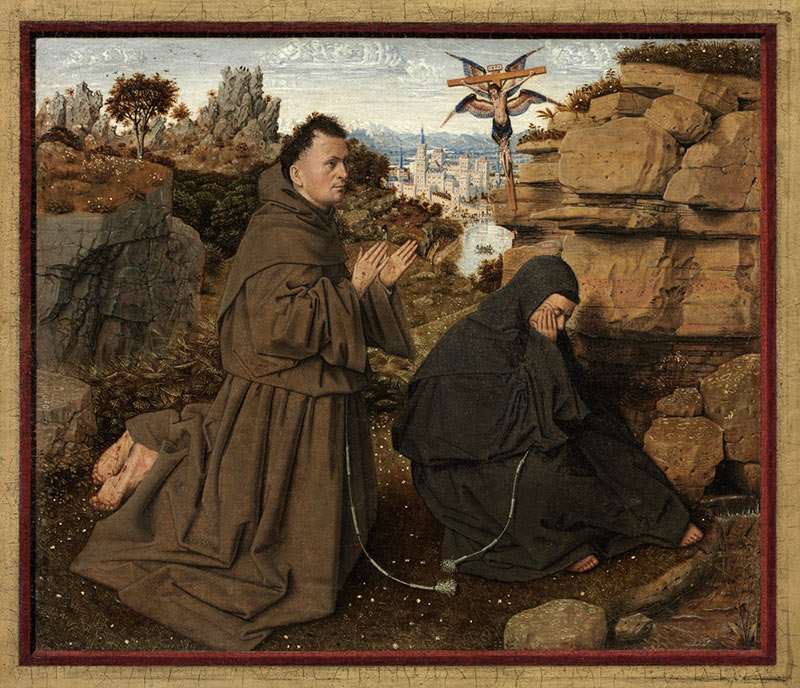
What if neither of the two paintings exhibited at the Galleria Sabauda in Turin and at the Philadelphia Museum of Art were by Van Eyck? Artificial intelligence is once again entering into attribution debates. Two almost identical 15th century panels representing Saint Francis of Assisi receiving the stigmata, traditionally attributed to Van Eyck (1390-1441), are the subject of debate.
According to an analysis carried out by the Swiss company Art Recognition, in collaboration with the University of Tilburg (Netherlands), neither of the two works presents the characteristics of the Flemish master’s touch. The AI algorithm, trained to recognize the artist’s hand from his brushstrokes, concluded that the Philadelphia panel is 91% negative, the Turin one is 86% negative.
Jan van Eyck (1390-1441), Saint Francis receiving the stigmatac.1428-1432, oil on panel, 29.2 x 33.4 cm, version from the Sabauda Gallery in Turin.
The method used by Art Recognition is now known. It is based on ultra-high resolution photographs, segmentation into thousands of fragments, extraction of recurring characteristics, then comparison with a corpus of works deemed indisputable. The same process applied to an undisputed Van Eyck, The Portrait of the Arnolfini couple from the National Gallery in London, gives a probability of authenticity of 89%.
These conclusions support a hypothesis already formulated by several art historians. Till-Holger Borchert, German Van Eyck specialist and director of the Suermondt-Ludwig Museum in Aachen, sees this as confirmation of a hypothesis according to which the two Saint Francis of Assisi receiving the stigmata are studio works.
But several art historians contest this touch-based approach. Maximiliaan Martens, professor at the University of Ghent (Belgium), recalls that Van Eyck is not a painter of the visible touch. He is, on the contrary, the artist who pushes the art of glazing and translucent superposition towards an almost smooth, shimmering surface, where the gesture tends to disappear. Furthermore, only around twenty paintings are attributed to Van Eyck. A very thin corpus to constitute a truly reliable training dataset for artificial intelligence.
The Ghent professor also points to material parameters ignored by algorithmic analysis. The Philadelphia version is painted on panel-mounted vellum, a rare choice that modifies the surface and can affect the visual markers used by the AI. Added to this are the oxidized varnishes, cracks, retouching, cleaning, restorations and reflectance modifications over nearly six centuries. The AI can then confuse style and aging, hand and alteration.
This is not the first time that the spotlight has been on Art Recognition and its AI-assisted analyses. In 2021, the company caused a sensation by concluding that the famous Samson and Delilah by Rubens (1609) kept in the National Gallery in London was not 91% authentic. This questioning was, however, rejected by several experts.
Despite these controversies, the young company founded in 2019 also claims success. In 2024, its AI would have made it possible to identify up to forty fake paintings put up for sale on eBay, demonstrating its usefulness in tracking down counterfeits on the online art market.