As we commemorate the centenary of the death of Antoni Gaudí (June 10, 1926), Barcelona City Hall has announced that a new museum will open in honor of the architect, by 2028. The project aims to highlight the spirituality in the work and life of the master of Catalan modernism. The announcement preceded by a few days the visit of Pope Leo XIV to Barcelona, Wednesday June 10, for the inauguration of the Tower of Jesus, the tallest of the Sagrada Família.
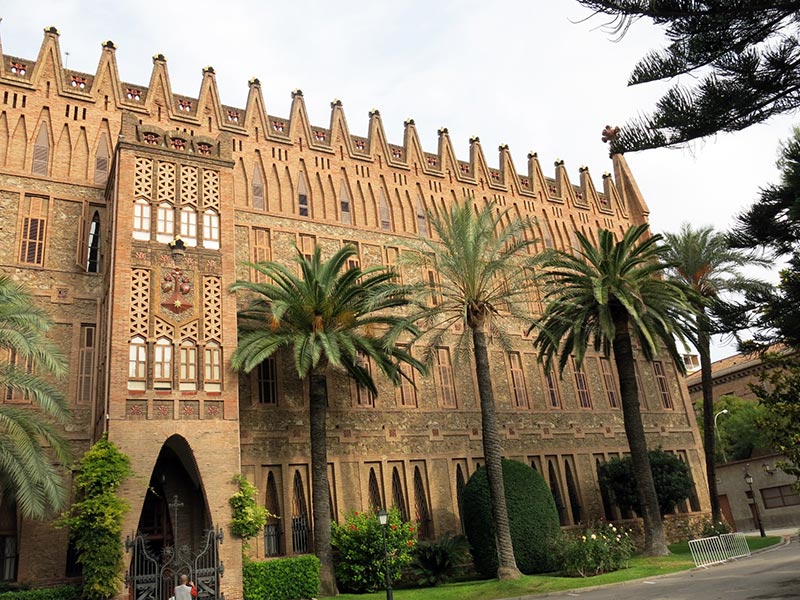
The Vatican has given its approval for the development of the future museum in the Religious College of Saint Teresa, one of the first works of Antonio Gaudí, built between 1888 and 1890. This will be the first time that the building has been made accessible to the public. The building, relatively modest in size compared to the architect’s later works, was originally intended to house the Sainte-Thérèse de Jésus company founded by Enric d’Ossó. With the brick facade, Gaudí had respected the religious congregation’s vow of poverty by using an economical material, which nevertheless gave him the possibility of shaping decorative elements. He also works with wrought iron at the openings, one of his favorite materials found in several masterpieces, such as the Palau Güell. The rectangular structure of the College, the angular battlements which overlook it and the thin windows which recall loopholes evoke The Interior Castle (1577) by Saint Teresa of Avila, a story describing the journey of a soul which journeys towards perfection by mobilizing the metaphor of the castle.
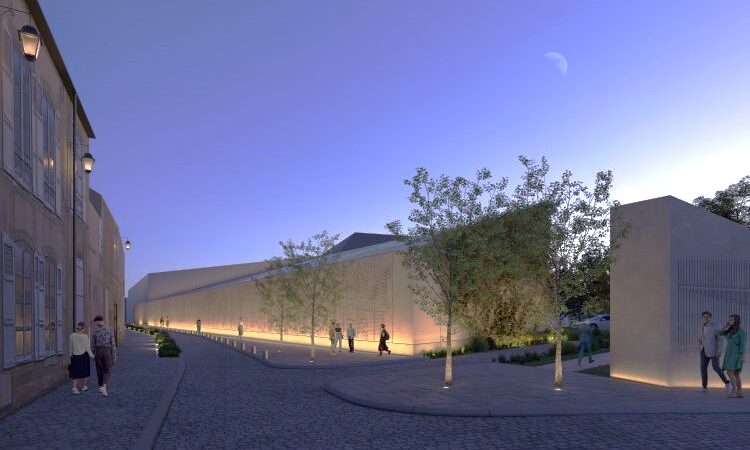
The museum project meets the objective of exhibiting Gaudí in a more spiritual light. The Arquitectura Genis Planelles agency, winner of the project management, focuses on modern museography based on cutting-edge technologies. The company Ingeniería Cultural, specialized in the development of immersive audiovisual devices, is participating in its creation. It provides virtual restitutions of Gaudí’s constructions as well as a room reserved for discovering his creative process through a virtual reality experience. Physical models and original documents will complete these devices.
Spirituality occupies an important place in the life and work of the man nicknamed “the architect of God”. “He expresses his faith in an architectural mode that is completely innovative for his time”explains historian Patrick Sbalchiero to Vatican News. During the last years of his life, religion occupied more and more space in Gaudí’s daily life, occupied by the greatest project of his career: the Sagrada Familia. The Musée d’Orsay dedicated an exhibition to him soberly titled “Gaudí” in 2022, which reaffirmed the progressive sacralization of his architecture based on the example of the basilica. In accordance with Catholic values, he had renounced material comfort. A choice that could have cost him his life: while he was lying on the ground after being hit by a tram, he was mistaken for a worker and no one rushed to help him at a time when social class structured Spanish society.
The importance of faith for Gaudí has recently been the subject of a reassessment: in 2025, Pope Francis put the process of beatification of the architect back on the agenda by declaring him “venerable”. Since then, the procedure has remained blocked at this stage, the recognition of a miracle being necessary for its success.
The museum project is part of “any Gaudí” in Barcelona, a program deployed throughout 2026 aimed at highlighting Gaudí’s cultural heritage, beyond the many known monuments. Events are organized in Barcelona, Reus and Mataro, at the main initiative of the Generalitat de Catalunya (the autonomous government of Catalonia). An international congress on Gaudi is planned for October and local and traveling exhibitions are organized by different venues. Casa Batlló and the Miró Foundation have joined forces to design an exhibition on Gaudí, Joan Miró and Joaquim Gomis, three major figures of Catalan modernism.
The Collège Sainte-Thérèse museum will add a footprint to a city marked by Antoni Gaudí. Its opening in a network formed by the Casa Museu Gaudí, the Sagrada Familia Museum, as well as several monuments, seven of which are listed as UNESCO heritage, however, questions the museum’s ability to stand out by providing a new look at the work of the Catalan master.