Paris. At the origin of the major exhibition, in two parts, dedicated by the Musée d’Orsay to Auguste Renoir (1841-1919) is a preparatory drawing for this poorly understood painting, Bathers. Painting test decorative also says The Great Bathers (1886-1887). It was one of the highlights of the “Le Décor impressionniste” exhibition in 2022, and, as critics did when it was first shown at the Georges Petit gallery in 1887, audiences walked past it pouting. However, it was an exceptional loan from the Philadelphia Museum of Art and had not been seen in France for a century.
The painting did not return this year but, following the acquisition in 2017 by its museum of this large Study for Bathers. Decorative painting test (around 1886-1887), Colin B. Bailey, director of the Morgan Library & Museum in New York, planned to mount an exhibition on Renoir’s drawings around her. This was launched by Laurence des Cars and confirmed by Christophe Leribault then Sylvain Amic who saw it as an original retrospective of an unknown Renoir, the designer, watercolorist and pastelist. It was only later, at the request of Christophe Leribault, that “Renoir and Love” was programmed in parallel, which covers the period from 1865 to 1885 which was not very productive in terms of drawings because, like a good impressionist, the painter then worked directly on the canvas. More than a hundred works on the drawing side, curated by Colin Bailey, Anne Distel, Sarah Lees and Paul Perrin, and around fifty on the painting side (in addition to Paul Perrin, Katie Hanson, Chiara Di Stefano and Christopher Riopelle are curators) therefore constitute an international monographic exhibition of variable geometry: the drawings have already been shown in New York while the paintings, after Paris, will visit London and Boston.
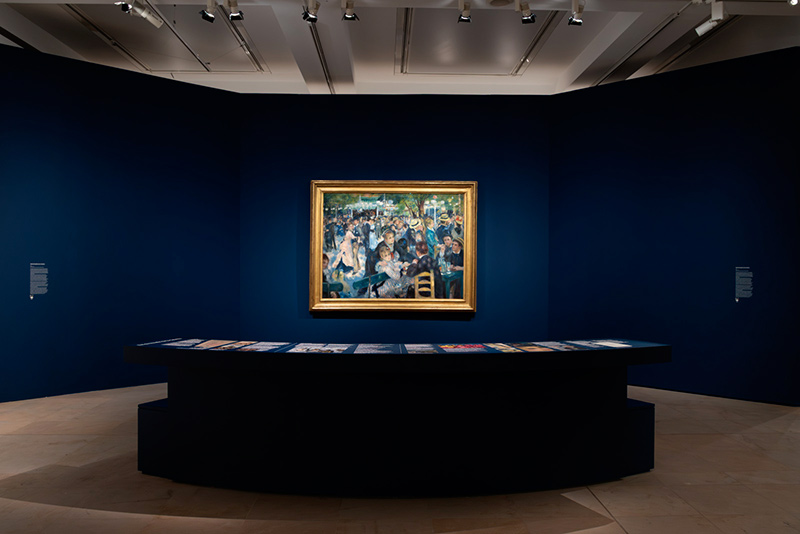
View of the “Renoir and Love” exhibition at the Musée d’Orsay.
© Allison Bellido Espichan
It would be a shame if attracted by famous paintings, such Ball at the Galette mill (1876), which precede Renoir’s midlife crisis – this painfully negotiated turn towards the line of Raphaël and Ingres of the man who, perhaps more than the other impressionists, had been the man of color –, the public neglects the presentation of the drawings, because it is a festival of international but also French loans of sheets rarely or never exhibited. Among them, six from a Notebook (around 1860-1861) from Ottawa and two Studies (around 1862-1863) based on antiques from the Louvre, sent by a collector, documenting the beginnings of the career. Study for Dance in the Country (1883), preserved in Budapest, marks, according to the cartel, the moment when, “for the first time, the artist prepares a painting with a significant number of drawn studies” ; pastel Young woman leaning on a balcony also says The Lodge (1879) comes from the Bemberg Foundation; the MET (New York) lent Young Woman in Blue Dress (watercolor with gouache highlights, circa 1885-1886) and the Ottawa Museum of Fine Arts is magnificent Crouching nude (around 1897).
A unique collection of masterpieces
When it comes to paintings, international cooperation has also worked wonders. Thus, thanks to the authorization given by a Philadelphia judge to the Barnes Foundation to now lend its works, Young Mother (1881) and Lunch (1875) are in Paris. According to Paul Perrin, “ we have not seen so many masterpieces by Renoir collected in France for forty years”. According to the other commissioners, it is the same in London and Boston and, adds Christopher Riopelle, “with the other major complementary and revealing exhibition, “Renoir Cartoonist”, it is a privileged moment in the renewal of Renoir’s critical fortunes”. And the possibility of seeing or revisiting with a new eye these distant works that are The Boaters’ Luncheon (1880-1881) (see ill.) and his dazzling still life presented at audience level or Dancing in Bougival (1883), one of the icons of the Museum of Fine Arts in Boston, the most sensual of the series of three Dance presented here together.
The feeling of love is palpable, as in The Walk (1870) and, perhaps, as Paul Perrin suggests in the catalog, in the duo of young women entitled Confidences (around 1876-1878). However, the title “Renoir and Love” is misleading and undoubtedly intended to tempt the public because the subject of the exhibition (subtitled “A Happy Modernity”) is rather Renoir, painter of modern life, an aspect of the artist which had never been addressed. However, we can admit that there is love on all the walls, since, according to Paul Perrin, the artist did not consider, like his contemporaries, that modernity was the mother of all vices but on the contrary the provider of meetings, friendships and shared celebrations. In the middle of this happiness stands out a small painting which evokes neither love, nor happiness, nor friendship or the simple pleasure of meeting, the enigmatic Young Girls (c. 1875-1879) from the Ny Carlsberg Glyptotek (Copenhagen). It is like a fault that reveals a completely different Renoir.
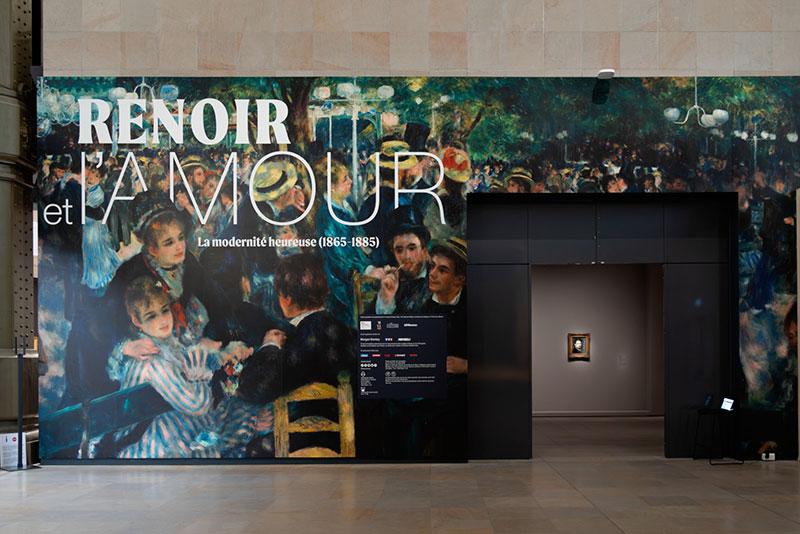
View of the entrance to the “Renoir and Love” exhibition at the Musée d’Orsay.
© Allison Bellido Espichan