
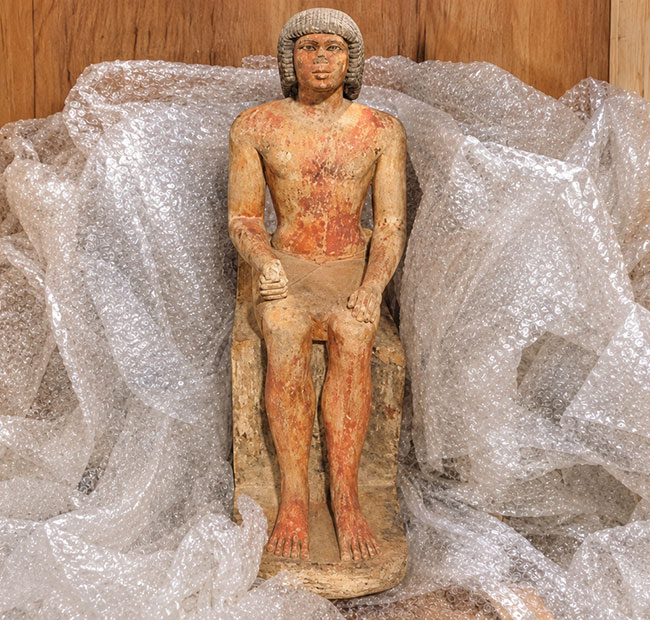
UNITED STATES. To combat the looting of archaeological sites, the United States is increasing bilateral agreements with countries whose antiquities supply the international art market. On November 9, 2026, a new agreement was concluded between Egypt and the United States, which extends for a period of five years the American restrictions on the import of Egyptian cultural property, in force since 2016. Without constituting a ban in principle, the system subjects artifacts falling within the categories concerned by the text to special customs control. This concerns archaeological objects dating from 300,000 BCE to 1750, as well as certain objects dating from 1517 to 1914. Any entry of these goods into American territory must be accompanied by supporting documents proving the lawful nature of their exit from Egypt.
The agreement builds on the Convention on Cultural Property Implementation Act (CCPIA), the US law that implements the 1970 UNESCO Convention on Combating Illicit Traffic in Cultural Property. Egypt is not the only one affected by these provisions. On November 21, the United States also extended restrictions on Greek antiquities and religious objects from the Byzantine and post-Byzantine periods for five years. Nepalese imports to the United States have been governed by a similar regime since January, applicable until 2031.
The looting continues
The renewal of the agreement with Egypt comes as clandestine excavations continue to fuel antiquities trafficking. Just this month, two men were arrested in possession of nearly 3,400 ancient objects, mostly Greek and Roman coins, obtained following clandestine excavations carried out in a protected area of the Nile Delta. In June, in South Sinai, ten people were sentenced to five years in prison for trying to smuggle nearly 2,200 antiquities into Jordan. According to the American Embassy in Cairo, the agreement with the United States has enabled the return of more than 5,000 objects over the past ten years.
The European Union has also strengthened its regulations regarding the importation of cultural goods. Since June 28, 2025, the provisions of European Regulation 2019/880 relating to import licenses and importer declarations have been fully applicable. Archaeological objects over 250 years old are subject to prior obtaining of an import license, regardless of their value. To obtain it, operators must provide proof that the goods were exported in accordance with the legislation of the country in which they were created or discovered. Since May 28, 2026, procedures have been done online via the centralized electronic Import of Cultural Goods (ICG) system.