
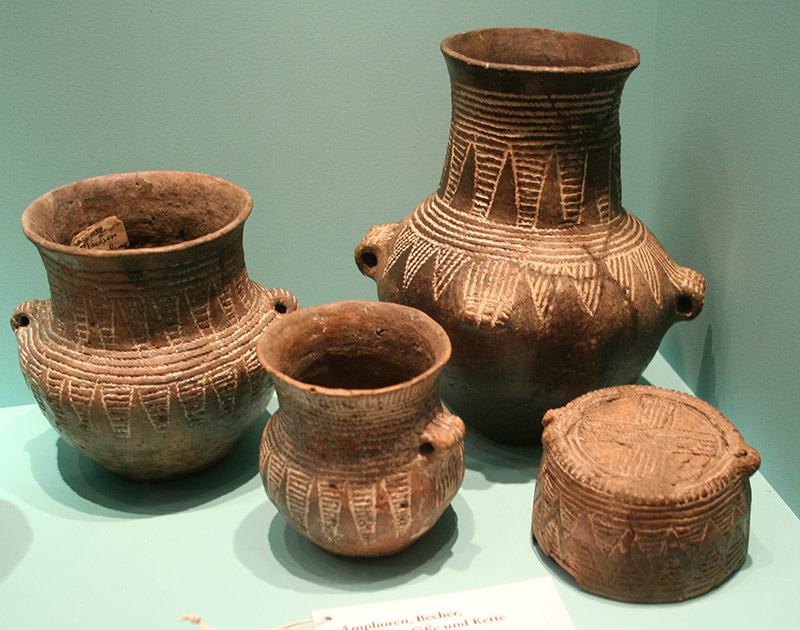
A study published on November 10, 2026 in the Journal of Neolithic Archeology traces the evolution of social inequalities within the corded pottery culture of central Europe in the 3rd millennium BC. Directed by Mikkel Nørtoft of the University of Copenhagen, this work focuses on Bohemia and Moravia, two regions of present-day Czechia. The researchers propose a scenario in which communities, originally relatively egalitarian, would have gradually developed forms of competition in the centuries following the arrival of populations from the Pontic steppes.
317 burials were analyzed using the QuantWealth quantitative method, which makes it possible to evaluate funerary wealth based on several criteria. The exceptional nature of the objects deposited, the time and skills required for their manufacture, the distance traveled from the place of origin of the materials, the depth of the graves and the food expenses associated with the funeral were taken into account.
These data were cross-referenced with age, sex, known diseases identified in the individuals observed and traces of malnutrition during childhood, as well as with genetic information. The researchers were particularly interested in Y chromosome haplogroups, which make it possible to trace paternal lines, in order to determine whether these could be associated with differences in funeral wealth. The objective is to determine whether the wealth attributed to individuals buried in ostentatious tombs can be correlated with this data.
The results revealed several developments. In a first phase, between 2900 and 2700 BCE, the Bohemian communities showed relatively limited differences in wealth. Between -2700 and -2500, the differences widen, because male burials demonstrate greater investments. Researchers suggest a competition between family groups, in which funeral banquets and the display of prestigious objects could have served to strengthen power. Then, between -2500 and -2300, a male lineage becomes largely the majority in the burials, and certain tombs of very rich children could indicate a transmission of wealth between generations.
This period coincides, in Bohemia, with the appearance and then the progression of the male haplogroup “R1a-M417”, associated with populations from the Pontic steppes, which becomes widely represented in the late phase. Thus, the authors envisage a possible progressive domination of paternal lines belonging to this haplogroup. The presence of particularly wealthy children’s graves in later phases could also signal a more lasting transmission of social status. In Moravia, the evolution observed is a little different, since particularly rich burials are present from the intermediate phase.
Beyond the widening of wealth gaps, the study suggests a progressive transformation of the social organization of these communities. Initially, the status of individuals would have been based more on their personal careers than on their belonging to a family or lineage, leaving room for a certain social mobility. The multiplication, in late phases, of richly endowed children’s burials, whose status can hardly be explained by their personal achievements, could testify to the transition from a society in which social position is acquired to one in which it is transmitted.
As the authors themselves point out, these conclusions must be received with caution. On the one hand, funeral wealth does not necessarily reflect the actual wealth of the deceased. On the other hand, the sample is incomplete, and the researchers specify that they do not have enough genetic data associated with documented graves to compare the richness of R1a-M417 carriers to that of individuals belonging to other haplogroups.