The construction of the triumphal arch wanted by Donald Trump in Washington is suspended by the courts. On November 5, federal judge Tanya Chutkan banned for fourteen days any start of work on the Memorial Circle site, located between the Lincoln Memorial and the Arlington Military Cemetery. The order was issued a little over an hour after the project was approved by the National Capital Planning Commission (NCPC), which is responsible for monitoring developments in the federal capital. The presidential administration planned to begin earthworks as soon as the final authorizations were obtained.
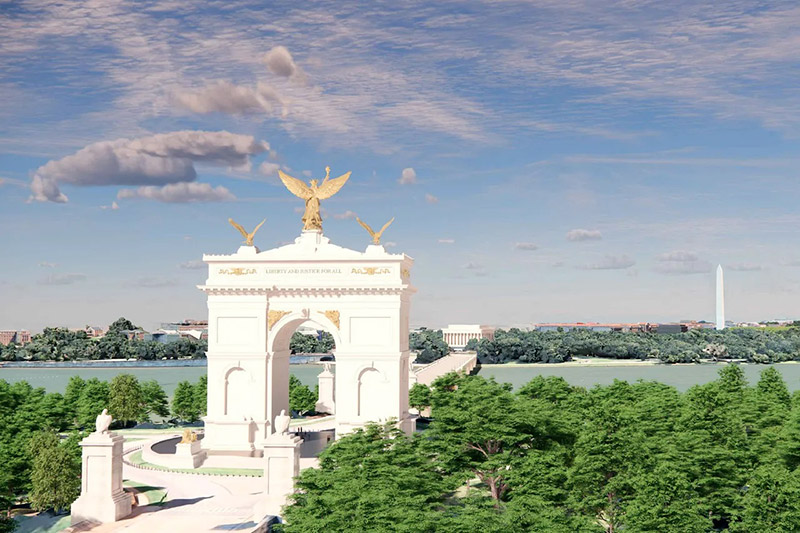
The planned monument would rise to 250 feet (76 meters), compared to around 50 meters for the Parisian Arc de Triomphe on which it is inspired. It would take place on a traffic circle on Memorial Avenue, near the Potomac River and Ronald Reagan National Airport. The building, topped with a winged figure of Liberty, would notably include an observation deck and interior spaces. Its establishment would profoundly modify the historical perspective linking the Lincoln Memorial to Arlington Cemetery, one of the main sites of military memory in the United States.
Donald Trump presents this project as a tribute to the American military and a way to further monumentalize Washington, like the great European capitals. It is part of a transformation program for several emblematic sites in the city, including the White House and federal public spaces.
The litigation began in February 2026 with a complaint filed by three Vietnam War veterans as well as a former architectural historian with the Virginia Heritage Department. The applicants believe that the monument would undermine the view between Arlington and Washington and the solemnity of the military cemetery. They also argue that its construction requires specific authorization from Congress.
A second procedure was initiated in the fall by the authorities of the District of Columbia and Virginia, who contest in particular the regularity of the authorizations and the consequences of the work on traffic and emergency services. Judge Tanya Chutkan joined the two cases.
The administrative procedure has nevertheless progressed. After an initial review by the Commission of Fine Arts, the federal agency consulted on the architectural and aesthetic aspects of Washington’s projects, the NCPC approved the siting and construction plans on November 5 by eight votes to four. This decision followed several hours of public hearings, during which veterans, elected officials and residents expressed their opposition. Representatives of the federal administration supported the project, while those in Washington voted against.
The National Park Service and the Department of the Interior have also initiated the final steps necessary to begin construction. According to a timetable communicated by the Ministry of Justice, the foundations were to require six to eight months, before the start of construction in elevation, at the earliest in May 2027. The total duration of the project is estimated between 33 and 39 months. The monument could therefore not be completed before the end of Donald Trump’s second term, in January 2029.
Project for the triumphal arch of Washington, wanted by Donald Trump.
© US Commission of Fine Arts
In her 33-page decision, Judge Tanya Chutkan considers that the authorities of Virginia and Washington have sufficiently demonstrated the risk of immediate harm that is difficult to repair. The work would cause significant road disruption and would mobilize public resources for the management of diversions, accidents and emergency interventions.
The magistrate also questions the legal basis invoked by the administration. This is based on a 1925 law which, according to it, would authorize the creation of a monument at this location. For the judge, it seems highly improbable that a century-old text, never used for this purpose by previous administrations, could justify the construction of a 76-meter arch in the heart of the capital.
The government has also put forward a national security argument, presenting the monument as likely to contribute to the protection of Washington, particularly against drones. The judge emphasizes that this justification, which appeared late, does not appear in the planning documents examined by the federal commissions and is not supported by sufficiently precise elements.
The order constitutes a precautionary measure, and not a definitive cancellation of the project or the authorizations granted. It prohibits construction-related operations for fourteen days and requires the administration to inform its contracting companies. A report on his execution is due to be submitted to the court on November 9. The litigation continues on the merits, in particular on the need for authorization from Congress and the legality of the administrative procedure.
The victory of the Democrats could compromise the project
The legislative elections of November 3 changed the political perspectives of the project. With a majority in the House of Representatives and the Senate from January 2027, the Democrats will be able to increase parliamentary hearings and investigations, exercise control over public spending and try to prohibit the use of federal credits for the construction site.
Jared Huffman, currently the top Democratic representative on the House Natural Resources Committee and likely to become chairman, denounced the lack of legislative authorization. The change in majority could also modify the composition of the National Capital Planning Commission: two of its seats go to the heads of the competent parliamentary committees. This development would not, however, cancel the authorization issued on November 5. Any legislative provision intended to stop construction would remain subject to congressional voting rules and a possible presidential veto. The provisional timetable, which postpones the completion of the monument beyond the mandate of Donald Trump, constitutes another uncertainty for its realization.