New York. Bourse de Commerce in Paris, Hammer Museum in Los Angeles, MoMA in New York, Prada Foundation in Milan: in recent months, the exhibitions of the American artist Arthur Jafa follow one another, even overlap, and attract a diverse audience, from art specialists to the general public. Child of Mississippi, born in 1960, passed through the cinema by collaborating as a cameraman then director of photography for Spike Lee or Stanley Kubrick, this “late bloomer” [personne qui réussit sur le tard, ndlr]as he calls himself, has become the new superstar of contemporary art in barely two decades. Since September 24, it is the turn of the New Museum to offer “Arthur Jafa: I’m Tony”, co-curated by Massimiliano Gioni and Gary Carrion-Murayari. Films, installations, sculptures, paintings and scrapbooks punctuate the exhibition space of the New York museum, unfolding like an artist’s manifesto.
The formula that the novelist Toni Morrison had with regard to the artist, “if you are looking for a great poet, perhaps he is in your mirror”, would have sparked his vocation. Its practice is also based on language. Through collages and montages, this assumed heir of Duchamp’s ready-made associates “randomly”, as he confides in the catalog, the fragments of black American culture, like a song, a kind of filmic rap which draws inspiration from Homeric myths. Jafa shows unknown people but also singers, musicians, athletes, artists, politicians, the heroes of his community, mistreated, defeated, but determined, powerful. So in this extract from the video Love is the Message, the Message is Death (2016) where Barack Obama begins singing amazing Grace echoing the racist shootings in Charleston of 2015, a scene that takes place during the funeral of one of the victims. But Jafa doesn’t linger, the next image is quickly there. The result is stunning sequences where racism rubs shoulders with the exploits of a black society that has become American under duress. The viewer is led towards the understanding of this “blackness”, which is distinct from African culture, because it is imbued with suffering and defined by skin color, in contrast to that of the white American world. Jafa proclaims the strength of black American identity to which the experience of racism is linked. What the philosopher Judith Butler summarizes in the essay appearing in the exhibition catalogue: “What characterizes these remarkable contributions to art and popular culture is that they oppose while cooperating with the destructive forces of racism. »
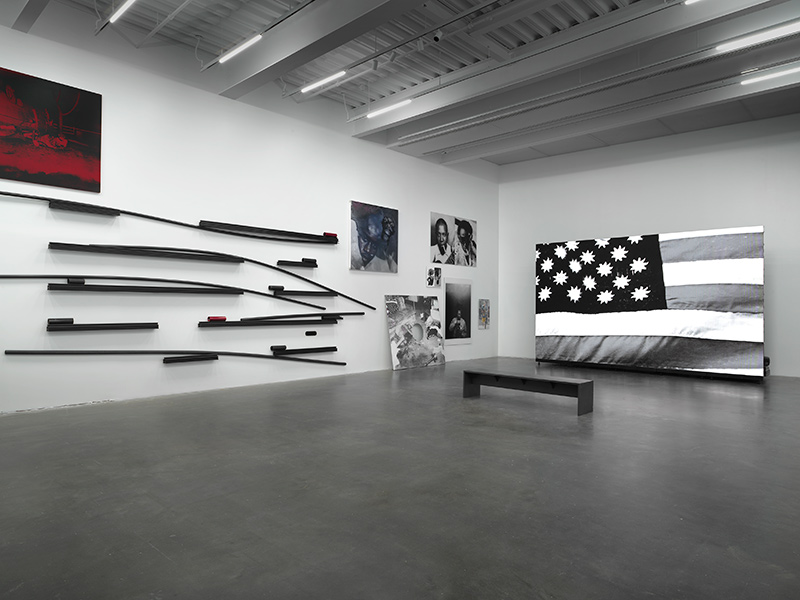
View of the exhibition “Arthur Jafa: I Am Tony” at the New Museum.
© Dario Lasagni
The artist declared at his beginnings: “I don’t talk to white people. » He explains himself today on this phrase sometimes misinterpreted, as being the sign of a work, non-racist, expression of “blackness” from an interior point of view. This blackness unable to reveal himself in a white world. He takes the example of modernism: “The perspective of Afro-descendants on the general question of modernism interests me because they are both inside and outside of it. » Arthur Jafa has therefore made an art of speaking about this “interstice”, the in-between where, according to him, black American culture developed.
From the bottom of the holds
The exhibition highlights this parallel circuit. The immense rooms of the museum are more like a series of hangars than a white cube. Their walls were covered with black paint. In the darkness, the visitor loses his bearings somewhat and lets himself be captivated by the works. The journey is solitary; it demands a dive into the black American psyche, a distancing from the white psyche.
A work attracts attention because it asserts itself as the matrix of African-American identity. This is the artist’s first digital animation video, Aghdra (2021). Or the images of an earthy, cracked ocean, forming slow and powerful waves under a setting sun. Its thick texture is doubly inspired. By the Japanese fictional monster Godzilla on the one hand, which the artist projects as the possible incarnation of the collective suffering of black people, and by the photography of Mathew Brady The Scourged Back (1863) on the other hand, showing the back of a slave lacerated by whippings, which became an emblem of the abolitionists – the artist also hung a life-size version a little further on in the exhibition.
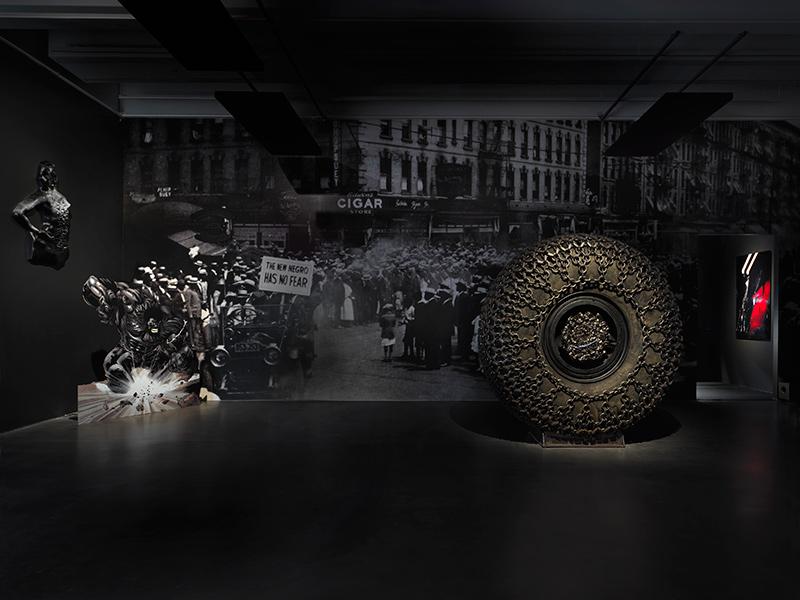
View of the exhibition “Arthur Jafa: I Am Tony” at the New Museum.
© Dario Lasagni
In the film, the sound alternates between dark oceanic notes and R&B pieces from the 1970s and 1980s. Here Arthur Jafa materializes the “middle passage”, the transatlantic crossing made during the slave trade between Africa and America. For him, it was deep in the holds that black American identity was sedimented. In the test My Black Death (2000) he writes: “During the “crossing of the middle”, African music […] found herself freed from her original environment […] and, thus liberated, developed exponentially, mutating in the process from African music(s) to black music(s). » The artist therefore confronts us with referential suffering, at the founding place of black culture.
The title of the retrospective, “I’m Tony”, refers to Tony Williams, “best drummer in the history of jazz”. In the same way, the works presented combine American figures, their exploits (musical, sporting, etc.) and their flaws (Michael Jackson facing accusations of child abuse).
Jafa is a conversation artist. In his works, archives come together. He collaborates with artists like Richard Prince in Venice or Kahlil Joseph, who is said to have inspired the documentary film Dreams Are Colder than Death (2013). In his practice, a desire for syncretism invites us to consider black identity as American. Jafa proclaims: “We are Americans. »