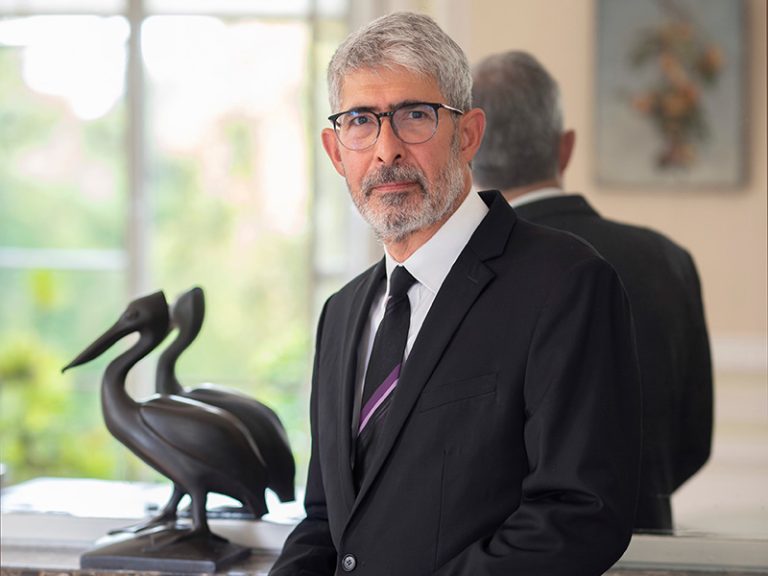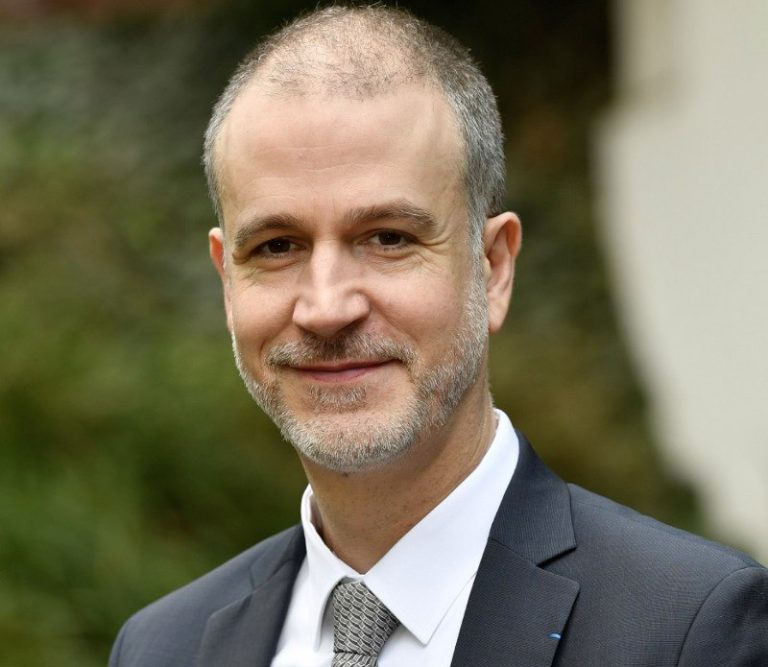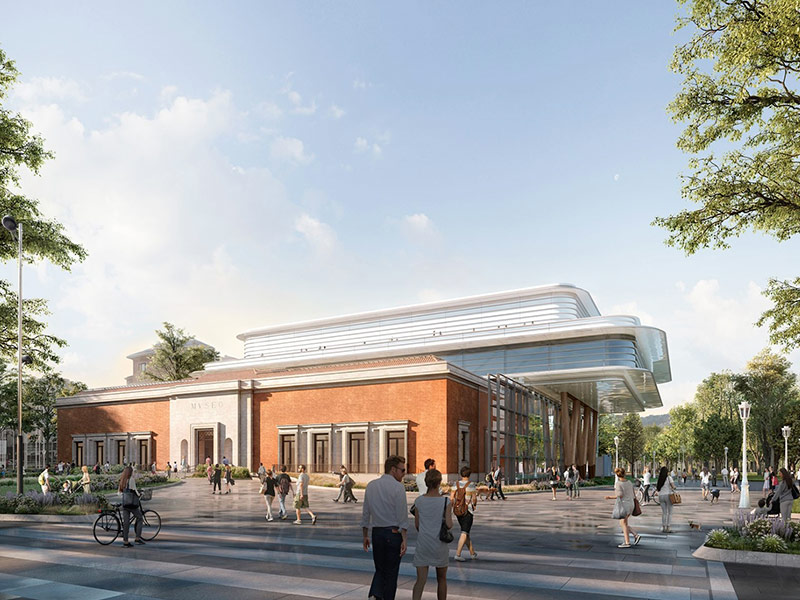
After four years of work, the Bilbao Museum of Fine Arts is now topped with a vast volume of steel and glass suspended above its historic buildings. The vertical extension project of the existing building, led by Norman Foster and the Basque architect Luis Maria Uriarte, was named “Agravitas” (literally, “without gravity”) in reference to the impression of weightlessness produced by the suspended volume. To celebrate the opening, the museum will be accessible free of charge for a week, until Tuesday October 13.
The inauguration ceremony, attended by the 91-year-old British architect, officially put an end to a project delayed several times, in particular due to an unforeseen increase in production costs, linked to inflation in the price of materials, changes in safety standards and difficulties with a subcontractor. Initially estimated at 29.5 million, the budget was revised to 35 million, before soaring to 45 million euros, financed in particular by a loan taken out from Kutxabank guaranteed by the three communities of the museum board of directors: the city of Bilbao, the Provincial Deputation of Biscay and the Basque autonomous government, with additional public subsidies.
The investment is commensurate with the project. In addition to the renovation of the historic building, the architects designed an extension of more than 6,000 m2, including a new atrium connecting the existing spaces, formerly separate, into a united and structured path. Two floors overlook the atrium, raised on V-shaped pillars, which include a terrace for hosting outdoor exhibitions. Following the objective of integrating this new architectural project into its urban environment, glass and steel are the main materials of the extension which thus evoke the industrial history of Bilbao, and echo Frank Gehry’s famous building.
Although the entire establishment has only just reopened, visitors have had access to the historic building again for a year. As for the atrium, which is one of the new features of the construction site, it has been accessible since June 24, 2026. The new rooms make it possible to exhibit 630 works, including a hundred from a loan from the Placido Arango collection, former president of the Board of Directors of the Prado Museum from 2007 to 2012, who died in 2020. A significant part of his collection was entrusted by his heirs to the new MBA of Bilbao, which presents them in an exhibition entitled “In search of the beginning. Tribute to Plácido Arango”, whose hanging plans to evolve every semester until 2030.
Composed of ancient and modern paintings, the current selection includes works by Greco, Ribera, but also 20th century artists such as Miró, Dubuffet, Warhol and Van Dongen. As the central piece of the new route, the sculpture Bilbao by Richard Serra, donated by the Arango family to the museum in 2018, which the artist created on site in 1983. The rest of the collection will be exhibited in new thematic spaces, dedicated to Basque art, women artists, design and architecture.
By associating another architectural legend with a cultural facility in its territory, Bilbao maintains the famous “Guggenheim Bilbao effect”. However, the MBA nevertheless cultivates its local dimension. In the 1990s, Norman Foster left a lasting mark on the city of Bilbao, designing the arches of the metro stations in the shape of glass and steel shells – which locals colloquially call “fosteritos”.
The MBA Bilbao opened to the public in 1914 in the old Atxuri hospital. During the civil war, some of his works were evacuated to France, before Bilbao fell into the hands of the Francoists in 1937. At the end of the Second World War, the MBA merged with the city’s Museum of Modern Art, created in 1924, and a special building was inaugurated to bring together their respective collections in 1945. A first extension of the building was carried out in 1970 by Ricardo Beascoa and Álvaro Líbano, in a modern style which contrasts with the historic neoclassical architecture, and which the current extension seems to extend again.