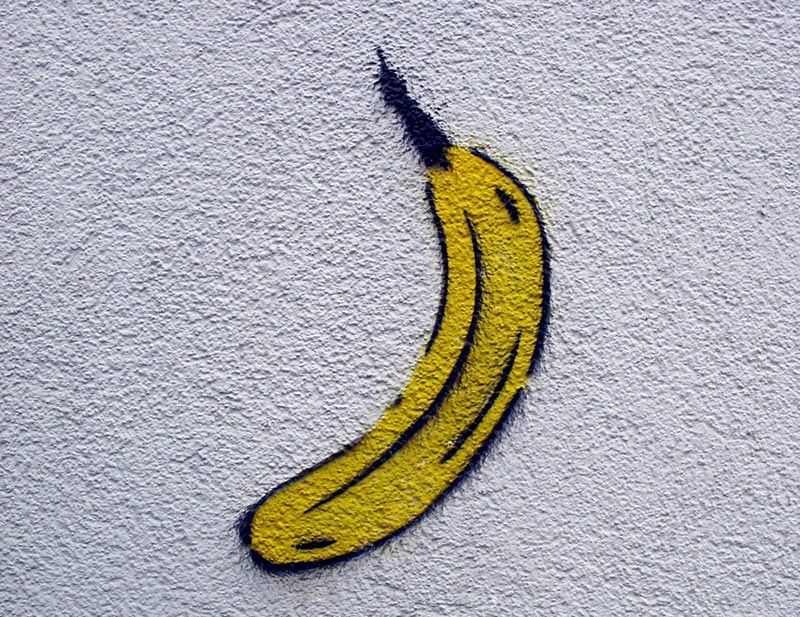
Thousands of artistic institutions around the world are marked with the seal of Thomas Baumgärtel: a yellow and black banana, inspired by the one created by Andy Warhol for the cover of the Velvet Underground album. They will soon be two fewer. On September 23, the municipality of Kamp-Lintfort (North Rhine-Westphalia) announced that the stencils will be removed from the Schirrhof and the Kunsthaus Bassier, two cultural establishments whose building is protected.
The municipal service responsible for the protection of monuments justifies the decision by the lasting alteration of protected buildings. While claiming to respect artistic freedom, he believes that it finds its limit when an intervention lastingly modifies the appearance of a monument. The city clarified that it would not ask the artist to cover the costs of erasure.
Denouncing an attack on creative freedom, the artist opposes the fact that his interventions are considered as degradation. From his point of view, his bananas serve, on the contrary, to distinguish cultural buildings in the urban landscape. Since 1986, the man nicknamed the “Bananensprayer” (“banana graffiti artist”) has affixed this signature motif to the facades of 4,000 museums, galleries and other establishments devoted to art.
In Germany, legislation on the protection of historic monuments is the responsibility of the Länder. In North Rhine-Westphalia, the applicable law, the Denkmalschutzgesetz Nordrhein-Westphalen (DSchG NRW) stipulates that authorization from the competent local authority is necessary to modify a historic monument, while providing for the possibility of authorizing certain interventions, provided that their public interest can be demonstrated. In this case, the administration considered that spray painting permanently modifies the appearance of the monuments.
The two establishments welcomed Baumgärtel as part of Niederrheintour 2026, an event bringing together forty cultural places in the German Lower Rhine to celebrate the 40th anniversary of its banana. The Schirrhof and Kunsthaus Bassier were among Kamp-Lintfort’s three stops and had presented his works from June 28 to the end of July. On the other hand, there is no indication that specific authorization was requested from the authority responsible for historic monuments before the artist painted the facades of the two protected buildings.
Until then, the municipal authorities had been conciliatory towards Thomas Baumgärtel’s interventions. The artist has generally been lightly constrained in his practice, although in 2020, he had to pay a fine of 500 euros after the owner of the former headquarters of the company KHD (Klöckner-Humboldt-Deutz), in Cologne, denounced him for having “bananaed” the facade of his building, used at that time by the artistic collective Raum 13, which was threatened with eviction.
In June 2026, in Cassel (Hesse), a large mural created by the collective of graffiti artists KolorCubes at the request of Documenta on the facade of the former ruruHaus, an experimental cultural third place, was covered by decision of the municipal authorities, who invoked the principle of protection of historical monuments and cultural heritage (Denkmalschutz).
In Cologne, the logic was the opposite. In September 2024, municipal agents accidentally almost erased Harald Naegeli’s Totentanz on the Sainte-Cécile church, a work initially created illegally in 1980 then redone with the agreement of the museum in 1989 and now protected. The city and the monuments services decided to restore it; the intervention was completed in June 2025. Cologne and Kamp-Lintfort nevertheless belong to the same Land, and both come under the DSchG NRW in terms of heritage protection.