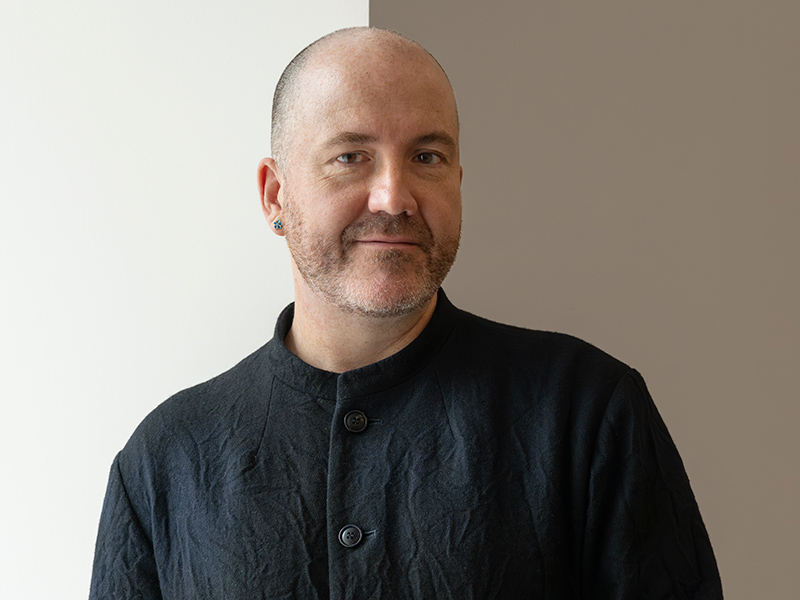
Having worked at the Centro Galego de Arte Contemporánea (CGAC), he directed the Centro de Arte Dos de Mayo (CA2M), in Madrid, from 2016 to 2023, before taking the helm of the Reina Sofía. He curated the Spanish Pavilion during the 2017 Venice Biennale.
The inventory of the collections has attracted numerous criticisms. Where is this construction site?
It will be completed in November. This work does not only consist of verifying the physical presence of the works, but also of reconstructing their history. We have already found several works of which we had lost track. Others will have to be officially declared lost, including some destroyed during the war and conflicts of the 1930s and 1940s.
How do you explain that a national museum has accumulated such a delay?
The Reina Sofía is a relatively young institution whose collections have developed very quickly. His organization has not always kept up with this growth. Since my arrival, nearly 170 people have been recruited, of whom around 140 previously held outsourced functions. It was essential to reintegrate these skills to improve collection management.
Attendance at the main site is increasing: 1.41 million visitors in 2023, 1.54 million in 2024 and 1.60 million in 2025. How are you working on welcoming these audiences?
Hospitality is central. We are developing spaces for rest and meetings. In a contemporary art museum, the visitor is not just an eye looking at a work, his body moves through the installations. Accessibility is also essential since around 60% of our visitors enter for free.
The Museo del Prado has a self-financing rate of 61%. Where is the Reina Sofía?
Today we finance between 30 and 35% of our budget thanks to our own resources, ticketing, sponsorship and museum activities. The Prado reaches a higher level, which shows that we still have room for improvement. We have created a department dedicated to the development of partnerships in order to strengthen this financial autonomy.
Madrid is experiencing increasingly intense heat episodes. Is the Reina Sofía adapted to these new conditions, for the works and for the visitors?
Not completely yet. The fourth floor is the only level of the museum fully equipped with LED lighting; the rest still partly operates with old installations which release more heat. Two rooms located on the fourth floor are currently affected by an air conditioning problem and no longer meet the conditions necessary for the conservation of certain works. We move them temporarily to replace them with rooms requiring less strict climate control. The problem should be resolved in the coming months and we have a three-year program to improve the climatic conditions of the entire building. This also concerns visitors. We are developing new rest and reception spaces. At the Palacio de Velázquez we have renovated the roof to improve interior conditions and we are rehabilitating the Palacio de Cristal to improve conservation and public comfort.
Museums are today at the heart of many social debates. Has their role become more political?
Museums have always been political. They are not neutral spaces since they reflect the debates of their time. Their responsibility is not to simplify the world, but to preserve its complexity. In a society where opinions are becoming radicalized, they must remain places where different points of view can coexist.
You know the French art scene well. How do you view its major institutions?
France remains an international benchmark. The Louvre, the Center Pompidou and the Musée d’Orsay have had a profound impact on the history of European museums. But major institutions must now go beyond the conservation of collections and question their role in society.
You also want to open the Reina Sofía to new eyes. Will this involve new international collaborations?
We will notably welcome Olivier Marboeuf, whose work on post-colonial stories and contemporary artistic practices nourishes reflections very close to ours. This dialogue with curators, researchers and artists from different backgrounds is at the heart of the museum’s scientific project.
Do the tensions experienced by certain large institutions, such as the Louvre, show that museums remain political issues?
When an institution or a work becomes the object of violent attacks, it is also proof that it retains considerable power. In a world where everything tends to become black or white, museums have the precise mission of preserving the complexity of the world.
Your scientific project plans a new presentation of the collections. What is the common thread?
I wish to offer a less linear narrative of art history, by establishing dialogues between works, periods and geographies. It is about making art history more open and faithful to the diversity of artistic experiences. Living artists also help us understand the present.
The return of Guernica to the Basque Country is regularly demanded. Can this work still be moved?
A technical assessment shows that its material condition makes any movement extremely delicate. Transport and old restorations have weakened the work: vibrations now represent a real risk. I believe that certain major works in the history of humanity, such as Guernica or the Mona Lisashould no longer be moved in order to guarantee their preservation and continued public access. If the question comes up regularly, it is also because Guernica is a deeply political work.
You defend the idea of a “museum in motion”. What do you mean by that?
A museum can no longer just be a place of conservation. It must be a space for research, debate and knowledge production. Collections only take on their full meaning if they allow us to question the present.