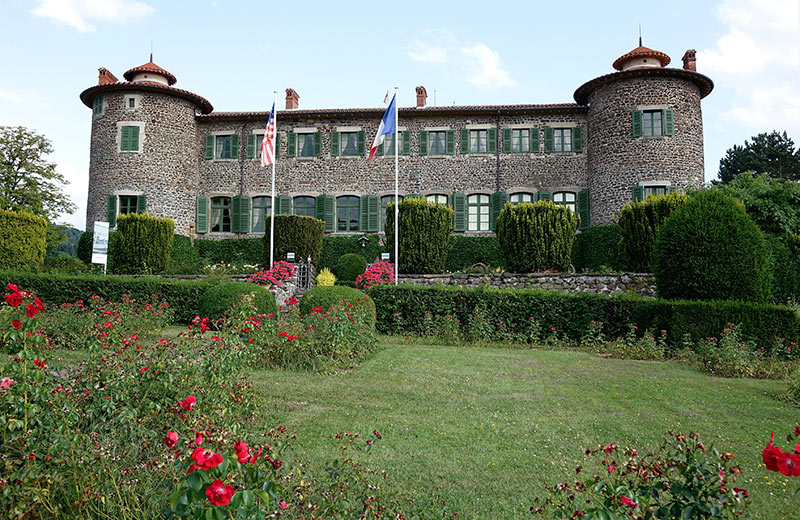
The situation is unprecedented: the American Department of State grants a grant of 235,000 dollars (or 202,000 euros) to the birthplace of the Marquis de La Fayette in Haute-Loire, via the program Ambassadors Fund for Cultural Preservation (AFCP), dedicated to financing cultural heritage preservation projects abroad. France had, until then, never benefited from aid from the AFCP.
The official announcement took place on Sunday September 6, while the museum celebrated the 269th anniversary of La Fayette’s birth, during a ceremony organized by the Department of Haute-Loire and the American Diplomatic Mission in France.
The contribution is intended for the restoration of part of the castle gardens and the conservation of the collections of the French Heroes of Lafayette Memorial Fund (FHLMF), which notably document the general’s journey and his engagement alongside American insurgents during the War of Independence.
Two rose bushes were planted during the ceremony, in memory of two major historical figures in the history of American independence: General Lafayette and Commander-in-Chief George Washington. Defying the orders of King Louis XVI, the Marquis de La Fayette enlisted at the age of 19 alongside the American insurgents, who had proclaimed independence a year earlier, in 1776. Very quickly, the Congress of the 13 colonies gave him the rank of major general of the Continental Army, and he became one of George Washington’s closest collaborators. As one of the actors in the victory over the British troops during the Battle of Yorktown on October 19, 1781, La Fayette contributed to the recognition, two years later, of the United States of America by Great Britain, established by the Treaty of Paris in September 1783.
Today, American aid to the Chavaniac castle-museum reads like a symbolic token of gratitude. While last July, the United States celebrated the 250th anniversary of its independence, the AFCP grant gives the Trump administration the opportunity to continue the commemorations across the Atlantic, and reminds us that this story is also that of the birth of Franco-American friendship.
In Washington too, Lafayette Square is the subject of major federal work. The National Park Service notably mobilized $1.5 million to secure and rehabilitate its paving stones. The Trump administration is also carrying out a project for a permanent fence around the park, currently subject to federal planning and heritage protection authorities. Temporary barriers already surround the square, which were installed following protests against police violence and racism following the killing of George Floyd in 2020.
Listed as a “Historic Monument” and labeled a “Remarkable Garden”, the Château de Chavaniac, in Haute-Loire, was the birthplace of the Marquis de La Fayette. Built in the 14th century, it was remodeled by the architect Vaudoyer from 1791, then sold as émigré property following the departure of La Fayette in 1793, in the midst of the French Revolution. The family managed to remain owners of the castle, thanks to its purchase by one of its members. In 1917, the association of American philanthropists French Heroes Lafayette Memorial Fund acquired the castle and renovated it so that it could house La Fayette’s historical collections. From 1966 to 2009, the Franco-American association “Memorial Lafayette” managed the castle, before it came under the responsibility of the Department of Haute-Loire, its current manager.
Until November, visitors can discover the treasures of the FHLMF collections, which retrace the journey of General La Fayette, emphasizing his decisive role in the American War of Independence. To celebrate the link that the general embodies between France and the United States, the exhibition “Lafayette, the American Adventure (1776-1781)” tells the story of a soldier who became an international hero.