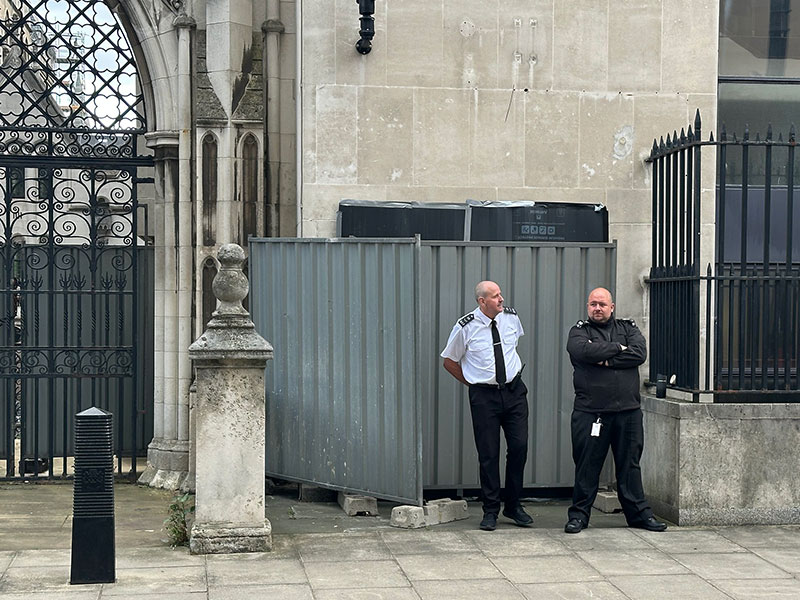
In total, 85,000 pounds sterling (nearly 100,000 euros) were spent by the British Ministry of Justice to erase the stencil, made by the artist Banksy in September 2025 on a wall of the Royal Court of Justice building in London. Part of the costs, however, relate to securing the area as indicated in Guardianthe first to report the information.
The importance of the budget mobilized to make this work disappear street artlevied on British taxpayers’ taxes, revives a debate as old as discipline: vandalism or art? While shadow justice secretary Nick Timothy has clearly positioned himself in favor of the first option, arguing that Banksy should pay the price, many are defending the protection of the street art.
If in the past, certain creations signed by Banksy have already mobilized public spending, they were often intended to ensure their protection. In 2006, the municipality of Bristol decided to preserve the work Well Hung Lover after a citizen consultation came out almost unanimously in favor of maintaining it. Three years later, the city intervened to restore the work following vandalization. More recently, in 2024, the former London police box transformed into a piranha aquarium by the artist was moved to Guildhall Yard and protected by barriers, before being acquired by the London Museum (formerly Museum of London) in 2025.
Banksy graffiti on the walls of the Royal Courts of Justice in London.
© Banksy
But the case of the Court of Justice stencil is more specific. The main reason for its removal lies in the fact that the building on which it was painted (the Queen’s Court Building, an extension of the historic building), is classified “grade II”, which means that the administrative service responsible for the British courts (His Majesty’s Courts and Tribunals Service, HMCTS) is legally obliged to preserve its historic character. Furthermore, like the majority of Banksy’s works, the painting conveys a strong political message which, in this case, directly attacks the judicial institution: it depicts a judge dealing violent blows to a demonstrator lying on the ground, armed with his mallet.
British law does not provide for a specific legal regime to ensure the protection of works of art. street artBanksy’s stencil remains unauthorized graffiti, and therefore constitutes damage (” criminal damage “). However, the English public body responsible for the protection of historic English buildings recognizes the difficulty in drawing a clear boundary between ” street art ” and “unwanted graffiti”, and the authorizations granted to other wild works of Banksy show that the legislation can evolve on a case by case basis.