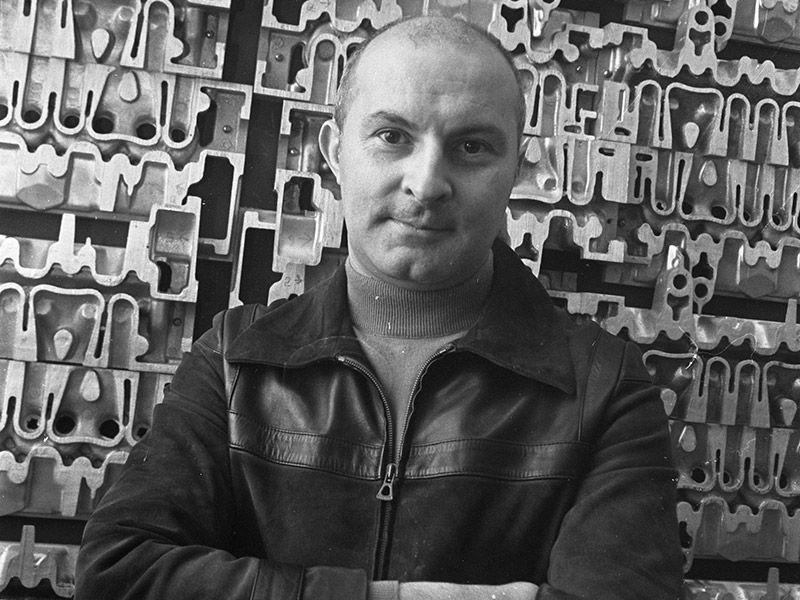
Mougins (Alpes-Maritimes), 1977. The young Alain Ducasse started as a clerk with Roger Vergé, champion of southern cuisine, in his restaurant Le Moulin de Mougins. It was at this sunny southern restaurant that the future starred chef met and became friends with (Jean-Michel) Folon, César (Baldaccini) and Arman (or Armand Fernandez). The work of the latter, whose name comes according to the anecdote from a printer’s spelling mistake, is emblematic of the use of everyday objects in art. Interested in the status of the object in modern societies, Arman criticizes overconsumption by diverting, cutting, burning, dynamiting or destroying violins, pianos, cars or bourgeois interiors. This explains why he is one of the founding members of New Realism, a movement which transforms society’s objects into relics, like powerful symbols of consumption.
In 2000, the paths of Arman and Alain Ducasse crossed again: the former produced seven paintings for the latter’s restaurant, called “Alain Ducasse at the Essex House”, in New York. But the chef failed to attract New Yorkers and was forced to close shop in 2005, the same year that Arman died at the age of 76. Ducasse then brought the seven paintings back to France and entrusted them to Camard & Associés in order to sell them at auction. An approach which attracted the attention of Arman’s widow, Corice Canton-Fernandez, because for her the works were only deposited with Ducasse. The latter replies that there was a manual donation from Arman and that he is the owner of the works. The question is simple: who owns the works?
Presumption of ownership
On November 26, 2007, the execution judge of the Paris High Court retracted his order of June 7, 2007 by which he had authorized the widow to seize the claim, as a precautionary measure, and ordered her to proceed with the restitution of the works. Dissatisfied, the widow appeals. On June 19, 2008, the court of appeal indicated that Alain Ducasse could benefit from the presumption of article 2276 of the civil code (at the time “article 2279”) which establishes a fundamental rule according to which “in matters of furniture, possession constitutes title”. Indeed, the possessor is the one who has material power (corpus) on the thing and has the desire to behave like a true owner (animus domini). It is deduced from this maxim: a probative function which makes it presume that the possessor of a piece of furniture is the legitimate owner; and an acquisitive function which implies that possession of a piece of furniture immediately transfers the right of ownership of this piece of furniture to the possessor when the latter is in good faith. To be valid, this possession must meet certain conditions: it must be neither precarious (case of deposit), nor equivocal (several people are owners of the same piece of furniture), nor clandestine (concealed). Also anyone who claims to have received a thing as a manual gift benefits from the presumption and it is up to the party who objects to provide proof that the possession is vitiated or proof of the precarious nature of the possession by producing, for example, a loan or deposit contract.
Chef Alain Ducasse.
© M. Vojinovic
However, this is where the problem lies because the appeal judges consider that the widow,“who must provide proof of the absence of manual donation, maintains that a wise man like Alain Ducasse could never have received these works without ensuring in writing that they now belonged to him”. Conversely, “an artist like Arman, who his wife says is concerned about the dissemination of his work and its economic value, could not deposit works with a friend without keeping written proof of this deposit, proof that Corice Canton-Fernandez does not provide.” The widow is dismissed.
French or American law?
The latter appeals to the Court of Cassation by contesting the application of French law to the dispute in favor of American law which does not have the same presumption of ownership as that attached to the possession of a piece of furniture by French law. To the first question is added a new question: should we apply American law, designated as the law of the location at the time of submission of the paintings, or French law, designated as the law of the location at the time of their claim? On February 3, 2010, the Court of Cassation considered that “French law is the only one applicable to real rights relating to movable property located in France”. Alain Ducasse having brought the works back to France in January 2007, where they were located when Corice Canton-Fernandez claimed them, the presumption “in terms of furniture, possession constitutes title” found application. On the other hand, it confirms the vision of the appeal judges: at the time of the arrival of the paintings in France, therefore at the time of the application of article 2276, no ambiguity weighed on the possession of the restorer. Arman’s widow is definitively dismissed, Ducasse can legitimately keep the seven works.
With this judgment, the Court of Cassation recalls that art is a playground for the most famous alexandrine of property law. It therefore ruled on March 22, 2012 that the beneficiaries of a gallery owner, to whom works by Alexander Calder had been given with a view to their possible marketing, could not invoke the benefit of the presumption due to precarious detention. In the same way, it ruled on October 28, 2015 that the archive management mandate entrusted to the widow of the artist Victor Vasarely constituted only a promise of donation and did not carry a presumption of ownership. Going further, she was able to admit, on May 15, 2024, that the proof of defective possession was sufficient to grant the action for recovery brought by the heirs of Henri Matisse against a third party claiming to derive its rights from an alleged depositary. The affair of Arman’s seven paintings reminds us that the claim to personal property navigates between order and disorder.