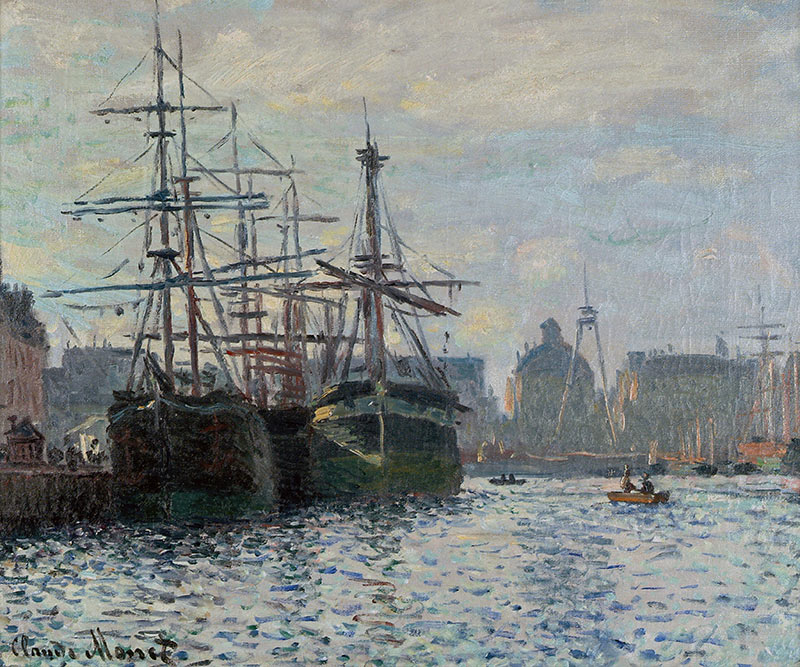
Le Havre (Seine-Maritime). Everyone who read Monet in Le Havre, the decisive yearspublished in 2016 by Hazan Editions, dreamed of an exhibition that shows the works reproduced in this book. It’s done, under the supervision of Géraldine Lefebvre, the director of the work who became director of MuMa. Of course, not everything is discussed (the possibility of the first contact with Japanese prints in Le Havre, for example) and not all the paintings have been obtained or requested. Print, rising sun (1872) was the subject of an exhibition at MuMa in 2017 and there was no point in returning to it. Jeanne Marguerite Lecadre in the garden Or Woman in the garden (1867), kept in the Hermitage Museum in St. Petersburg, was out of reach. Furthermore, if the subject, “Monet in Le Havre”, which has never been the subject of an exhibition, could excite museums and collectors, it is today part of the commemoration of the centenary of the death of Claude Monet (1840-1926) and international competition for loans is tough. The curator therefore fought to bring together works likely to document Monet in the city where his vocation as a painter was affirmed, among those who guided and supported him.
Arriving in 1845 in Le Havre with his parents and his brother Léon, Oscar Claude left in 1860 to settle in Paris. But he often returns to stay in the town of his childhood and in the nearby town of Sainte-Adresse where Le Coteau, owned by his family, is located. He also continues to maintain relationships with his first Le Havre collectors. Throughout his career, he participated in various fairs organized by this city with its dynamic cultural life and whose fans remained loyal to him, to the point that in 1910 he donated three works to the Le Havre Museum. Of this long history, Géraldine Lefebvre only addresses the first years and the end, with the donation of Varengeville Cliffs (1897), from London Parliament, fog effect (1903) and Water lilies (1904).
Claude Monet (1840-1926), Camille with the little dog1866, oil on canvas, 73 x 54 cm, private collection.
© Dominic Büttner
At the heart of the family archives
To carry out her project, the curator benefited from her knowledge of the painter’s family, thanks to which she was able, in 2023, to present the exhibition “Léon Monet, brother of the artist and collector” at the Luxembourg Museum. Claude Monet having no direct descendants, it was those of his brother Léon (1836-1917) who inherited from him. They are therefore the main source of information apart from the descendants of Le Havre families allied to Monets or his Le Havre collectors. With them, the work of the commissioner, her assistants, Michaël Debris and Pascal Perrin, and her network has borne fruit. Thus, the photographic portrait of the notary Léon Manchon (around 1865), identified in an album of the Lecadre family allied to that of the Monets, could be linked to the charged portrait of Leon Manchon (1858), showing how the young Monet (who still signed with his first name, Oscar) captured the salient features of his model.
Two important unpublished paintings have been identified. At the exhibition “Léon Monet” was presented Adolphe Monet (1865) by his son Claude, profile portrait still kept by the painter and today belonging to the Zimmerli Art Museum (New Brunswick, New Jersey). However, we knew that Léon had acquired another version which he also kept until his death. This one, three-quarter face, remaining in its descendants, is presented for the first time to the public. The other discovery is Camille with the little dog (1866, [voir ill.]), portrait of Camille Doncieux (1847-1879), companion and future wife of Claude Monet. “To my knowledge, says Géraldine Lefebvre, this portrait kept in a private Swiss collection had never been shown. Obtaining it was the result of long negotiations. » The owners feared that the work had been stolen during the war. Helped by Pascal Perrin, the curator reconstructed its history ” flawless “ and was able to obtain the loan.
Other choices make this exhibition a unique look at Monet. This concerns, for example, the place given to still life and flower painting, to charged portraits and finally to pastels, key manifestations of the painter’s emerging genius. It is also about the importance given to the first two drawing notebooks of the very young Monet – the second was unpublished – still belonging to the artist’s family. Presented enlarged in facsimile and in a glass case, open on the first page, they are fully reproduced in the appendix to the excellent exhibition catalogue.