Paris. On the left, a portrait of Louis XIII sporting gleaming armor, a sword and a baton of command. On the right, Cardinal Richelieu in full length, dressed in a satin simarre with refined embroidery. Behind this pendant presentation plays the founding act of the Royal Navy. It all began in 1626, when the king granted the cardinal the office of grand master, head and general superintendent of navigation and commerce in France. The French Navy, which had become a veritable corps of war, then established itself as a major element of royal policy. But what role does painting play in this story? It is precisely this link between art and power that the National Maritime Museum highlights, showing that the ambitions of the State are expressed as well on the seas as on canvases.
By unfolding four centuries of history, the exhibition deals with a subject that is as little known as it is fascinating.“The naval fact in painting is a theme that raises historiographical issues, but also theoretical, scientific, typological… There is an enormous amount of work to be done on the subject, which this exhibition covers very modestly but with conviction! “, underlines the commissioner and curator at the museum, Bertrand de Sainte-Marie. The spotlight is therefore on painters who have fallen somewhat into oblivion, whose works nevertheless seduce with their plastic force. Matthieu de Plattemontagne (around 1608-1660), the first, in 1648, to receive the title of “painter of the King for the seas”, produced engravings of naval battles which recreate all the violence of a threatening sky and the raging sea. Théodore Gudin (1802-1880), one of the very first painters to be officially attached to the Ministry of the Navy, boarded ships and depicted the French fleet with great chromatic subtlety.
The naval battle, but not only
Naval art has also attracted the attention of big names in painting. Claude Lorrain (1600-1682), who also joined the Royal Academy under the title of “Royal painter for the seas”, wonderfully merges Italian antiquity landscape and Nordic tradition of maritime landscape. For the vault of the Grand Gallery of Versailles, Charles Le Brun (1619-1690) mixed history and fable in order to create an allegory of the power of the Navy. “The Navy seen by painters is based on a crossing of various artistic and figurative categories. This is the complexity of the subject, but also what makes it fascinating,” observes Bertrand de Sainte-Marie. In fact, the interest of the exhibition lies in this choice of works at the crossroads of genres, which combine historical painting, allegory, landscape, genre scene…
Emile Mathon (1842-1899), Translation of Admiral Courbet’s ashes1885, oil on canvas, 196 x 265 cm.
© National Maritime Museum / P. Dantec
Therefore, these works where art and power intertwine by no means form a uniform whole, but on the contrary deploy a wide variety of subjects. The naval battle is of course the spearhead to exalt the power of the Navy, but we also find all the portraits of leaders, the representations of ports and ships, the construction of arsenals, the maritime celebrations… In the selection presented there are also more singular scenes: an episode of cholera seized by Horace Vernet (1789-1863), a release of military pigeons aboard a torpedo boat by Paul Jobert (1863-1942) or a night view of a port by Manet (1832-1883), more focused on the development of the merchant navy.
Reflection of various styles
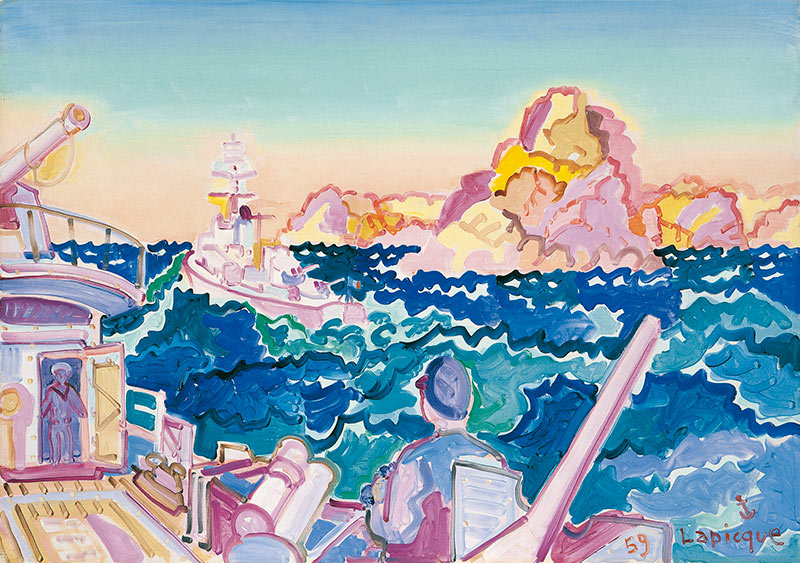
The exhibition raises awareness that naval painting is a beautiful reflection of major artistic developments. The navy follows the tastes of the times, embraces the search for pictorial modernity, draws on post-impressionist, Cézanian, Fauvist and then Cubist trends. Vibrant touch of Paul Signac (1863-1935), chromatic audacity of Charles Lapicque (1898-1988), utopian realism of Arnaud d’Hauterives (1933-2018): new expressions are emerging. With its chronological progression, the journey clearly highlights the way in which each painter uses certain codes and offers his own vision of the sea, whether he himself is a sailor, a painter attached to the Navy or not.
At the end of the exhibition, the 46th Salon de la Marine presents the recent creations of the official painters of the Navy (POM) – the title was created in 1830 – some of whom are still in practice. Paintings, drawings, engravings, sculptures, but also photographs and videos remind us that the tradition, although ancient, still remains alive.