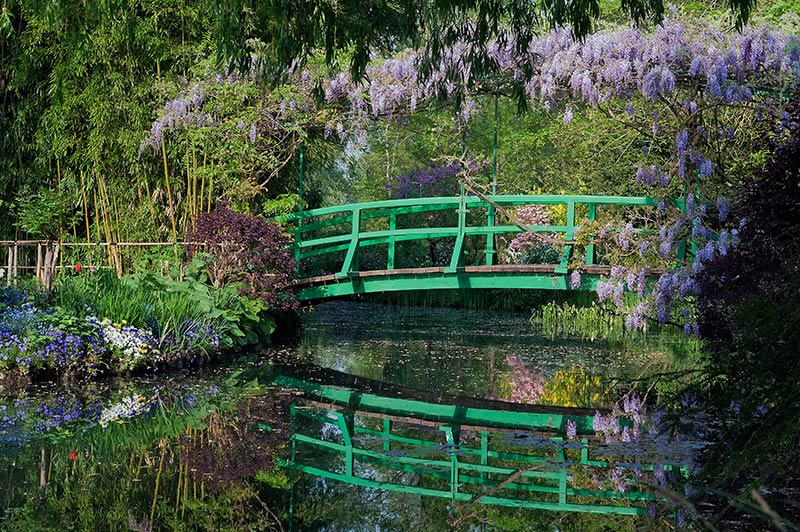
Giverny (Eure). First there is the story. And she is beautiful. On April 29, 1883, Claude Monet (1840-1926) saw this Norman village of 279 souls from the door of a train and decided to settle there. He transformed the garden, built three greenhouses. Then had a pond dug on the other side of the path which a Japanese bridge spanned. A perfectionist, he hires up to seven gardeners, including one responsible for mopping up the drops of rain or dew on the water lilies every day. A garden-picture which will inspire 300 paintings including the large decorations presented at the Orangery.
In 1947, upon the death of Blanche Monet-Hoschedé, her daughter-in-law, nature took back its rights. The Norman enclosure is invaded by brambles, the Japanese bridge is rotting in black water. And the banks are destroyed by coypu.
“When the curator Gérald Van der Kemp, who had just saved the Palace of Versailles, hired me in 1976 to recreate the garden, it was completely abandoned and most people did not know that Claude Monet had lived there,” remembers Gilbert Vahé, the gardener behind the recreation of the gardens. He then uses the master’s paintings, but also the memories of relatives still alive. Everyone makes lists of the plants they saw there. The restoration lasts four years. The opening in 1980 attracted 70,000 visitors. Two years later, there are 200,000. “We were forced to adapt gradually by protecting the plants with brick rafters, surrounding the water garden with woven bamboo fences and concreting the paths, explains Gilbert Vahé. We have managed to limit the trampling, but every morning the gardeners spend hours repairing what was destroyed. »
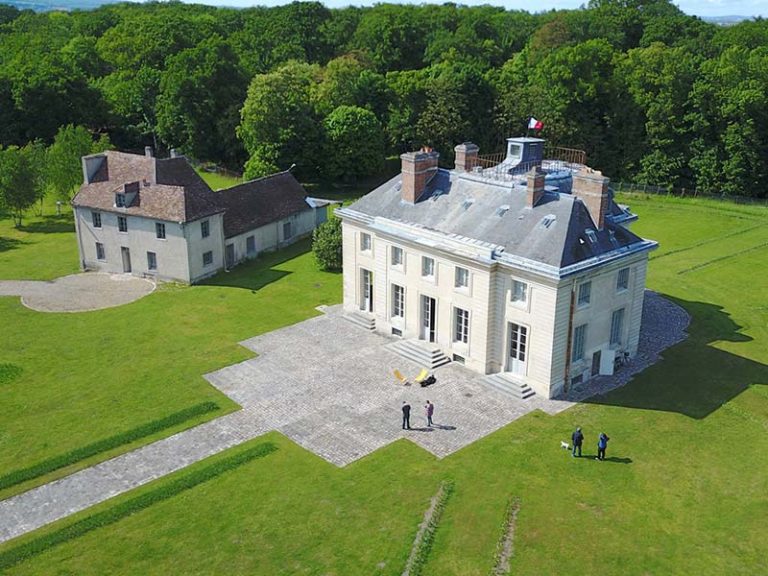
Claude Monet’s House in Giverny seen from Clos Normand
The flower factory
Because attendance is always increasing and should exceed a million visitors in this year of the centenary of the painter’s death. In the aisles, the spectacle is almost frightening. Compact clusters of humans following one another, almost glued to each other. Waiting in endless queues to be able to take the photo of the flower, the water lily. Still waiting to go up on the Japanese bridge and take away a photographic souvenir. Unforgettable. Impressions are mixed. Liam, a fifty-year-old from Boston, is circumspect. “There are fewer people in the toy section of a department store at Christmas”he observes. While Min-Jun, a thirty-year-old from South Korea, confides her disillusionment: “The incessant trampling of people makes any emotion impossible. »
The gardens bear the scars of this overtourism. Gardeners have built up a reserve of summer plants to remedy incidents that have occurred in the gardens. No less than 140 different varieties are cut each season, or nearly 15,000 plants. “Timetables have been adjusted to river tourism, but this does not make the work of gardeners easier and is detrimental to the garden,” confides Gilbert Vahé. How far can we push attendance at a living work? Because logic favors perpetual substitution rather than preservation. Have gardens become an industrial product with defective parts constantly being replaced?