
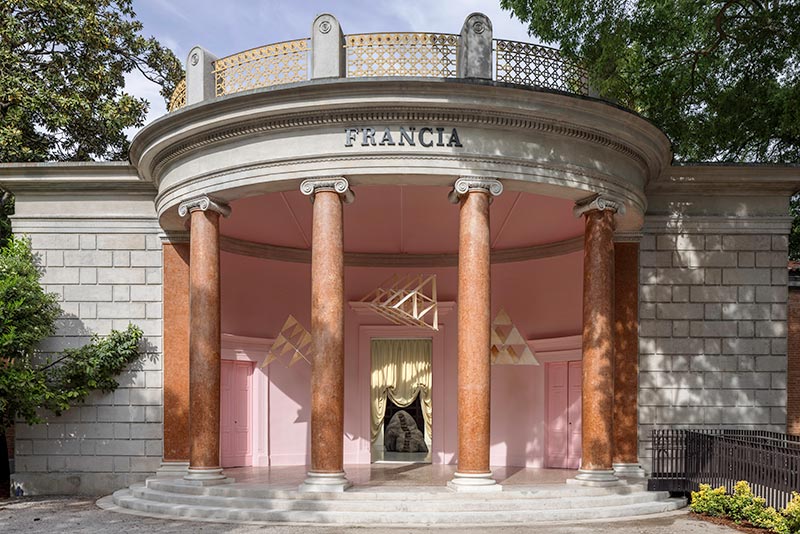
Venice. It was in a French pavilion renovated after fifteen months of work that Yto Barrada (born in 1971 in Paris) unveiled Like Saturna vast multidisciplinary installation in four chapters. For the 61st Venice Biennale, the Franco-Moroccan visual artist-researcher explores different layers of the history of textiles by summoning the figure of Saturn, god of Time and Agriculture both in Greek mythology, and planet associated with melancholy, contemplation as well as artistic creation since the Renaissance.
To carry out her project, the founder of the Cinémathèque and the associative garden The Mothership, both in Tangier (Morocco), entrusted the curatorship of the exhibition to Myriam Ben Salah, general director and chief curator of the Renaissance Society at the University of Chicago. The result is a complex, eminently conceptual exhibition, combining meditation on the characters, places and rituals associated with Saturn in Greco-Roman mythology and reflection on the stories and techniques linked to the textile medium. Yto Barrada notably draws an analogy between the father of Zeus, who devoured his children, and the “devoured” technique which since the 17th century has made it possible to chemically dissolve the velvet fibers in order to obtain a transparent fabric.
In the shadow of the masters of modern art
In the four rooms of the pavilion, Yto Barrada also multiplies the nods, more or less explicit, to the artists who nourish his practice. “Yto ou Tard”, “Saturn Saturn Saturn It’s turning”, “anti-headed stubborn haunted ante stubborn” : it’s impossible not to think of the puns so dear to Marcel Duchamp when reading the screen-printed letters enthroned on the picture rails, puns composed in the purest Dada tradition. The ghost of this tutelary figure of the international avant-garde hovers over the entire exhibition, with the dissemination, here and there, of ready-made conjugated in the present.
Yto Barrada, “Comme Saturne”, view of the Salle des Plis in the French pavilion.
© Jacopo La Forgia / French Institute
Still in the large room of the Giardini pavilion, a “wheel of rules” pays homage to the writing games based on the constraint of the Oulipo research group (Ouvroir de literaturepotential), founded in 1960 by Raymond Queneau and François Le Lionnais, a group to which Duchamp belonged at the end of his life. Cinematographic references are also legion: the shape of the “dress color of time”, worn by the character Peau d’Âne in the film of the same name by Jacques Demy (1970), is sewn on a large woolen curtain hanging in the first room while a television screen broadcasts extracts from the cartoon Billy Boy (1954) by Tex Avery in the side room assigned to the work.
What could possibly be the purpose of such an overabundance of quotations, often without the slightest connection with the Saturnian theme of the exhibition? For the shaping of his intuitions and games on the language, Yto Barrada’s assistants carried out a real “funnel work”, confides the artist. And this is precisely where the exhibition goes astray: if it loses sight of its common thread too much, it ends up looking like a simple exercise in style.
Furthermore, if the artist manages to develop a unique statement, faithful to his usual research themes around the history of textiles and dyeing practices, his imposing cultural background seems to prevent him from asserting a touch emancipated from a plastic vocabulary worn to the wire by several decades of repetition of all kinds. Its large textile installation deployed in the “Study room” [voir ill.], at the back of the pavilion, is a perfect illustration: the artist aims to develop a new theory of colors going beyond the system theorized by the Bauhaus (1919-1933) in Weimar in Germany by the painter and teacher Josef Albers and which dominated a good part of the 20th century. Yto Barrada, however, ends up adopting the emblematic representational codes of modernism, in the lineage of geometric abstraction and minimalism. Its 71 shades of natural red pigments on wool, from madder to indigo, form a monumental composition decorated with a multitude of monochrome rectangles. It’s a shame that substantive reflection has taken so much precedence over formal expression.
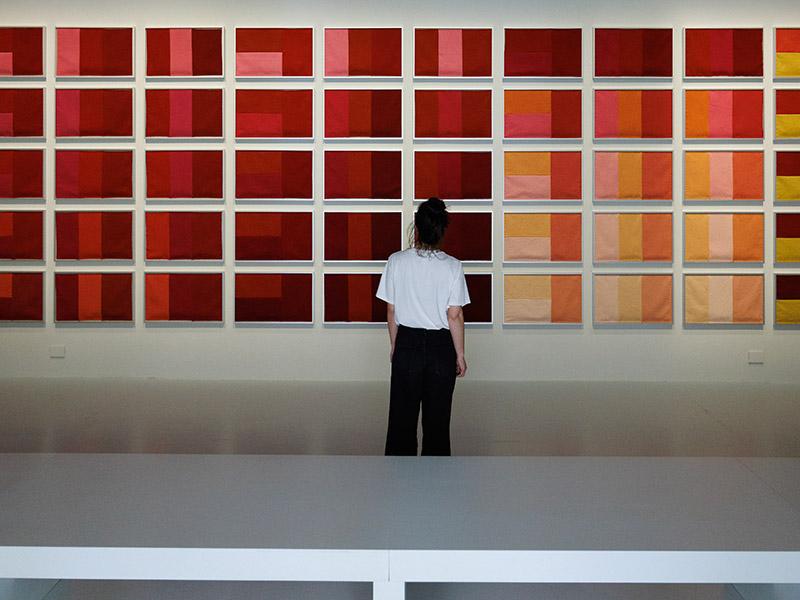
Yto Barrada, “Like Saturn”, view of the Study Room in the French pavilion.
© Jacopo Salvi


