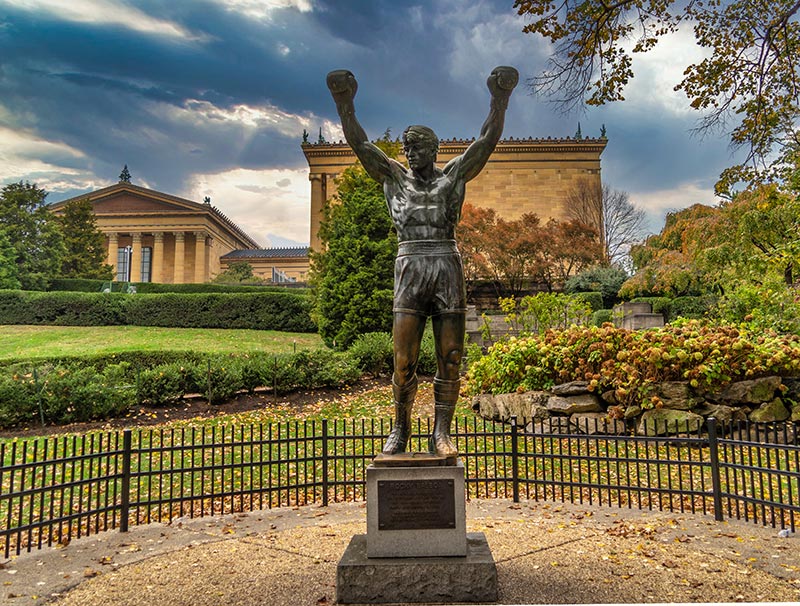
Philadelphia, Pennsylvania. It’s a cinema sequence that is especially familiar to those over 60. In Rocky released in 1976, Sylvester Stallone plays an amateur boxer who trains in the streets of Philadelphia for a fight against the world champion, and ends his training by climbing the steps of the Philadelphia Museum. The character of Rocky Balboa was so successful that several sequels were filmed. For the third opus, the actor had a large bronze statue of his character made, donated to the City and installed at the bottom of the museum steps. To the great dismay of the establishment which has long maintained a form of distance from this statue considered cumbersome, while the tourists, delighted, rush to have their photos taken alongside it. So much so that it has become one of the symbols of the City and even of the museum. Thus, an object outside his collections strongly contributed to his image.
The statue becomes an object of art
But today, the museum has come to terms with this fictional character, to the point of organizing an exhibition since April 25, entitled “Rising Up: Rocky and the Making of Monuments”, presented until August 2. The statue was even temporarily moved inside the building. Entrusted to guest curator Paul Farber, the tour brings together more than 150 works and objects. It covers more than two millennia of representations of fighters, from Antiquity to contemporary art. The museum confronts the figure of Rocky with old sculptures, images from the golden age of American boxing, as well as works by modern and contemporary artists, including Andy Warhol, Jean-Michel Basquiat, Keith Haring and Carrie Mae Weems. The objective is to show how certain figures of fighters become collective emblems, shaped by artists, the media and public uses.
The statue is also placed in the social history of Philadelphia. Rocky Balboa, a fictional white character, has become one of the most reproduced symbols of the city, even though it has a real boxing history, notably marked by Joe Frazier (1944-2011). World heavyweight champion, based in Philadelphia, Frazier was one of the inspirations for the character imagined by Stallone. At the end of the exhibition, the original Rocky statue must be permanently installed at the top of the museum steps. A new statue of Joe Frazier is planned at the bottom of the stairs, in the location long associated with Rocky.
The exhibition is part of a broader context of re-examination of monuments in the United States. While for several years, groups have contested the presence in public spaces of statues of figures they consider to have played a harmful role (including Christopher Columbus), Donald Trump is blowing a headwind described as reactionary. In Philadelphia, the Rocky case presents a singularity: it is neither a military hero nor a political figure, but a fictional character. Its legitimacy is not due to history in the strict sense, but to the use that has been made of it by generations of visitors. But it’s hard not to see it also as submission to Trumpian injunctions.