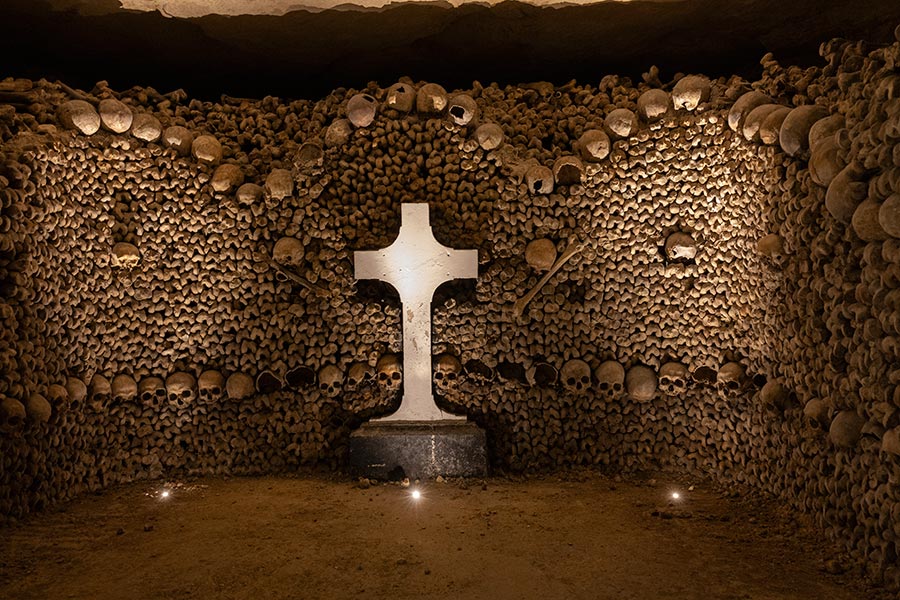
Paris. It is a place that does not know the crisis. Despite an entrance fee of 31 euros, a record for a Parisian heritage site, the Catacombs are never empty. Better still, they even have the luxury of refusing people. Therefore, the 600,000 annual visitors, mainly foreigners, must reserve a visit slot. “In a way, attendance hasn’t changed much in two centuries, smiles Isabelle Knafou, the site administrator. From the start, the catacombs were “reserved” for a small number of visitors. They were accessible by reservation only and, from the outset, they attracted mainly an international audience. » From the outset, we are tempted to add, the place has also attracted a certain public in search of thrills and unfortunately not always respectful of its sacred dimension. “This remains a very small minority, but unfortunately some people behave like they are in an amusement park and try to touch the bones. But, here too, this is nothing new, explains the administrator. In 1830, the prefect Rambuteau ordered the closure of the site because he considered it immoral; not only because of the exposure of the bones, but above all because of the inappropriate behavior of visitors, some of whom leave with bones in their pockets or leaving graffiti. »
A public health problem
Unlike their Roman counterparts, the Parisian Catacombs are not ancient, they are an invention of the 19th century. In 1809, the Catacombs welcomed their first tourists. Their creation results from two contemporary, but totally distinct, phenomena. At the very end of the Age of Enlightenment, the capital faced two imminent dangers. First of all, a severe risk of collapse of part of the city due to the collapse of the old quarries dug underground in the Middle Ages to industrially extract the limestone necessary for the construction of the city’s large buildings. The decision was made to consolidate this sprawling network of underground arteries, under the leadership of the General Inspectorate of Quarries (IGC). Service which plays a crucial role and which still employs many engineers and technicians.
The catacombs photographed by Nadar in 1861.
Alongside this danger, Parisians are faced with another public health problem. For decades, residents have complained that the cemeteries, all located within the walls, are full to bursting. And this, literally, since in 1780 a mass grave in the Halles district overflowed into the cellars of adjacent houses! “Nearly three thousand corpses per year were deposited in the Innocents cemetery, located in the most populated district. The dead were buried there since Philippe-le-Bel”says Sébastien Mercier. “What a melting pot!” »exclaims the writer in his Paris painting denouncing the cohabitation between the living and the dead. “A market where grass and vegetables are sold has been built on these remains of the human species. »
The overflowing of graves arouses, it is easy to understand, the anger and indignation of local residents. Grouped together as a collective, like a class actionthey obtained from the Parliament of Paris the closure of the cemetery and the transfer of the remains. “There are few pictures more dark than that offered by work in the middle of a mass grave, comments Mercier. Let us imagine lit torches, this immense pit, opened for the first time, these different beds of corpses suddenly stirred, these remains of bones, these scattered fires fed by coffin boards, the moving shadows of these funerary crosses. » To avoid further shocking the population, the transport of bones “was constantly carried out at dusk, in funeral chariots, covered with a funeral sheet”. The creator of the Catacombs, Louis-Étienne François Héricart de Thury, recounts this procession “followed by priests in surplices, who sang the office of the dead”. Fifteen months are needed to move the two million “residents” of the Saints-Innocents in the old quarries. Gradually, all urban cemeteries met the same fate and transfers continued until 1860.
“The terrible crash of bones”
Although the new ossuary, renamed the Catacombs, was consecrated by the Archbishop of Paris, there was nothing dignified or sacred about it. The remains are in fact unceremoniously thrown from wells located 20 meters high and form undignified pyramids languishing on puddles of water. In his Description of the CatacombsHéricart de Thury deplores this Dantesque spectacle evoking “the terrible crash of dried bones, precipitated and rolling with a noise that the vaults repeated in the distance”. The new quarry inspector testifies with horror of the “disorder and confusion” who reigns underground when he takes office. But also the state of abandonment, landslides, infiltrations as well as the “stagnation of thick, humid and unhealthy air”.
The inspector improved air circulation and especially the presentation of the bones in preparation for the opening of the site to the public in 1809. In order to “break the sinister and dark monotony of this immense ossuary”he installs “inscriptions taken from Holy Scripture, poets and philosophers”. To guarantee the preservation of this fragile heritage, he also arranged the bones to form solid walls. Finally, for greater solemnity, he designed this museum-walk of a unique kind by drawing on ancient inspirations. The altar of obelisks cites for example “a magnificent marble tomb, discovered between Vienna and Valencia”he explains in the guide he publishes. “ As for the pedestals, they are made of bones.” From the outset, this museum attracts a curious public. Its inventor has the excellent idea of providing him with a guest book which records the reactions of the first tourists. “What terrible abysses open around me, notes a certain Rousseau. What a deluge of victims presents itself to my eyes full of fear. » Two centuries later, the emotion in this unique place is intact.