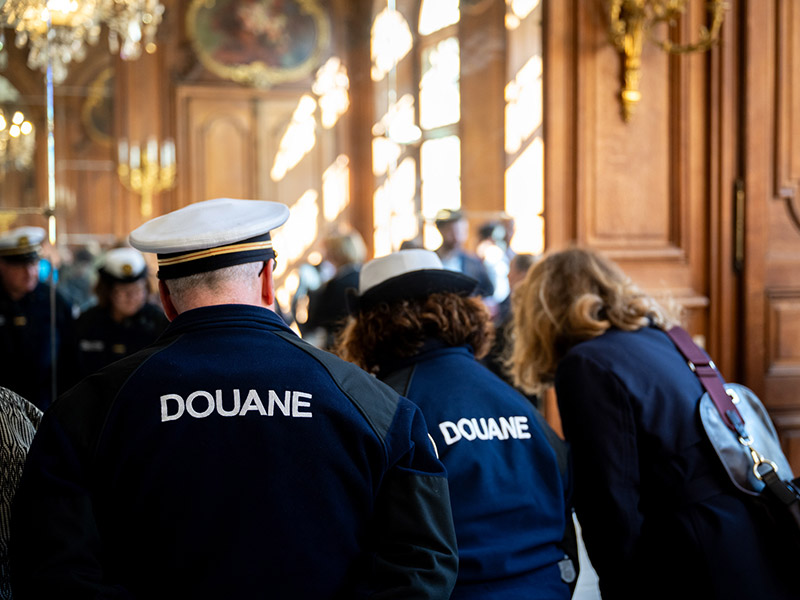
According to its annual report, French customs seized 25,070 cultural goods in 2025, an increase of 12% compared to 2024. These seizures mainly concern archaeological objects, coins, fossils, pieces of goldwork and ethnographic objects. A notable part of these goods comes from zones of conflict or instability (Middle East, Ukraine, certain Latin American countries), as well as countries rich in fossil heritage (Mongolia, China, Morocco, Brazil).
Among the emblematic cases, customs intercepted a gold penny attributed to Charlemagne, then returned to the National Library of France, where it joined the monetary collections accessible to researchers. A series of operations carried out in Lille, Amiens, Bayonne, Béziers and Sète also resulted in the seizure of nearly 3,000 objects. In Lille, customs officers intercepted fragments of monuments and inscribed Iranian bowls, some dating from the 12th century and estimated at between 106,000 and 137,000 euros. In Bayonne, Bronze Age swords and ingots were seized.
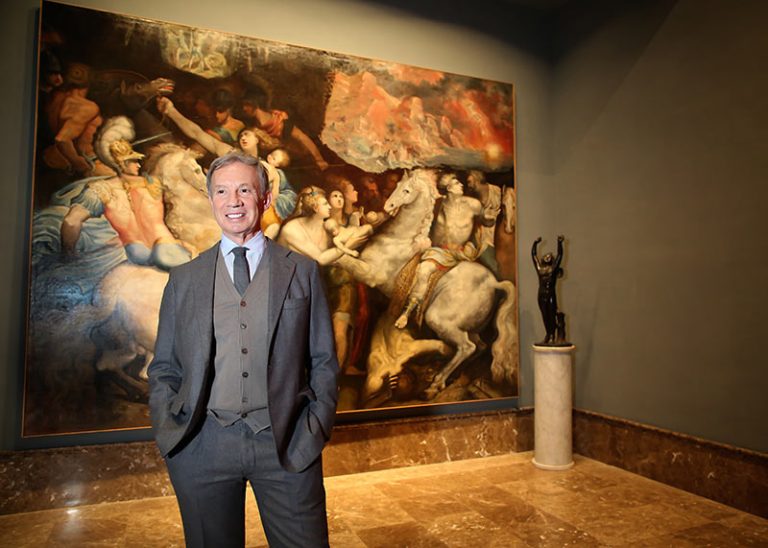
Charlemagne’s gold penny given by Customs to the BnF.
© French customs
An investigation by the National Directorate of Intelligence and Customs Investigations also led to the seizure of around 6,000 archaeological objects from a detectorist-looter, including a statuette of the god Mercury dating from the beginning of the 2nd century and numerous coins from illegal excavations.
Once seized, these sets are entrusted to archaeological services and museums, which inventory them, document them and decide on their integration into public collections. Goods can be returned to their country of origin.
Customs officers note a high use of the Internet for the sale of cultural goods, via social networks, general platforms, specialized sites and encrypted messaging. Express and postal freight constitute the main logistical vector for this traffic, in particular for small objects with a high unit value (coins, fossils, statuettes, fragments of sculptures). The declarations of these shipments use generic descriptions (“decorative objects”, “fossils”, “souvenirs”). To identify offenders, customs cross-references the profile of the senders, the repetition of shipments, their origin and recurring recipients.
Since June 2025, the import of cultural goods into the EU has been governed by a harmonized system which requires the importer to prove that the export from the country of origin was lawful. Certain objects, notably archaeological, can only be entered upon presentation of prior authorization, while other ancient categories require a declaration beyond an age and a value threshold.
French customs have strengthened documentary and physical controls, verification of export certificates and proof of provenance, and are making greater use of dematerialized procedures and data analysis to target risky shipments, without blocking the legal trade in art. For traffickers, this means that at each stage (export certificate, customs declaration, freight bill) an inconsistency can be enough to bring down the entire chain.