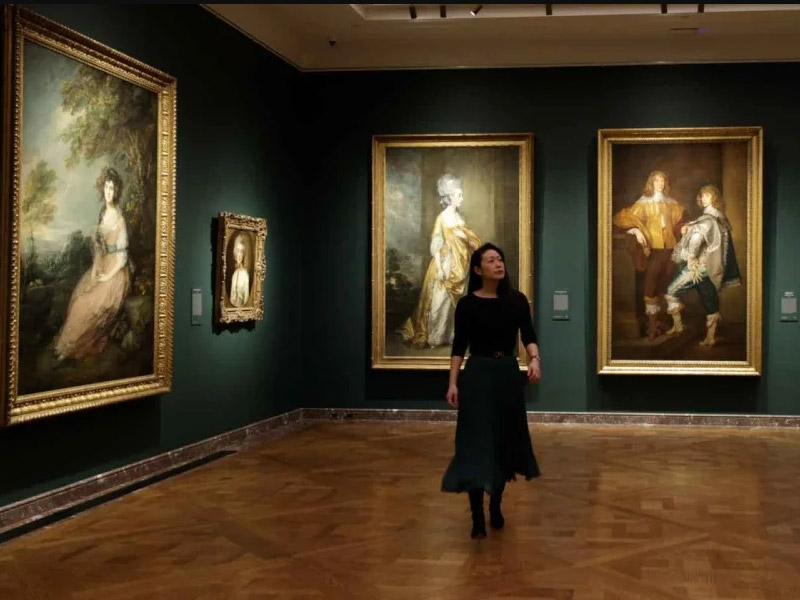
New York. The three rooms of the Frick Collection, newly dedicated to temporary exhibitions, are covered with paintings (nearly 25) by Thomas Gainsborough (1727-1788) from wall to wall and from floor to ceiling. The works, often monumental, like the full-length portraits, dear to the English master who does not deny the influence of Antoine van Dyck (1599-1641), fill these spaces with paradoxically domestic proportions. The thick golden frames almost touch. The visitor oscillates between the joy of this profusion, the dialogue it creates between the models and an impression of overflow, a sort of nod to the Salon du Louvre where the Royal Academy of Painting and Sculpture exhibited its artists, at precisely the same time.
Aimée Ng, the curator of “Gainsborough: The Fashion of Portraiture”, which runs until May 25 at the Frick Collection in New York, admits that this exhibition, planned 10 years ago, and imagined on a model, when the spaces did not yet exist, “is somehow too gigantic”. As the preparation progressed, the questions flooded in: “Would everything fit together correctly?” Would the result be harmonious? »
Finally, the curator, promoted to chief curator of the Frick Collection, made the decision to show as many paintings as possible, including numerous loans from British and American museums. “The idea is to create a strong and striking impression”she confides to JdA. She adds: “I love watching people walk into this exhibition, with all these imposing works, with all these canvases at full height, and there, seeing them speechless, as if they were saying: ‘There are so many of them! They are so big! I’m overwhelmed!’ »
When fashion paints the portrait
It is true that, in addition to a certain dizziness, this exhibition with its compact layout offers choice points of view and comparison. It is a short history of Georgian fashion that she offers and, through it, an understanding of British society of the time. It demonstrates how the artist reveals, with the choice of painted clothing, the social status or political opinions of his models. Gainsborough opted for contemporary clothing, sometimes of his own invention, which distinguished him from Joshua Reynolds (1723-1792), another portraitist of the period, who preferred more timeless classic costumes. Gainsborough, who officiated in Bath from 1759 to 1774, then in London, for a clientele of aristocrats and wealthy merchants, here asserts his tropism for textiles, cuts and accessories.
The exhibition highlights the notion of “fashion trends” which emerged at a time when the British Empire was expanding and the textile industry was developing and leading society to more frequent changes in their clothing style. So everyone will attach great importance to the way in which they are painted to ensure they are in keeping with the times. From there, Aimée Ng leads us to “the idea that portraits themselves can be subject to passing fashions. The format, for example, between the conversation portrait, the monumental full-length portrait and the pastoral portrait, has also experienced trends. »
Discoveries from scientific research
This exhibition, the first devoted to the artist in the United States in twenty years, and even the first in New York for portraits, allowed the convergence of research on the subject. To serve the fashion focus, Frick relies on scientific reference studies. Met teams, with whom the Frick is in partnership for the conservation of its collections, carried out an in-depth examination of his three paintings. The same goes for the British art center at Yale University, which studied in detail the loan granted for the exhibition. A new reading of the works therefore emerges. Aimée Ng confirms: “The additional time and resources these institutions have dedicated to conservation makes a difference. »
Thomas Gainsborough (1727-1788), Mrs. Sheridancirca 1783, modified between 1785 and 1787, oil on canvas, 219 x 153 cm, Washington, National Gallery of Art.
© NGA
The most convincing and most recent contributions arise from the analyzes of Kari Rayner, curator at the Getty Center, who relied on material studies of the paintings. Examination of pigments, brush techniques and the structure of pictorial layers allowed him to assert, for example, that Gainsborough liked to paint the drapes of textiles himself, without the intervention of a specialist as was the practice at the time. She also studied the numerous repaintings and highlighted old restorations, some of which were carried out by the artist himself, proving his desire to return to an earlier painting to improve the light, movement and texture.
The most interesting scientific insight from the exhibition is undoubtedly that which concerns these covers of paintings made by the artist. Sometimes a decade later, Gainsborough returns to a work and repaintes a model’s clothes to adapt them to a new fashion. By the example of Portrait of Mrs. Sheridan (between 1785 and 1787, National Gallery of Art, Washington) (see ill.) where the model, initially represented as a shepherdess wearing a bonnet, was later given clothing preferring to reflect her high social rank.