In Barcelona, the National Art Museum of Catalonia (MNAC) will double its exhibition space. The Catalan authorities decided to expand the premises by rehabilitating the Victòria Eugènia Palace, a 1923 modernist building designed by Josep Puig i Cadafalch for the 1929 International Exhibition, and connecting it to the National Palace, the museum’s current headquarters on Montjuïc hill.
Work is due to begin in the first quarter of 2028. A first phase, including the partial opening of the Victòria Eugenia Palace and its galleries, is planned for the third quarter of 2029. The entire project is due to be completed at the end of 2029, one hundred years after the International Exhibition. The museum will be partially closed between 2027 and 2029 before its full reopening. The budget reaches 112.7 million euros. The Generalitat of Catalonia finances 50% of the sum (56.3 million euros). The Spanish State contributes 30% (33.8 million euros) and the City of Barcelona 20% (22.5 million euros).
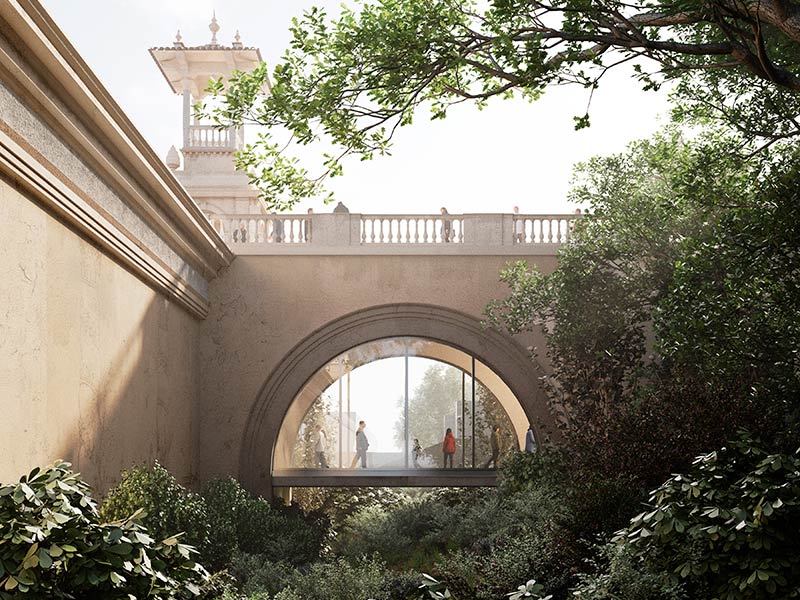
The architectural intervention, entrusted to the HArquitectes and Christ & Gantenbein agencies, transformed the Victòria Eugènia Palace, a building of approximately 14,000 m², classified as an asset of cultural interest. Its ground floor will be open on Plaça Carles Buïgas, opposite the Columns of Puig i Cadafalch and near the Mies van der Rohe pavilion. The architects are planning a large glass porch and a through hall lit by natural light.
The route will be organized around a circulation axis connecting the two buildings. Visitors will enter from the square, pass through the restored palace and then reach the National Palace. This interior passage, designed as a covered street, will be completed by an underground tunnel connecting the exhibition spaces and the reserves. The two buildings will form a single museum complex.
Architect’s view of the expansion project of the National Art Museum of Catalonia (MNAC) in Barcelona. ©
© Victoria Eugenia / Guillem Roset
The architects chose to rehabilitate one of the pavilions from the 1929 International Exhibition rather than construct a new building. The large halls of the palace will be transformed into exhibition spaces. The constructed area will increase from approximately 49,000 m² to 71,417 m², or an additional 22,417 m². The exhibition spaces will reach approximately 19,500 m² compared to 9,000 m² today. The museum will have new rooms for temporary exhibitions, an auditorium, educational spaces and a library-documentation center with more than 150,000 works, as well as a café-bookstore.
Intervention on the historic building will remain limited. The structure of the palace is preserved and the old exhibition halls transformed into museum platforms. Patios and skylights will illuminate interior spaces. The main modification concerns the base of the building, cut to create the new entrance. This will be moved to Plaça Carles Buïgas. The National Palace, built for the 1929 International Exhibition, dominates a vast esplanade accessible by a long climb of stairs. The new access will directly connect the museum to the Spanish Steps and to public transport.
The extension responds to an old museological challenge. The MNAC’s collections cover the history of Catalan art from the Middle Ages to the contemporary era, but the permanent collections rooms are dominated by the Romanesque and Gothic ensembles, which have made the museum’s international reputation, notably the wall paintings from churches in the Pyrenees transferred to Barcelona at the beginning of the 20th century to avoid their dispersion.
The operation continues an ambition formulated in 1934 by the first director of the museum, Joaquim Folch i Torres, who wanted a museum covering all Catalan art. The civil war then the dictatorship had interrupted this perspective.