Rueil-Malmaison (Hauts-de-Seine). Among the Napoleonic museums, the Château de Malmaison is dedicated to the period of the Consulate (from November 9, 1799 to May 18, 1804), a moment of great creativity in the decorative arts, which the public often does not differentiate from the same arts under the Empire. The curators, Élisabeth Caude, director of the National Museum of the Châteaux of Malmaison and Bois-Préau, and Isabelle Tamisier-Vétois, who is responsible for the furniture and textile collections there, therefore decided, with the help of prestigious lenders, to show what the consular style is in terms of furnishing and decoration.
Birth of a style inspired by ancient discoveries
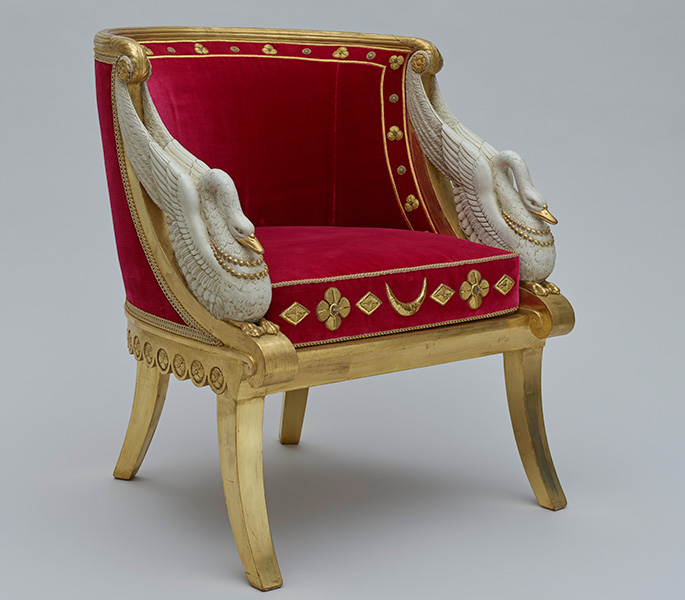
The curators analyze the development of this style based on the taste of the end of the Ancien Régime and its modernity put at the service of politics. Thus, among the armchairs of the Laiterie de la Reine at the Château de Rambouillet ordered in 1787 by Marie-Antoinette from the cabinetmaker Georges Jacob, one of them anticipated the Etruscan style characteristic of the Consulate. This fashion which had come from England in the 1780s adapted perfectly to the celebration of the Roman Republic desired by Bonaparte. The “return to antiquity” at the end of the reign of Louis XVI was followed by the adoption of togas for the attire of the members of the Council of Five Hundred and of furniture, objects, fabrics and wallpaper freely repeating the lines, ornaments and colors discovered in Herculaneum and Pompeii. The Egyptian style was also very political, a tribute to the young general who became First Consul.
Tea table having appeared in the Tuileries Palace, circa 1800-1802, mahogany, bronzed wood, gilded bronze, marble, 76 x 130 cm, Paris, Mobilier national.
© Mobilier national / Isabelle Bideau
The exhibition also highlights those who, around the Bonapartes and some major sponsors, created the new taste: the “Minister of Culture” Dominique-Vivant Denon, the architects Charles Percier, Pierre François Léonard Fontaine and Alexandre Théodore Brongniart, the designer of the Sèvres factory Charles Éloi Asselin, invented the forms which would last, fossilized, until the end of the Empire. Those who had served the Ancien Régime like Georges Jacob, his sons, another cabinetmaker, Pierre Benoît Marcion, the goldsmith Martin Guillaume Biennais, Jean Démosthène Dugourc whom we would today describe as a “designer”, the merchant-merchant and creator Martin Éloy Lignereux or even the Lyon silk maker Camille Pernon were their talented partners, benefiting from a policy of encouraging the French luxury industry.
The conclusion of the tour, beautifully designed by Jean-Paul Camargo, surprises by revealing that 20th century creators have brought back into fashion the daring shapes and colors of the Consulate, this period of decorative arts to be rediscovered.