Florence (Italy). With the exhibition “Cera una volta. Sculptures from the Medici collections”, the Uffizi gallery does not only inaugurate the new exhibition spaces on the ground floor of the museum. It revives a tradition of Florentine wax sculpture between the 16th and 17th centuries. A little-known and almost forgotten art.
For centuries, however, the use of wax has been popular among artists. Their works, at the crossroads of art, religion and science, adorned cabinets of curiosities and princely collections, starting with those of the Medici, Florence being one of the main centers of production. The intrinsic fragility and perishability of the material almost erased it from collective memory. Yet that’s what makes it so interesting. The organic appearance and flexibility of this support give it a unique advantage: its uncanny ability to imitate the appearance of flesh and faithfully reproduce the slightest transformations of the human body.
A thousand-year-old tradition
The artistic use of wax dates back to Antiquity. As early as the 1st century, the historian Pliny the Elder already documented this practice, inherited from Etruscan and Roman funeral rites. Over the centuries, this tradition has been perpetuated through religious practices, notably through the creation of ex-votos and devotional objects. It was between the 15th and 17th centuries, under the leadership of the powerful Medici family, that the art of waxwork reached its peak. During this period, the technique reached an unparalleled level of refinement and splendor, transforming this ancient craft into a prestigious court art.
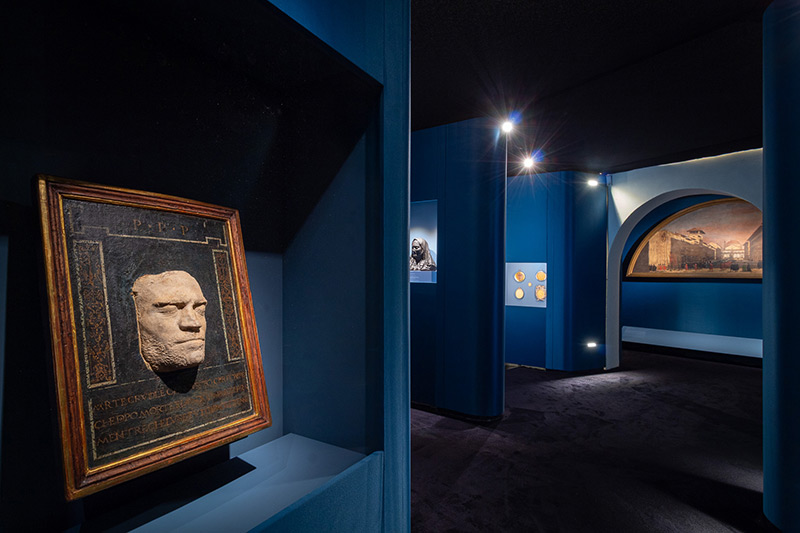
View of the exhibition “Cera una volta. Sculture plaque collezioni medicee” at the Uffizi Gallery.
© Uffizi
The exhibition reveals ninety pieces: sculptures, paintings and precious art objects. It traces the epic history of this visual style which fascinated the intellectual and artistic elite of its time. Among the major works presented are the expressionist Urlante Anima all’Infernoattributed to Giulio de’ Grazia, of striking dramatic intensity, but also the funerary mask of Lorenzo the Magnificent. A section of the exhibition pays tribute to Gaetano Giulio Zumbo (1656-1701). In particular, we discover The Corruption of Bodiesan emblematic work recently acquired by the Uffizi Gallery. This work on wax reflects the artist’s obsession with decay and finitude, transforming physical degradation into a powerful poetic metaphor for the human condition.
To present these delicate works, whose aura oscillates between the sacred and the macabre, the staging of the exhibition relies on a subtle balance between theatricality and intimacy. In order to meet conservation requirements while serving the artistic purpose, the rooms are bathed in controlled darkness. The light in the windows highlights the translucent and almost organic texture of the wax. “With a staging that we wanted to be nocturnal, almost evocative of the underground world of hell, where lost souls and visions reside, the Offices offer visitors a journey through time”claims its director, Simone Verde. This choice creates a dramatic chiaroscuro effect that enhances the works.
![Cera Wax [EXPO]](https://paintandpainting.com/wp-content/uploads/2026/02/At-the-Uffizi-wax-comes-out-of-the-shadows.j.jpeg)
View of the exhibition “Cera una volta. Sculture plaque collezioni medicee” at the Uffizi Gallery.
© Uffizi