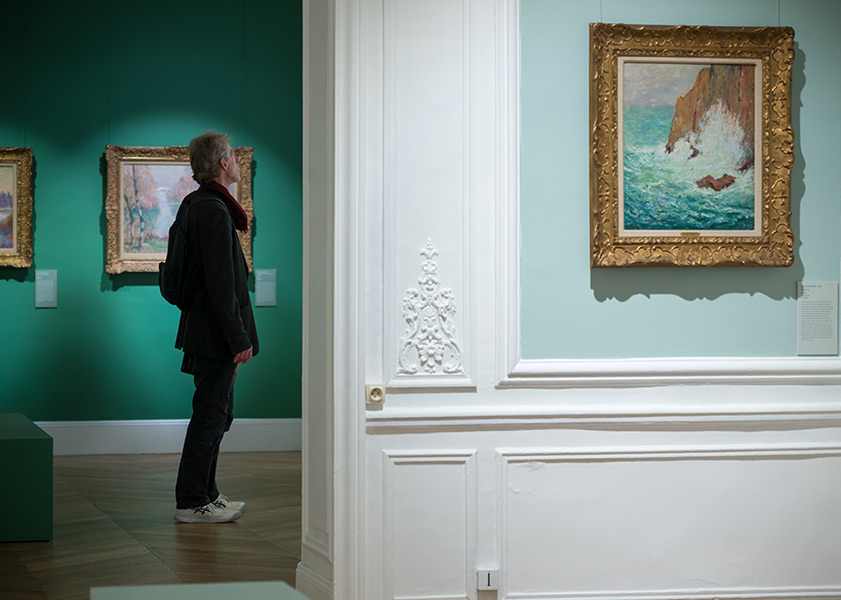
Versailles. Émilie Maisonneuve, director of the Lambinet Museum, presents it as “a house of collectors”because it benefited from significant donations made by amateurs. Among these, Fernande (1903-2004) and Marcel (1901-1991) Guy bequeathed him the set of paintings and works on paper that they owned as well as some furnishing objects. For the first time, the museum is presenting the entire collection of around fifty works as well as a chest of drawers and an 18th century cartel, without comparison with other works not belonging to the collection as was the case in 2006. This exhibition is accompanied by a catalog presenting each work with its date of acquisition when it is known: Marcel Guy had drawn up an inventory which came to the museum with the collection.
“My wife from 1945 to 1963 gathered, after long periods in the sales rooms, purchases, exchanges, a collection of paintings, watercolors, drawings by post-impressionist painters – Loiseau, Luce, Signac, Lebourg, Maufra, etc. – which has taken and will continue to take on a certain value. For almost twenty years, I have followed his efforts and appreciated this collection and want to ensure that after our death it is not dispersed,” wrote Marcel Guy in his will. Most of the purchases took place in Drouot but also in the galleries, particularly that of Reynald Forgeot, a specialist in post-impressionism who undoubtedly became close to the couple. In her will, Fernande Guy mentions that she was the first to be interested in these artists. And we know that the first work inventoried, Wheat field Or Wheat field in Normandy (nd) by Gustave Loiseau, acquired in 1946 from Forgeot, was in reality exchanged for another Loiseau, A bridge in Paris which had been purchased “in a gallery between rue La Boétie and boulevard Haussmann”specifies the inventory.
Maximilien Luce (1858-1941), Landscape, Bazincourt1897, oil on wood.
© Raphaële Fresnais / City of Versailles
The public can therefore admire a beautifully presented ensemble essentially composed of landscapes. He rediscovered these works, usually presented only in part and, of course, rarely as far as the drawings were concerned. These, which have always been exhibited by the Guy couple, have suffered over time, just like the canvases which were dirty: the entire collection passed into the hands of restorers. Émilie Maisonneuve admits that she was finally able to admire the light and delicate colors of Elbeuf suspension bridge (1911) by Gustave Loiseau, while the restorer of the paintings, Élodie Delaruelle, recounts in the catalog having experienced the same emotion with Banks of the Orge in Saint-Chéron (1897) by Armand Guillaumin.
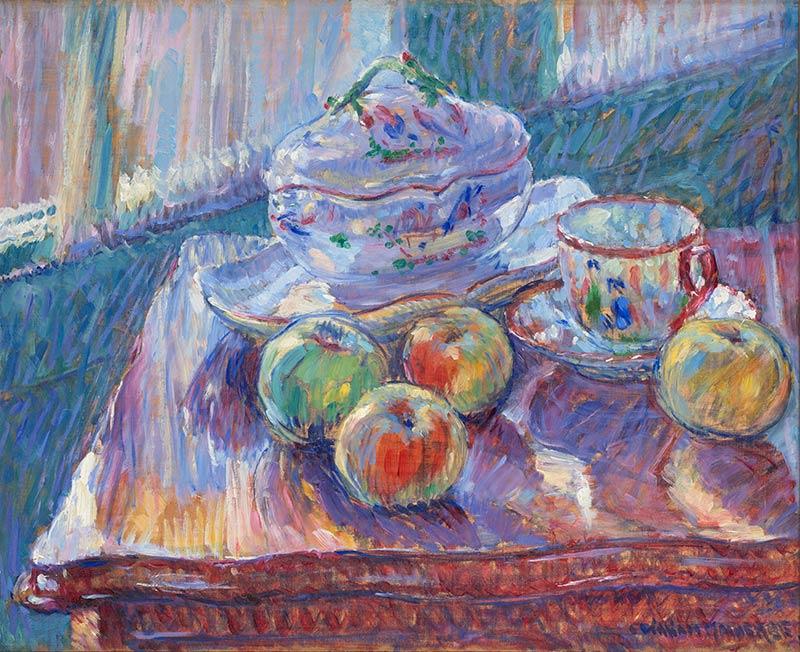
William Malherbe (1884-1951), Still life1922, oil on panel.
© Thierry Ollivier / City of Versailles