
But what does this sentence really mean, often associated with abstraction? Does Klee seek to make the invisible visible in a religious sense, that of a revelation? Certainly not. Rather, it would be advisable to speak of “the involu”: all that the human eye does not perceive directly. For Klee, as for Hans Reichel (1892-1958)-an artist still largely unknown in France-, it is above all the organic process: germination and growth specific to nature. Both have a rare gift, that of inventing new forms, condensed expressions of both personal and universal poetry. Endowed with what could be called an inner eye, they dare to explore territories that have so far been inaccessible. Without insistence, their images resonate with nature. Their works are not similar, and yet what unites them is stronger than what distinguishes them: Klee, Growth (1921), Reichel, The chaotic garden (1928). If the latter is inspired by Klee, he nevertheless manages to find a discreet melody which is its own. Two young contemporary artists accompany their elders. Anne-Charlotte Finel (born in 1986) presents two videos, one of which features a lush landscape: a mini-garden buried in a station on the Paris metro, on which the gaze of users no longer stops (Gardens2017). Julien Discrit (born in 1978) explores biological processes through various techniques. His sculpture Pierre, Re-Member 2 (2021) is a hand holding a fossil which he himself shaped: a kind of telescoping between distant past and archeology of the future. Other fossils, from collections of the museum, enrich an elegant scenography. However, the imbalance is regretted – probably due to difficulties of obtaining loans – between the works of Reichel, about sixty, and the seven pieces of Klee.


Similar Posts

In Grenoble, Julien Creuzet prepares the Venice Biennale
Grenoble. Five months before the start of the 60th Venice Biennale, this solo by Julien Creuzet over 2,000 m2 obviously…
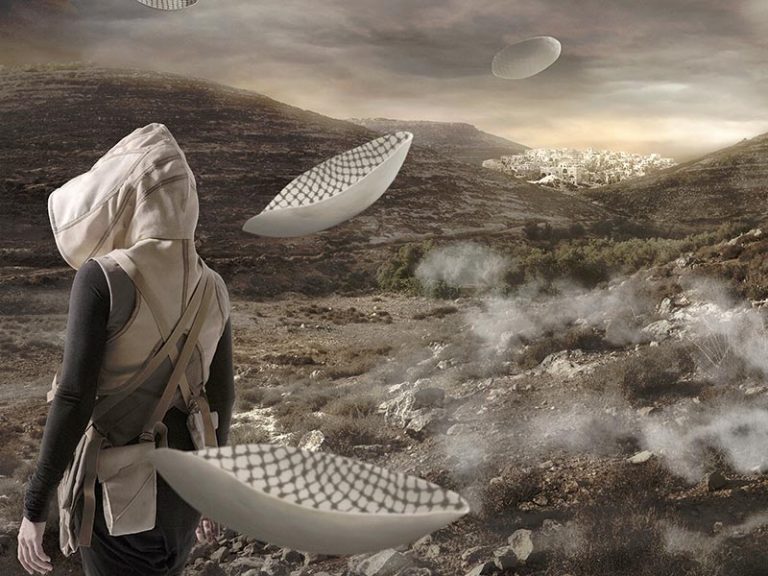
Journey into the futuristic Arab imagination
Paris. Apart from a few specialists, Arab futurism is almost unknown in Europe, unlike Afro-futurism which is experiencing renewed interest…

Philippe Co -écagni’s tressor
Sète (Hérault). Barely two years after a splendor year, 2023, marked by three simultaneous exhibitions at the Orangery, the Bourdelle…

Thomas Hirschhorn, see and be seen
Caceres, Everyday materials, found photographs and texts are the starting point of the Swiss artist Thomas Hirschhorn to articulate installations,…

Huguette Caland, beyond transgression
Madrid, In the case of Huguette Caland, the biography matters: daughter of the first president of the independent Lebanon and…

Erick Beltrán, the current catafalques
Madrid, Mexican resident in Barcelona, Erick Beltrán (1974) has focused his work on the investigation of the structures of thought…