Metz (Moselle). If the thought of finitude haunts the present, that evoked by the new exhibition of the Center Pompidou-Metz is very different from the apocalypse described at the BNF (until June 8). Manuel Borja-Villel, his commissioner, is less interested in eschatology than he engages in a critical examination of the concept of “end of history”.
At the political slogan “Tina” (“There is no alternative”) set out in its time by Margaret Thatcher and implemented since the dislocation of the Eastern Bloc by a hegemonic liberalism, the former director of the Reina-Sofía museum in Madrid opposes Metz other visions of history: those of Aboriginal and African peoples of the Caribbean and the Mediterranean marked by colonization. In the works of around forty “diasporic” artists, a dozen of which were produced specially for the exhibition, he set out to flush out of the “Cards for another future” Or stories formulating alternatives to the absence of alternatives. As such, it is not trivial that “after the end” offers as a preamble a film of the Giap (Grupo de Investigación in Arte Y Politica) showing a “snail dance” zapatist: by its implementation Concrete and non -violent work of a mode of governance “in a spiral”, based on the articulation between global and local, between tradition and adaptation to the present, the autonomist movement Mexican was one of the most active ferments in alterglobalism.
Presented by Chiara Parisi, director of the premises, as an invitation to “Look at things differently”, Manuel Borja-Ville’s project is far from being unprecedented: in the artistic field, decolonial thought is a thought that is illustrated both in policies of restitution of looted objects as in a volley of recent exhibitions, among which “another world history” in Mucem in Marseille (2023-2024). In the exhibition catalog, the artist-counter Olivier Marboeuf also points out the limits of such an approach, often put at the service, he recalls, “Of a Western Pacification project – and neoliberal logics of appropriation”.
A game of echoes
Manuel Borja-Ville is nevertheless denied giving in to the times. According to him, “after the end” is even a criticism of modernity and its tropism for novelty. In replying to the idea of progress, exposure substitutes for a linear approach to time the image of the spiral. It unfolds from the conquest of Mexico mentioned at the edge of the course in a triple panel dating from the 17th century to the parallel news of migrants and restitutions by Western museums (Unocumedéed, Video produced in 2019 by Ariella Aïcha Azoulay), or that of Israeli colonization (“occupation” photographic series of Ahlam Shibli).
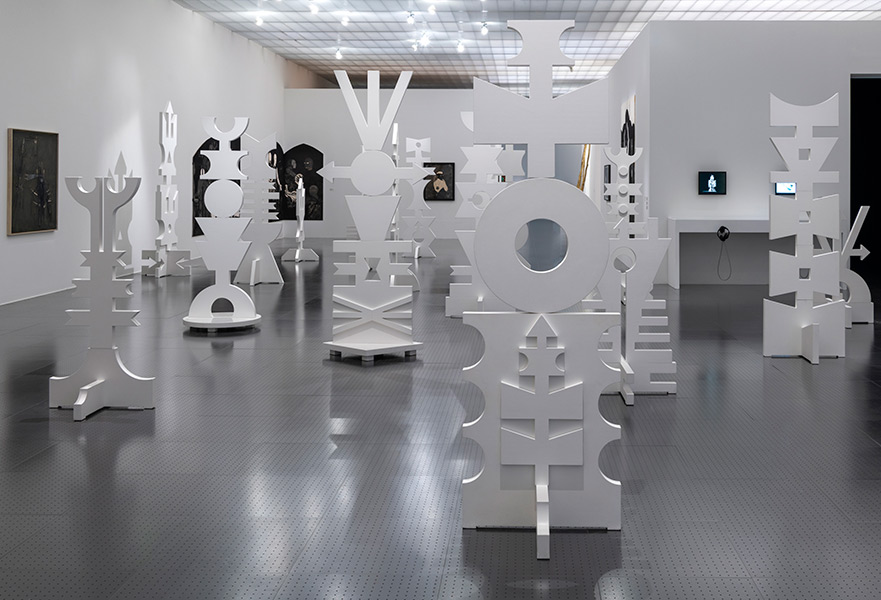
Olivier Marboeuf, Peyi in return2024-2025, installation, chalk on acrylic acrylic acrylic paint overseas on wood and sound diffusion, 181 × 395 cm, view of the exposure to the Center Pompidou-Metz.
© Marc Damage
Figuring all chronology, “after the end” also orchestrates a game of echoes between several generations of artists: the late surrealism of Wifredo Lam and the modernism of Ahmed Cherkaoui rub shoulders there the “totems” of Rubem Valentim (Templo de Oxalá1977) or the films of the young Moroccan collective Tizintizwa. Above all, this cyclic approach is sensitive in the works presented: when some vivifice, in terms of the codes of modern and contemporary art, artisanal traditions and ancestral myths, others weave a complex relationship to the archive like means of documenting colonization and/or exhuming the almost silent history of its victims.
The scenography reinforces this circularity. Around a central pivot showing a set of filmed choreographies, the exhibition does not impose any journey. The works are distributed on two sets devoted to one in the Caribbean, for the other in the Mediterranean. The scenography opts for minimalism and partitions are reduced to the congruent portion. This choice makes it possible to spatialize one of the leitmotifs of the exhibition: the notion of “border”, heard here not as a fence but as a porous space allowing to circulate from one world to another. In fact, the artists presented all found their work on the complex articulation between their cultures of origin and adoption. Many of them invent devices – films, sound installations … – to tell otherwise the history of the colonized. The restitution of a found memory is embodied in them in the bodies. It is donated in gestures, rituals and dance, but also in breath, singing or poetry. The beautiful film by Philip Rizk (Listen to the earth2024) Magnifies for example the poetry of the Nubian people exiled from its territory by the construction of a dam, when that of the Tizintizwa collective (Teide2024) gives to hear the whistled tongue of the Amazighs. Further on, Olivier Marboeuf signs with the fresco Peyiin return A masterful sound piece on the edge of wall, cartography and extensive cinema.
Between all these works, water runs like a common thread. Its omnipresence draws in the exhibition space a landscape made of flows, passages, circulation, rather than cards and borders. Despite the complexity of his words, “after the end” is a great success. The “spiral” approach to Manuel Borja-Villel and his ability to link the works to each other gives the course a powerful coherence, which leaves a lasting imprint on the visitor.